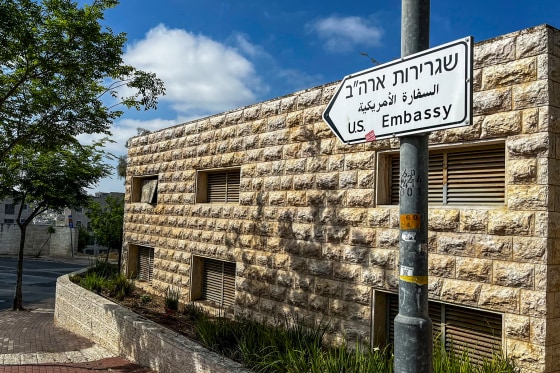
The State Department on Tuesday ordered the mandatory departure of non-emergency personnel and family members in six countries in the Middle East over growing security concerns, after the U.S. Embassy in Saudi Arabia was struck by two Iranian drones.
Officials are also urging Americans across the region to depart as soon as possible, though many airports are shuttered, transportation options are limited. If they can't leave, then they should shelter in place until further notice as Iran retaliates across the region in response to the U.S.-Israel attack.
The State Department created a task force to help U.S. citizens after the weekend strikes by the U.S. and Israel on Iran, and Iran’s retaliatory efforts. But as a growing number of U.S. embassies and consulates suspend routine and emergency services, Americans still in the region have been left with limited options.
Airports in Dubai, Abu Dhabi and Doha — including Dubai International Airport, one of the busiest in the world — are important hubs for travel between Europe, Africa and the West to Asia. All three were directly hit by strikes, according to The Associated Press.
Oliver Sims, a 24-year-old content creator from Dallas, got stuck in Doha on his way back from a friend’s wedding in India. He contacted the U.S. embassy there but said they couldn’t offer him any immediate assistance.
“They had so many emergency calls coming in so they had to hang up on me,” he told NBC News.
Sims got in touch with his senator, John Cornyn, whose office reassured him they were aware of his location. “They said they’ll let me know of any plans to extract U.S. citizens,” he told NBC News.
Sims said he feels relatively safe and has been able to work remotely from his hotel room in Doha, but his parents are worried.
“My parents are constantly calling” he said, asking if he’s ok and if there’s any other way he can get out of the country. For now, Sims is staying calm, but he’s hoping to get back to Dallas in time to celebrate his 25th birthday on Saturday.
In a video posted on X, Secretary of State Marco Rubio outlined how Americans can get in touch with State Department officials.
“Our number one priority is the safety and the security of American citizens everywhere in the world,” Rubio said.
But a recording on the phone number Rubio recited to help Americans says: "Please do not rely on the U.S. government for assisted departure or evacuation at this time. There are currently no United States evacuation points."
Later Tuesday, State Department officials said they were working on charters and military aircraft for Americans who wish to leave, and had been in touch with nearly 3,000 Americans abroad.
The U.S. Embassies in Jordan, Bahrain, Iraq, Qatar, Kuwait and the United Arab Emirates were now operating on limited staffs.
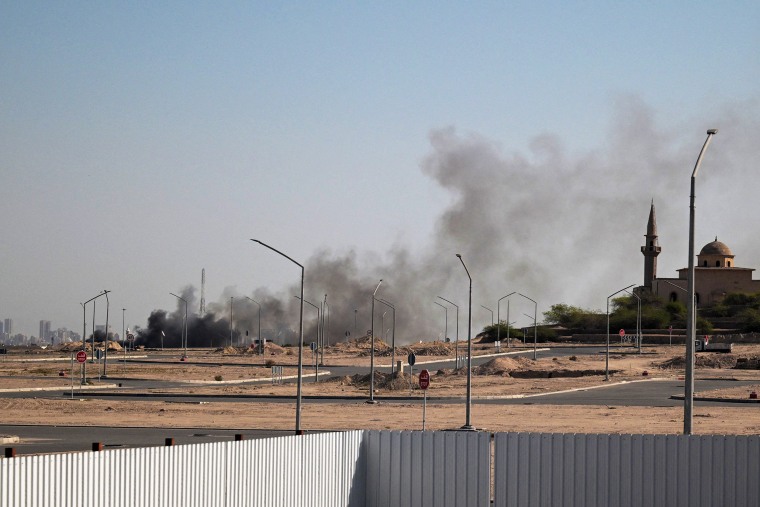
The embassy in Saudi Arabia was closed after the drone strike, which did limited damage and caused no injuries. In Bahrain, Jordan, Qatar and UAE, the U.S. embassies are also warning of potential drone or missile strikes from Iran.
In Kuwait, the embassy was closed and Americans have been told to stay indoors. In Jordan, diplomatic staff was temporarily evacuated Monday over a threat.
The State Department issued a “worldwide caution” alert for all Americans overseas on Saturday, the first since June 22, 2025, after the U.S. intervened in the 12-day conflict between Israel and Iran. The State Department doesn’t reveal its diplomatic footprint so it’s unclear how many Americans are stationed in the Middle East.
But on Monday, State Department officials urged Americans to depart from Bahrain, Egypt, Iran, Iraq, Israel, the West Bank and Gaza, Jordan, Kuwait, Lebanon, Oman, Qatar, Saudi Arabia, Syria, United Arab Emirates and Yemen.