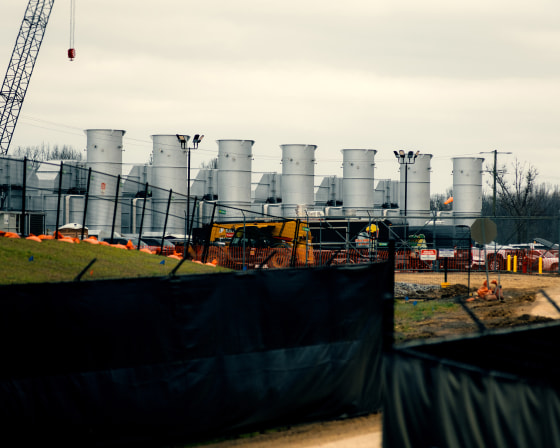
A rare source of bipartisanship has broken out in state capitols across the country: tackling data centers.
Legislators from both major parties in red, blue and battleground states alike are rushing to figure out how to regulate the construction and energy consumption of the data centers fueling the AI boom.
This year alone, state lawmakers have proposed more than 300 bills designed to tackle the emerging challenges presented by data centers, according to Multistate, a state and local government relations firm that tracks state legislation across the country.
The flurry of activity comes as voters express wariness about the technology that industry leaders say will transform the American workforce, as well as long-standing concerns about high costs.
The proposals span various categories. Some legislators have sought to implement moratoriums on data center construction — accusing their emergence as a big driver in the increase in utility costs for communities. Many who are pushing for moratoriums say they’re a tool to buy time to study and better understand their impact on communities.
Other state lawmakers have attempted to put in place requirements that put restrictions or reporting requirements on the amount of electricity and water that such centers need to function. And others have pitched cutting the tax incentives that were initially intended to attract fresh construction of the centers.
At the moment, most proposals from both Democrats and Republicans have seized on rising utility costs by framing the issue as one related to affordability, particularly heading into this fall’s midterm elections. And the debate has not fallen along the typical partisan lines.
“There just are not very many issues these days that you can’t predict what a state is going to do based on their partisan makeup,” said Morgan Scarboro, a vice president and economist at MultiState who leads the teams monitoring data center legislation. “It’s been really interesting to see this play out in a way that doesn’t make clear sense on a partisan basis.”
“The perception among legislators and the general public varies widely, state to state, even locality to locality and the legislation is reflecting that,” she said.
In part, that has been a product of the fact that state legislators “are definitely playing from behind” on the issue of data center construction, due to the breathtaking speed with which the artificial intelligence boom has happened, added Daniel King, a research fellow who specializes in AI and data centers at the Foundation for American Innovation, a tech policy think tank.
“That’s not to say that now that the issue is center stage, they should be cracking down extra hard, but there’s certainly been a lag in how fast the technology has moved and how and when state legislators have decided to react,” he said.
It’s an issue that has connected political polar opposites on the national level as well, such as Sen. Bernie Sanders, I-Vt., who has called for a national moratorium, and Florida Republican Gov. Ron DeSantis, who has warned of significant job displacement for white-collar workers from the AI boom.
A new NBC News poll helps to underscore the uncertain political terrain politicians at the state and national levels are facing on the issue. The survey found that a majority of voters nationally said the risks of AI outweigh the benefits, while a plurality viewed AI negatively and said they don’t believe either party is doing a good job handling the technology.
For some lawmakers, that has translated into proposing temporary moratoriums on new data center construction. Democratic legislators in New York, Maine and Vermont, Republican legislators in Oklahoma and lawmakers from both parties in Georgia have proposed temporary moratorium bills that would also require studies of the environmental and energy effects of data centers on their states. In Georgia, Republicans have also proposed bills intended to limit utility bill increases.
Meanwhile, many states that already have a large presence of data centers are now looking at legislation that aims to curb further development. In Virginia, which has the most data centers in the United States, state senators from both parties have supported a proposal in the chamber that would end about $1.6 billion in annual tax breaks in the state for companies constructing data centers. Democrats in Arizona, Michigan and Maryland have proposed similar legislation. And Republicans in Georgia, which is also among the states with the highest number of data centers, advanced a bill this week to end tax incentives for new data center development.
Florida Republicans, with the backing of DeSantis, have proposed bills that effectively increase data center regulations.
In South Dakota, Republican legislators have advanced a so-called Data Center Bill of Rights that would effectively eliminate state tax exemptions for data center operators and would require them to pay for most electric and water costs.
Meanwhile, Democrats in Washington and Colorado have proposed legislation built around staving off the perceived environmental impacts of data centers. Washington legislators were among the many who have proposed requiring data centers to report energy and water usage levels — though the bill died last week after mounting industry opposition — while Colorado legislators have proposed a bill that would require data center operators to provide their own renewable energy sources to power their centers.

