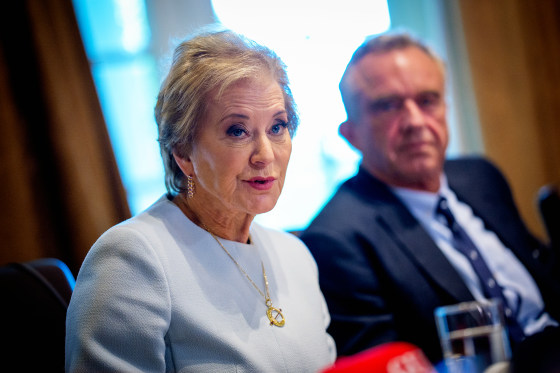
COLORADO SPRINGS, Colo. — Linda McMahon and Robert F. Kennedy Jr. have largely been skewered by Democrats for the way they have run President Donald Trump’s Education and Health departments.
But over the weekend at a bipartisan summit of governors in Colorado Springs, they received a distinctly warm welcome — including from the Democrats on hand.
Instead of pressing McMahon on her plans to eliminate the Education Department, a move that will substantially affect state budgets, Democrats who attended the National Governors Association meeting in the mountain foothills of Colorado offered praise to McMahon during a Friday session over the Trump administration’s decision to release billions in education funding it had withheld. And they peppered her with questions about students’ mental health, early childhood education and artificial intelligence — areas where they might be able to find common ground.
On Saturday, Kennedy, whose stances on vaccines have drawn fierce criticism, held court with a group of Democratic governors, assuring them that he did not want to see budget cuts at the Department of Health and Human Services.
These conciliatory moments, which occurred throughout the NGA’s summer meeting, underscored the bind Democrats have found themselves in during Trump’s second term: weighing when to fight back against the administration, as the base is pushing for, and when to work with it to benefit their constituents.
It’s a balancing act that’s particularly acute at the state level. While Democrats are out of power in Washington, the party’s governors have much more authority. And governors in particular have prided themselves on searching for common ground, even in a heated political environment — a core purpose of the NGA.
Still, a growing number of Democrats argue that calls for bipartisanship do not meet the current moment. Govs. Tim Walz of Minnesota and Laura Kelly of Kansas were among several Democrats who did not attend the summit. All told, seven Democratic governors and 11 Republican governors came for at least part of the weekend, the NGA said, while three governors attended virtually.
Walz and Kelly, as The Atlantic first reported, declined to renew their NGA membership dues for the upcoming fiscal year, due to broader frustrations with how the group has approached the Trump administration.
A source familiar with the governors’ thinking said that Walz’s and Kelly’s feelings were “a view held by more than just these two governors” and were a product of “frustration” that the NGA “had tied its own hands” by not taking a more active role in advocating for states and governors amid Trump’s attacks.
“If we can’t agree on standing up for states’ rights, we’re passively endorsing what the president is doing,” the source said.
During his second term, Trump has defied or threatened many Democratic-led states. Trump deployed National Guard troops and Marines to Los Angeles amid unrest over his immigration policies, despite objections from California Gov. Gavin Newsom. Trump also froze federal funds for a child nutrition program in Maine after he clashed with Gov. Janet Mills over an issue related to transgender athletes. (The Trump administration later halted the freeze.) Newsom and Mills also did not attend the summit.
'We can’t just walk away'
Several Democratic governors who attended the weekend meeting expressed sympathy for Walz’s and Kelly’s decision. They also highlighted the importance of finding common ground with their political adversaries, suggesting that it remained a better option to try to win influence with them instead of not showing up.
“The promise that I made to the people of Maryland when the Trump administration came on board was that I will work with anyone, but I will bow down to no one,” Maryland’s Democratic Gov. Wes Moore said during a session with reporters at the summit in response to a question from NBC News.
“But there’s a clear understanding and a clear desire to be able to work with anybody to make sure that the people of my state and the people for all of our states are getting the support that they need. And I think one of the benefits of this weekend was, you know, we got a chance to sit down with Secretary Kennedy, that we got a chance to actually sit down with Secretary McMahon,” added Moore, who was elected vice char of the NGA over the weekend.
He noted that previously he had not had the chance to do so in the first seven months of Trump’s second term. “I actually think it was a real benefit,” Moore said.
Moore is no stranger to fighting with the administration: Most recently, he has accused Trump of denying his state federal disaster assistance for flooding in Maryland in May. Moore said he’d spoken with Walz and Kelly, calling their frustrations “justified.” But he added that the NGA “is never going to be either the cheerleader nor the heckler of a federal administration.”
Hawaii’s Democratic Gov. Josh Green, a physician who has blamed Kennedy for measles outbreaks, said he had a “valuable” private meeting with the health secretary that lasted an hour.
“I have some deep ideological differences with Secretary Kennedy,” Green said in an interview with NBC News. But he added that creating a collaborative environment with Kennedy and McMahon helped him explain to them why he felt “things have to happen to protect vulnerable people.”

