WASHINGTON — Top Trump administration officials do not yet have clear guidance on what President Donald Trump would hope to accomplish with military action in Iran as U.S. and Iranian officials were meeting Friday to try to avoid a war, according to two U.S. officials.
While Trump has left open the possibility of pursuing regime change in Iran, the two U.S. officials said he has not yet settled on precisely what his objectives for any possible military action would be. They also said there is no clear road map or consensus within the administration over what role the U.S. would play after any such operation.
Asked Wednesday in an interview with NBC News whether Iran’s supreme leader should be worried, Trump said: “I would say he should be very worried, yeah. He should be.”
Trump told NBC News’ Tom Llamas that he learned Iran may be trying to reconstitute its nuclear program after the U.S. military “wiped out” three of its nuclear sites in June.
“They were thinking about starting a new site in a different part of the country,” Trump said. “We found out about it. I said, ‘You do that, we’re gonna do very bad things to you.’”
Trump has not publicly outlined his precise goal in Iran, including whether he is seeking to topple the clerical regime, weaken it or force it to accept restrictions on its nuclear and missile programs.
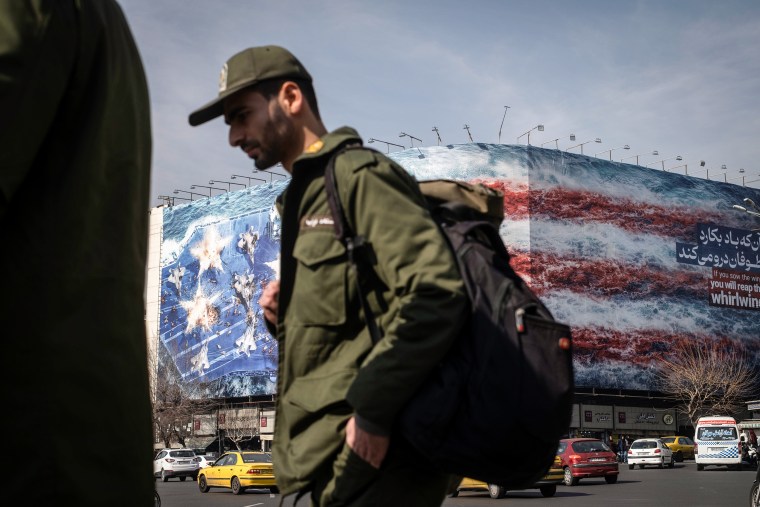
Secretary of State Marco Rubio said Wednesday that negotiations between U.S. and Iranian officials, which were taking place indirectly early Friday in Oman, must include curtailing not only Iran’s nuclear program but also the range of its ballistic missiles, as well as its support for proxies in the region and “the treatment of their own people.”
“I’m not sure you can reach a deal with these guys, but we’re going to try to find out,” Rubio told reporters. “We don’t see there’s any harm in trying to figure out there’s something that can be done. This is a president that always prefers a peaceful outcome to any conflict or any challenge the time for one.”
Oman said Friday that its Foreign Minister Badr al-Busaidi met separately with Iranian Foreign Minister Abbas Araghchi, then with U.S. Mideast special envoy Steve Witkoff and Jared Kushner, Trump’s son-in-law.
Asked about Trump’s pursuit of negotiations with Iran while he is still considering military options, White House spokesperson Anna Kelly said in a statement, “The commander-in-chief has ample options at his disposal to address these issues — and he wisely does not broadcast them to the fake news.”
Iran has consistently ruled out any negotiations beyond its nuclear program, which it has insisted is for peaceful purposes, and it has rejected the idea of restrictions on its ballistic missile arsenal or its support for ideological allies in the region.
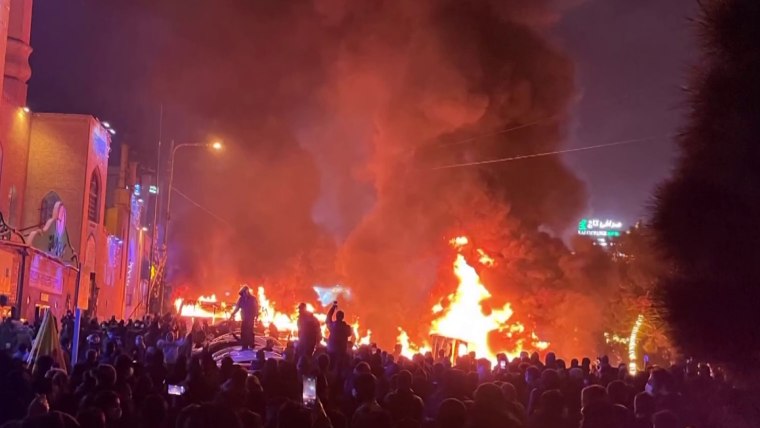
Trump, who withdrew from the 2015 nuclear deal with Iran in his first term, has shifted his rhetoric toward the country’s leadership in recent weeks. He threatened military action to back up his promise to help protesters in Iran who endured a bloody crackdown by the regime.
He then announced Iran had agreed to halt the crackdown, which killed more than 6,000 protesters, as well as planned executions of those who were arrested, so he would not be taking military action. And now he is pursuing negotiations with Iran. He is demanding that Iran agree to curtail its nuclear program or face military action, though he has said U.S. strikes in June “obliterated” three of its nuclear sites.
It is unclear what Trump seeks to negotiate with the Iranians that would be aimed at supporting the protesters.
Trump’s latest recalibration toward Iran has raised questions about what he would seek to achieve with military action if talks failed, such as targeting nuclear and missile sites or a higher-risk, larger-scale attack designed to topple the regime.
The U.S. military continues to flow aircraft and land-based air defense systems into the Middle East, while the Abraham Lincoln aircraft carrier and its attending ships are getting closer to being within striking distance of Tehran, U.S. officials said. But for now, U.S. officials insist the influx of assets is in response to ongoing tensions in the region, not part of planning for a specific mission.
The U.S. military threat, including the possibility of removing Iran’s top political and military leadership, for now serves as leverage while Trump pursues diplomatic talks. Trump’s special envoy Steve Witkoff is expected to lead the U.S. meeting with Iranian officials Friday, according to three U.S. officials.
Friday’s diplomatic meeting was initially scheduled to take place in Istanbul and to include representatives from top Persian Gulf countries, including Qatar and Oman, as well as U.S. and Iranian officials.


