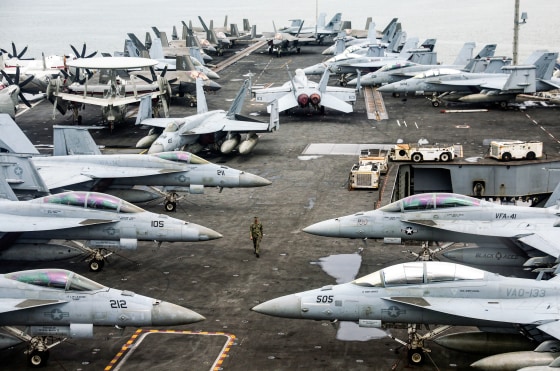
American forces shot down an Iranian drone Tuesday as it “aggressively” approached the USS Abraham Lincoln aircraft carrier in the Arabian Sea and appeared to have “unclear intent,” U.S. Central Command said.
“USS Abraham Lincoln was transiting the Arabian Sea approximately 500 miles from Iran’s southern coast when an Iranian Shahed-139 drone unnecessarily maneuvered toward the ship,” a spokesman for the command, Capt. Tim Hawkins, said in a statement. “The Iranian drone continued to fly toward the ship despite de-escalatory measures taken by U.S. forces operating in international waters.”
The drone was shot down by an F-35C fighter jet from the aircraft carrier, the statement said, and no American service members were injured and no U.S. equipment was damaged.
Tensions between the U.S. and Iran have spiked as President Donald Trump is considering military strikes against the Islamic Republic.
Top American and Iranian officials are expected to hold talks Friday in Turkey, four senior Middle East diplomats and a U.S. official told NBC News. White House special envoy Steve Witkoff and Iranian Foreign Minister Abbas Araghchi would be part of the delegations, according to four of the sources.
Asked about the possibility of U.S. and Iran talks this week in a gathering of reporters at the Oval Office on Tuesday, Trump noted that negotiations have already begun.
"They are negotiating. They’d like to do something, and we’ll see if something is going to be done," he said. "They had a chance to do something a while ago and it didn’t work out, and we did Midnight Hammer. I don’t think they want that happening again, but they would like to negotiate. We are negotiating with them right now."
Midnight Hammer was the name the U.S. military gave the operation that targeted Iran's nuclear facilities last June.
The Tasnim news agency, which is affiliated with Iran's Islamic Revolutionary Guard Corps (IRGC), cited an “informed source” in a report on Tuesday that said the drone was carrying out a “routine and lawful mission in international waters, engaged in reconnaissance, monitoring, and imaging, which is considered a normal and legal activity.”
“This drone successfully transmitted its surveillance and reconnaissance images to headquarters, but subsequently lost communication. The reason for this loss of contact is currently under review,” the report said.
An Iranian official told NBC News on Tuesday that if there is a new war with the U.S. it will be much bigger than the 12-day-war last summer.
“It will certainly be a regional war,” the official, who asked not to be quoted by name because he was not technically authorized to speak on the record, said, echoing a recent statement from Iran’s supreme leader.
Iran has the capacity to disrupt marine traffic in the Strait of Hormuz, a vital shipping lane that handles about 20% of global oil supply, according to the official. “If oil supplies are disputed for several months, it would have a major impact,” he said, noting that Arab states are particularly concerned that the U.S. and Iran reach a deal for this reason.
The official pointed out that Iran will fight if forced into a corner. “It is better to fight than wait for someone to kill you," he said. "Death is better than humiliation."
In a separate incident hours later in the Strait of Hormuz, the IRGC harassed a U.S.-flagged, U.S.-crewed merchant vessel that U.S. Central Command said was lawfully transiting the international sea passage.
Two IRGC boats and an Iranian Mohajer drone approached the tanker, the M/V Stena Imperative, at high speed and threatened to board and seize it, according to the U.S. military.
The guided missile destroyer USS McFaul was operating in the area and escorted the tanker with defensive air support from the Air Force, according to Central Command. “The situation de-escalated as a result, and the U.S.-flagged tanker is proceeding safely,” Hawkins’ statement said.
It is unclear whether Trump will decide to use force. He said “we’ll find out” when he was asked Sunday whether Iran’s supreme leader, Ayatollah Ali Khamenei, was correct to predict that a U.S. attack on the country would spark a regional war.

