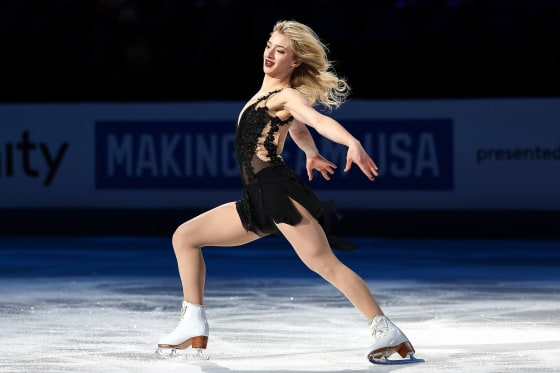
Amber Glenn had just skated off the ice when she screamed.
Waiting in a cooldown area after a run at this month’s U.S. Figure Skating Championships, Glenn reacted in disbelief after she saw her score of 83.05 flash on a monitor. The score was a U.S. championship record for the women’s short program, and it would help her, two days later, become the first U.S. woman in 21 years to win a third consecutive U.S. championship.
The victory clinched Glenn a spot on her first Olympic team and created an opportunity at next month’s Milan Cortina Winter Olympics to become the first U.S. woman to medal in singles at an Olympics since 2006.
Earlier in her career, Glenn lost confidence that such success would ever materialize. She went so far as to step away from the sport, citing her mental health.
Sign up for NBC News’ The Sports Desk newsletter
It is no coincidence, she believes, that the high point of her career has overlapped with her best years personally, too, since she came out publicly as bisexual and pansexual in 2019. Glenn will become the first out woman to figure skate at an Olympics, according to Outsports, a website that has tracked LGBTQ athletes since 1999.
“It was something that did set me free,” Glenn said in the run-up to the Olympics. “I was able to feel like I wasn’t being pressured into trying to fill someone else’s shoes.”
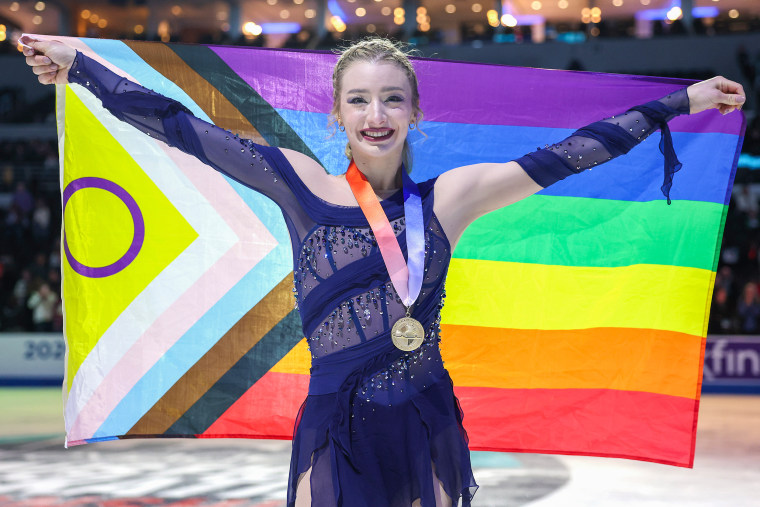
Glenn was raised in Plano, Texas, and by 2019 was training outside Dallas when the Dallas Voice, an outlet covering LGBTQ issues in Texas, wrote a story about two North Texas-based pairs skaters who had just won a national championship. One of the skaters, Timothy LeDuc, had become the first openly out athlete to win a U.S. title in pairs skating. Several hundred words into the story, Glenn was quoted supporting the pair, who were her friends. Then, Glenn acknowledged publicly for the first time that she identified as bisexual and pansexual.
In hindsight, Glenn would have created a more “professional” announcement, she said. She was not prepared for the amount of attention the story garnered.
“I thought, ‘OK, this is my little baby step, and ... barely anyone’s gonna see it.’ It was a local newspaper,” Glenn said. “Yeah, it did not stay local. The next day it was, like, international news.”
She was not sure how she would be received when she competed outside the United States in countries with differing cultural views of, or laws concerning, the queer community. The reaction from sponsors that funded her career and judges who determined her place at competitions also concerned her.
Figure skating is ruled by a subjective scoring system in which a technical element score and a program component score combine into a final score. The component score is based on a competitor’s skating skills, presentation and composition — what has sometimes been referred to obliquely as “artistry.” Glenn had long worried that she was “too muscular, I was too big, I didn’t fit the mold.”
"It’s not whoever crosses the finish line first wins," Glenn said. "Part of it is up for discussion. It’s up to that person’s opinion. So of course I was scared that I’d be looked at as less feminine, less graceful or ‘Oh, are you the man in the relationship?’ Something like that ... was something that I was scared to happen.
“But I realized, well, if we’re ever going to get past that worry, someone has to do it. Someone has to break that mold and break that stereotype in order for the next person who comes out not to be afraid of that because they saw that it didn’t affect me.”
Glenn said she did not ultimately believe that her scores had ever been affected in the six years since she came out. She said other fears around her reception from fans or sponsors also never were realized. During her first competition after she came out, she saw Pride flags in the audience, which she took as a welcoming sign. And although some out LGBTQ athletes have described a struggle to raise sponsorship money — NHRA driver Travis Shumake told the Los Angeles Times this year that he'd lost most of his sponsorship deals — Glenn said she was “really lucky” not to have felt a financial pinch.
“Figure skating is unique,” she said. “We have more acceptance and more of a community in the queer space, and I feel like I’ve been accepted with open arms, and that’s not the case for all sports.”
Coming out had made Glenn feel better, but it did not, by itself, make her a better skater.
Multiple concussions delayed her training. Her skating was inconsistent. She could not land a triple axel at the 2021 U.S. championships, and she was later named an alternate for, but not a member of, that year’s U.S. team at the world championships. A year later, she finished 14th in the short program at the U.S. championships before she withdrew after a positive Covid-19 test.

