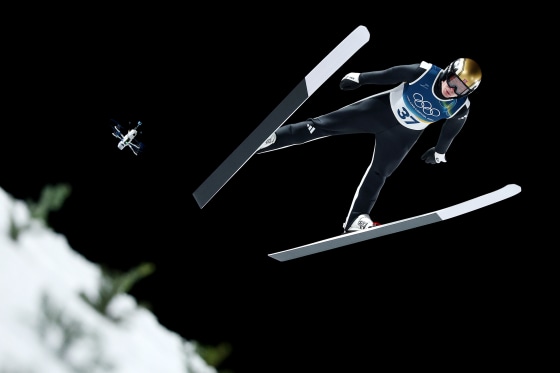
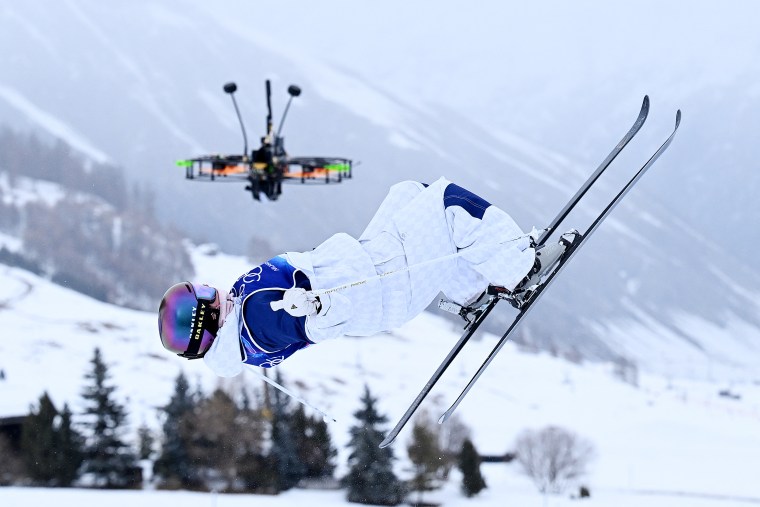
The planning to expand the use of drones began more than two years ago, because organizers wanted to find a way to hook casual sports viewers, who Exarchos said make up more than half of any Olympics’ viewing audience.
Advancements in technology had reduced their size, increased their broadcast capabilities and reduced the lag time in transmitting shots via RF signals to broadcast trucks. These drones have been modified for their sport, and they come from a number of vendors, including Chinese-based companies, Exarchos said. Weighing between a half-pound and a pound, they weren’t added as a gimmick.
“We use a technological innovation only if it adds to the story that we’re telling, not just to showcase technology,” he said. “If we simply started flying around drones and showing random things, people after the first day would get sick of it.”
Of the 16 sports at the Winter Olympics, drones have captured footage in all but hockey, curling, short-track speedskating and figure skating, where the organizers felt traditional cameras, including overhead cameras that move on cables, were a better fit.
Ski jumping has long been a sport watched from below. But at these Olympics, they’ve been seen from above, as a drone operator — a former ski jumper himself — maneuvers a drone behind a skier at the moment of liftoff, high above the ground. The operator’s background in the sport helped develop their plan to shoot the sport, Exarchos said, adding he hopes that more Olympic athletes will become trained drone pilots to enhance the Games’ coverage.
Long before viewers began embracing the footage, however, organizers needed athletes to get on board, with Exarchos calling their safety his top priority. All drones must comply with civil aviation rules and are required to be flown behind or to the side of athletes to avoid the possibility of an aerial mishap that could endanger a competitor, Exarchos said. Test crashes have taken place; at the short-track speedskating venue, course marshals have practiced how to dispose of any fallen drone parts and get the course ready for the next run.
The owner of a Dutch drone company, who posted that he was among the pilots flying at the luge track, said he had been preparing for 12 months.
“100% the most difficult job I’ve ever done, flying a tight space like this 50 times per session consistently without any room for error. Now let’s go for 2 more weeks!”
Some Olympic sports allow extra chances for mistakes. But with drone operators, “there is no room for error,” said Jelmer Poelsma, a drone operator for speedskating.
It’s generally considered easier to operate drones in so-called “linear speed” sports in which athletes move at a consistent speed, rather than a sport like moguls, where athletes speed up and slow down, requiring pilots to do the same.
Poelsma had been flying drones for 11 years before he began training for the Olympics. The drone he uses can’t stabilize the image, he said, requiring him to both keep a safe distance from skaters traveling about 40 mph while doing it smoothly enough that producers can get a usable shot. He first tested the drone in Milan two months before the Games opened and said he was “not nervous.”
“Some of the athletes already get in contact with me, and obviously it was if I could share the footage of them,” Poelsma said. “They thought it was really cool.”
Drones lose their connectivity at different distances based on different conditions, Grzybowski said, but at luge, drones follow the first three turns before flying back to their “base,” often for a battery swap after only a couple runs. The drone team stationed at ski jumping has come up with a way to catch the drone, change the battery and throw it back in the air.
“Even better than an F1 pit stop,” Grzybowski said.
Grzybowski will oversee coverage of canoe slalom at the 2028 Olympics and said he’s already interested in flying a drone between the slalom course’s gates to show “what kind of feeling [it’s] like going through all this course.”
Their use has been praised by athletes but hasn’t drawn universally rave reviews.
Bea Kim, the U.S. snowboarder, said that drones had sometimes flown too close to competitors. Their presence wasn’t distracting to Zoi Sadowski-Synnott, a silver medalist in big air from New Zealand, but “the bird’s-eye view of our tricks isn’t the best or coolest way to see what we’re doing,” she said.
Anna Riccardi, the Milan 2026 sports director, said this week that organizers had not received any complaints from athletes “that could have led to the non-use of drones.”
The noise the drones produce has also been a persistent topic. But between noise-damping wind and helmets, some athletes don’t notice.
“When you’re watching it, you’re thinking there’s no way they’re not hearing that,” Hurt said. “But I have never heard it when skiing.”
Austrian snowboarder Anna Gasser said the presence of a drone during her runs was nothing new because her boyfriend already flies racing drones around her when she trains.
“I didn’t care at all about the drone,” Gasser said. “If it had hit me, I hope they would have given me another run.”