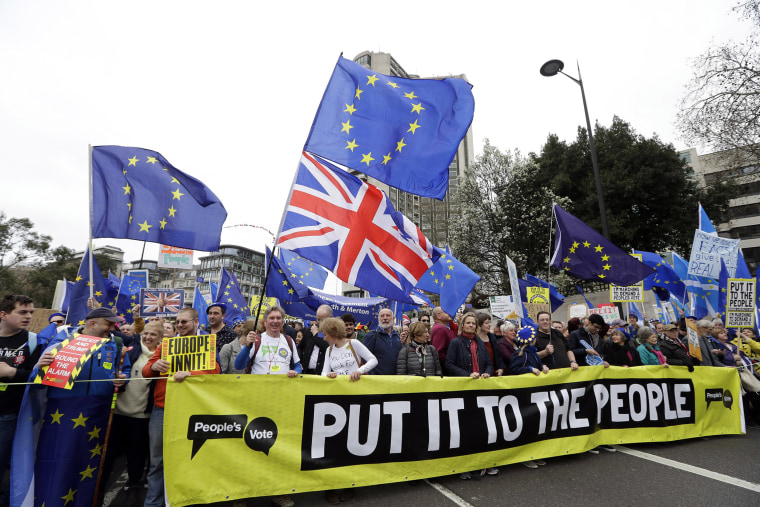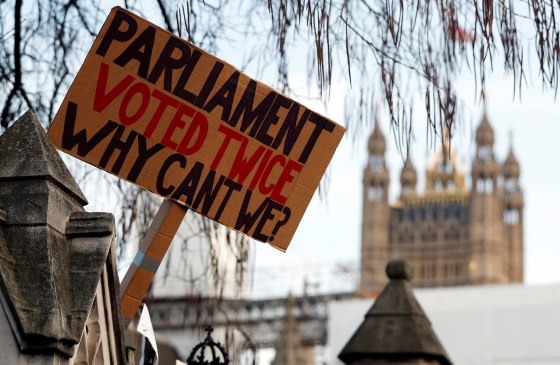
LONDON — Britain is mired deep in its most serious political crisis in a generation.
Almost three years ago, the country voted in a referendum to leave the European Union. But with lawmakers deadlocked on the issue, many believe that the only way out of this morass is to ask the people again.
The idea has gained momentum in recent weeks, from a demonstration that flooded the streets of London last month to senior members of Prime Minister Theresa May's own government now saying a new referendum should be seriously considered.
Such a drastic move would provoke uproar among pro-Brexit supporters. However, the idea of holding another referendum now seems far less implausible than it did even a few weeks ago.
"There is no prospect of closure in the Brexit debate without respecting the right of voters to have the final say," said former Conservative lawmaker Stephen Dorrell, one of the prominent bipartisan voices behind the campaign for a so-called People's Vote.
He added: "It would show our country has finally come to its senses after a spasm that has undermined our democracy. "
The argument goes like this: The yes or no referendum in June 2016 showed that most people wanted to leave the E.U. — but it gave little idea what a post-Brexit Britain should look like.
Backers of another vote say any deal thrashed out by lawmakers should be put back to the electorate to make sure that the vision of the future is actually what they wanted.

Opponents claim this is a nothing short of a conspiracy cooked up by those who want to cancel Brexit altogether. But supporters say that only a final, definite act of public endorsement can break the impasse.
Their cause has been boosted by the hundreds of thousands of demonstrators who marched through London last month calling for another referendum. Furthermore, a parliamentary petition to cancel Brexit altogether gained more than 6 million signatures.
From fantasy to 'credible'
For a long time during this process, the idea of another referendum seemed far-fetched, a fantasy reserved for the pro-European fringes desperate for any excuse to remain in the E.U.
As recently as December, May outright rejected the idea, saying it would do "irreparable damage" to the public's trust in British politics. A month later, opposition leader Jeremy Corbyn bluntly said his Labour Party was "not supporting or calling for" another referendum.
Fast forward to this week and the picture has changed remarkably.
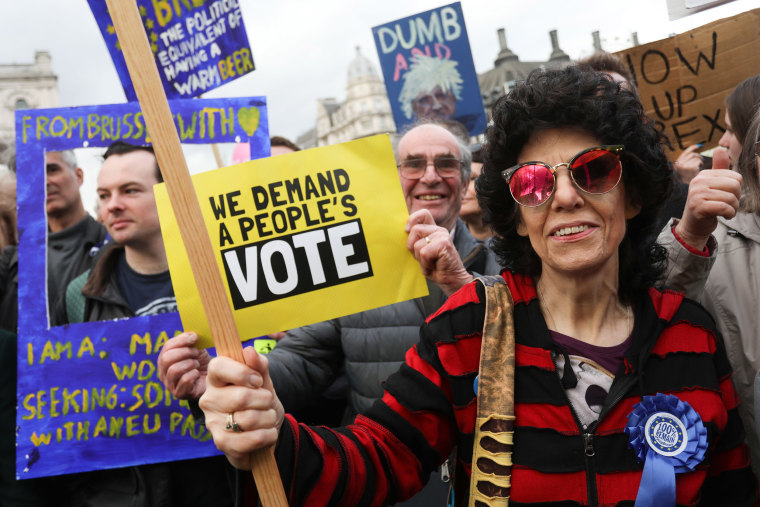
May is no longer ruling out the prospect of another vote, and her finance minister, Philip Hammond, told ITV News on Wednesday night that there was a "credible case" for one.
That this is even being discussed in the political mainstream shows how limited May's options have become.
Because the U.K. is so closely tied to the other 27 E.U. countries, its politicians have been trying to agree on a deal to ensure a smooth divorce as well as a clear path to a future relationship.
The prime minister's attempts to secure this have resulted in a stalemate in Parliament — where her plan has been rejected three times — and it has exacerbated bitter divisions within her Conservative Party, with lawmakers of all stripes blaming her for the chaos.
"I deeply regret the state of my party, a party that is in a profound state of existential crisis," said Dorrell, the former Conservative lawmaker.
Speaking with the enemy
In a final throw of the dice, this week May entered into talks with Corbyn, a man on the far-left of his own Labour Party, and someone with whom she has spent the past few years trading vitriolic attacks.