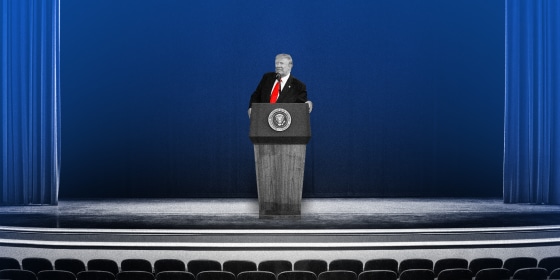
President Donald Trump's rabid online following will be smaller from now on, but it may be more extreme.
That's the takeaway from researchers who study "deplatforming," the sweeping form of digital banishment that Trump got from Twitter and much of the rest of the tech industry after a mob of his supporters laid siege to the U.S. Capitol last week, leading to the deaths of five people, including a police officer.
Trump joins a growing list of high-profile personalities — most of them on the far right — who have been banned from Facebook, Reddit, Twitter or YouTube after having repeatedly broken the sites' rules. Conspiracy theorist Alex Jones is banned from most of them, as is far-right activist Milo Yiannopoulos.
The past examples have given researchers a window into whether such moves are effective. But as a soon-to-be-former president, Trump presents a unique case that may shatter expectations. There's anecdotal evidence that banished figures get less web traffic and attention than they did before being banned, and research says followers who regroup on other social media networks after a ban do so in smaller numbers.
"It's likely that he will have a much smaller reach than he did on Twitter," said Manoel Horta Ribeiro, a doctoral student who has researched online extremism at École Polytechnique Fédérale de Lausanne, a Swiss university.
Without a megaphone to distribute his views on social media, Trump would have a difficult time influencing other media or finding new people to build his audience. His most hardened fans, however, will inevitably find a place to communicate and organize, researchers said.
Ribeiro and a team of others published a study in October examining what happened after Reddit shut down message boards where toxic language had been common, including a particularly notorious subreddit called r/The_Donald. Its users tried to regroup at a specific, standalone website.
"What we found is that there is a huge decrease in the activity and the number of members and reach of the community when these communities migrate to these new platforms but substantial evidence that the community became much more toxic," Ribeiro said.
Using linguistic analysis techniques, the researchers found that the content of discussions changed. Trump supporters were increasingly fixated on outsiders, with more of their posts discussing subjects such as "socialism" and "antifa."
Other research supports the idea that deplatforming is effective. One study found that Reddit's ban in 2015 of other message boards notorious for harassment worked, as many users of the boards left Reddit entirely and those who remained drastically cut their hate speech. In the United Kingdom, researchers have said Facebook's removal of an extremist group there in 2018 largely hobbled it.
But it's also possible that the research so far doesn't cover enough territory. There's not a precise way to measure the clout of someone like Jones, who was dropped by Facebook, YouTube and Spotify in 2018 after he glorified violence, they said, or Yiannopoulos, a provocateur who was banned from Twitter for harassing others.
"Just because you're not hearing from them doesn't mean people aren't listening," said Barry Bradlyn, a physicist at the University of Illinois Urbana-Champaign who has studied fringe social media networks, such as Gab.
Jones, for example, has fallen off the list of most-listened-to radio talk show hosts in the U.S., and in the weeks after he was banned, his web traffic fell by half, a New York Times analysis showed. But Bradlyn said more research is needed on the influence he and others like him still wield.
Likewise, there's little conclusive research about how much deplatforming draws attention to otherwise obscure objectionable material or what it does for the health of the internet at large.
One guess about Trump's fate may be inspired by former Fox News hosts Glenn Beck and Bill O'Reilly. Beck left the cable network after his ratings declined and some advertisers dropped his show, and O'Reilly was forced out after a series of sexual harassment allegations.
Each has a niche audience now outside the mainstream of political media.
"Bill O'Reilly, he was the most-watched person on cable news for decades," said Angelo Carusone, president of Media Matters, a liberal watchdog group that monitors conservative media. "You don't hear about him. He doesn't have any influence anymore."
Download the NBC News app for breaking news and politics
