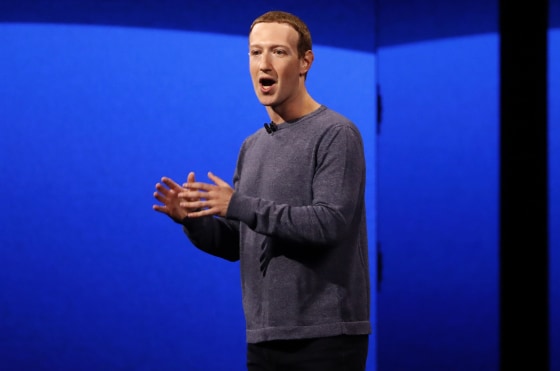
Facebook CEO Mark Zuckerberg on Thursday launched a defense of how tech companies promote and regulate free speech, arguing that Facebook and its peers have emerged as a “fifth estate” of digital speech in society alongside traditional news media.
Zuckerberg, in a speech at Georgetown University, repeatedly cast Facebook and free expression as one and the same. He echoed language from the 18th century, when people began referring to journalists and the press as a “fourth estate” co-existing with three existing tiers in the British Parliament.
"People having the power to express themselves at scale is a new kind of force in the world," Zuckerberg said in the speech, which was broadcast online. "It is a fifth estate alongside the other power structures in our society."
“People no longer have to rely on traditional gatekeepers in politics or media to make their voices heard, and that has important consequences," he said.
The speech in the nation’s capital was Zuckerberg’s most visible move yet to counter growing pressure from Democratic presidential candidates, Republican lawmakers and other critics calling for Facebook and tech companies to broadly change how they regulate speech on their platforms.
Former Vice President Joe Biden’s Democratic presidential campaign blasted Zuckerberg after the speech, attacking the executive for his decision not to fact check the ads of political campaigns. Biden's campaign has called for Facebook, Twitter and Google to take down ads from President Donald Trump's campaign that contained false claims about Biden.
“Facebook has chosen to sell Americans’ personal data to politicians looking to target them with disproven lies and conspiracy theories, crowding out the voices of working Americans,” Bill Russo, Biden’s deputy communications director, said in a statement.
“Zuckerberg attempted to use the Constitution as a shield for his company’s bottom line,” he said.
Zuckerberg’s views on free expression have wide-ranging effects because, as Facebook’s controlling shareholder and chief executive, he has final say in all of the company’s policies and products, which billions of people worldwide use.
He has frequently rewritten Facebook’s speech rulebook depending on changing circumstances. Recently, the company eliminated a rule that for years had banned advertisements with “false or misleading content,” and ahead of the 2020 presidential election, it has said it will not attempt to fact check the ads of political candidates.
Zuckerberg defended those decisions on Thursday.
“We think people should be able to see for themselves what politicians are saying,” he said. “I don’t think it’s right for a private company to censor politicians or the news in a democracy.”
He said he has considered banning political ads on Facebook, as some have proposed, but he couldn’t figure out where to draw the line and decided that doing so would favor incumbents and whomever the media chooses to cover.
“There are going to be issues any way you cut this,” he said. “We should err on the side of greater expression.”
Zuckerberg invoked free-speech legal precedents from the civil rights movement to support his positions — a move that later drew a rebuke from one civil rights organization.
“The fact that Zuckerberg would even invoke civil rights icons in remarks that justify his decision to exempt politicians’ speech from Facebook’s Community Standards underscores his willful refusal to accept how voter suppression has played out, from Jim Crow to now. He is in denial and so is his company,” Vanita Gupta, president of the Leadership Conference on Civil and Human Rights, said in a statement.
Democratic presidential candidate Sen. Elizabeth Warren, D-Mass., who has called for breaking up or heavily regulating big tech companies such as Facebook, last week harshly criticized Facebook for its handling of political advertising.
“Facebook changed their ads policy to allow politicians to run ads with known lies — explicitly turning the platform into a disinformation-for-profit machine," she said on Saturday.
