IE 11 is not supported. For an optimal experience visit our site on another browser.
Left in limbo, Afghans who served with U.S. forces fear Trump could send them back to the Taliban
The State Department says it's closing a U.S.-run camp in Qatar, with some residents offered money to return to Taliban-ruled Afghanistan, where they risk persecution and death.
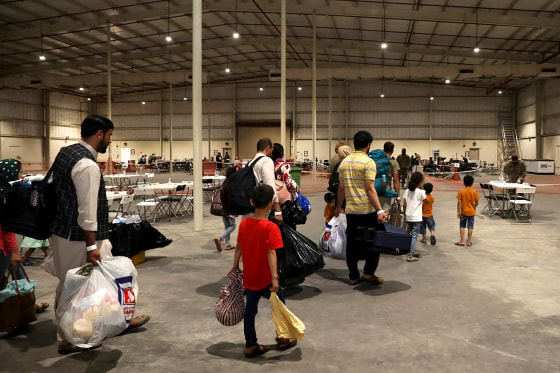
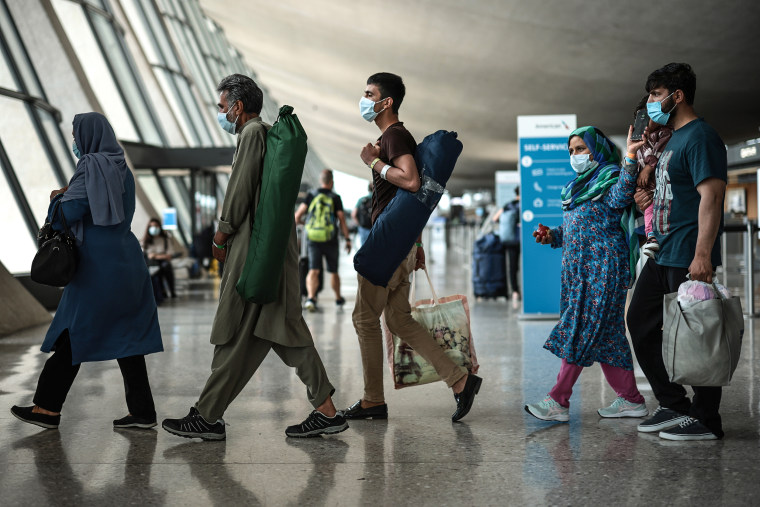
Special immigrants from Afghanistan walk through the in-processing building at Camp As Sayliyah, Qatar, in 2021 after their evacuation.Sgt. Jimmie Baker / U.S. Army via Reuters file
On a former U.S. military base in Qatar, Afghans who supported the United States in its 20-year war against the Taliban have been left in limbo, living in windowless shipping containers far from the new lives they were once promised in the U.S.
Now, the Trump administration is presenting them with a stark choice: move to an unspecified third country or return to Taliban-ruled Afghanistan, where they potentially face persecution, imprisonment or death.
Camp As Sayliyah, located outside Doha, hosts more than 1,100 Afghan men, women and children, most of whom have been approved for U.S. resettlement after extensive vetting. Instead, the State Department says everyone will be removed from the camp by March 31, making it the latest casualty in the Trump administration’s efforts to block virtually all paths to the U.S. for Afghan allies.
The camp is the only Afghan refugee site run directly by the U.S. government, with its residents among thousands of people stranded across Afghanistan, Pakistan and elsewhere since Trump returned to office and halted all refugee resettlement. Days before the State Department’s self-imposed deadline, they say they have been given almost no information about what will happen to them next.
00:39
Afghan refugees in Qatar protest over travel suspension
00:0000:00
The people at Camp As Sayliyah include former members of the Afghan special forces, interpreters and others who worked with the U.S. military, and relatives of U.S. service members and veterans. Their situation has become even more urgent with the U.S.-Israeli war with Iran, as the camp is rattled by Tehran’s retaliatory missile strikes on a nearby U.S. air base.
Mohammad, a U.S. Army veteran whose family has been at the camp for a year and a half, said they were offered between $1,000 and $4,500 per person to return to Afghanistan, where they spent three years in hiding after the withdrawal of U.S.-led forces in 2021.
“It doesn’t matter if it’s a million dollars,” said Mohammad, who asked not to be identified by his full name out of concern for his family’s safety. “How am I going to trade my dad’s life or my brother’s or my sister’s life for, I don’t know, a billion dollars?”
A State Department spokesperson said Camp As Sayliyah is “a legacy of the Biden administration’s attempt to move as many Afghans to America as possible — in many cases, without proper vetting.”
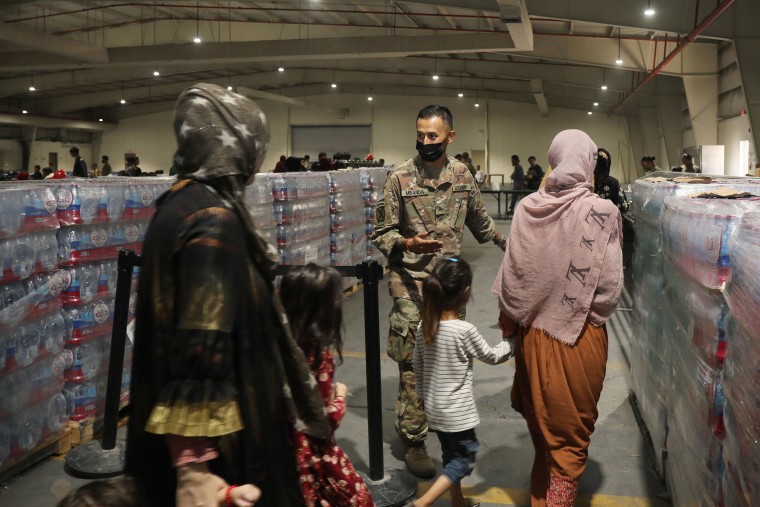
Afghans enter the dining facility at Camp As Sayliyah in 2021.Sgt. Jimmie Baker / U.S. Army via Getty Images file
While the Trump administration has no plans to force anyone back to Afghanistan, the spokesperson said, “it is not appropriate or humane to keep this group of individuals on the platform indefinitely.”
Moving the camp population to third countries is “a positive resolution that provides safety for these remaining people to start a new life outside of Afghanistan,” the spokesperson said.
Mohammad, who was gravely wounded in Afghanistan as a combat interpreter for the U.S. military and enlisted in the Army after moving to Texas, said he felt “betrayed — not by my fellow battle buddies, but by the administration.”
While he remains proud of his service, he says his parents and siblings were targeted in Afghanistan because of it, and later evacuated to Qatar by the U.S. government. He says America has a duty to protect his relatives instead of “handing my family over to the Taliban.”
'What are they going to do with us?'
Camp As Sayliyah was the “flagship relocation camp” for people fleeing Afghanistan after the U.S. withdrawal, said Shawn VanDiver, president of the San Diego-based advocacy group AfghanEvac.
It was a place where they could safely wait as final preparations were made for their U.S. resettlement, he added, and a symbol of the promise America made to Afghans who risked their lives in the conflict.
Now, it is little more than a “prison camp,” said VanDiver, who has visited the site multiple times. Residents are not allowed to leave the camp, where they live in windowless shipping containers designed for temporary lodging.
While moving the Afghan refugees to third countries may address immediate safety concerns amid the Iran war, it “cannot be the final step,” AfghanEvac said in a statement.
Staying long term in a third country is not a good option, VanDiver said, with no guarantee that those countries wouldn’t just send people back to Afghanistan.
“It’s untenable for a lot of reasons, but mostly because it’s the wrong thing to do,” he said.
The Trump administration has not publicly confirmed any third countries that have agreed to accept people from the camp, and denies that Afghan allies face being repatriated against their will.
“Some have gone of their own volition, but we are not forcing anybody,” Assistant Secretary of State S. Paul Kapur told lawmakers at a congressional hearing last month.
He said he believed about 150 Afghans had accepted the payments and that he did not know what had happened to them.
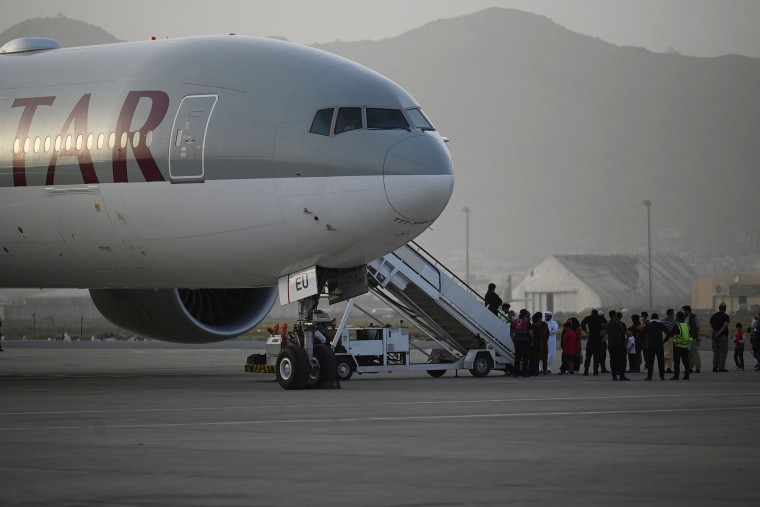
Passengers boarding a charter flight carrying Afghan nationals to Qatar from Kabul in 2021.Aamir Qureshi / AFP via Getty Images
Those still at the camp struggle to fill their time, resting in the middle of the day to avoid the desert heat and roaming streets that are named after U.S. states to help them learn about what was supposed to be their new home. Schooling is limited, especially for older students.
Twice in the past year, Iranian strikes have hit nearby in Qatar — once last June in retaliation for U.S. strikes on Iranian nuclear facilities, and again during the U.S.-Israeli war with Iran that began Feb. 28.
The camp offers poor protection against the strikes, said VanDiver, whose group received multiple recordings from “terrified” residents of missiles being intercepted over their heads.
The arrival of Afghan allies to the U.S. had already slowed to a crawl as the Trump administration reshapes the U.S. immigration system. But their hopes were further dashed in November when a shooting in Washington killed one National Guard member and seriously injured another.
The suspect, identified as Rahmanullah Lakanwal, 29, is an Afghan national who served alongside U.S. troops as part of an elite CIA-backed unit in Afghanistan. Lakanwal, who pleaded not guilty to nine federal charges last month, was granted asylum by the Trump administration last year after arriving in the U.S. during the Biden administration.
The Trump administration imposed harsher restrictions for Afghans after the attack, halting asylum decisions, suspending visa issuance for all Afghan nationals and moving to detain refugees already in the country.
Afghans at Camp As Sayliyah condemned the attack, but say it was the act of one individual.
“We want to ask the American government not to link the crime of a single Afghan to all Afghans,” said a woman surnamed Salimi, a lawyer who has been at the camp with her husband and two sons, ages 2 and 4, for more than a year.
Salimi, who asked to be identified only by her last name because of security concerns, was approved for U.S. resettlement because her legal work put her at risk of persecution by the Taliban.
She had her own legal office, mostly representing women “who were poor, who were physically abused, who were pursuing divorce.”
Many of her clients’ husbands were members of the Taliban, some of whom were imprisoned for physical abuse or other crimes, she said.
The night the Taliban returned to power, Salimi said, she got a call from an unknown number.
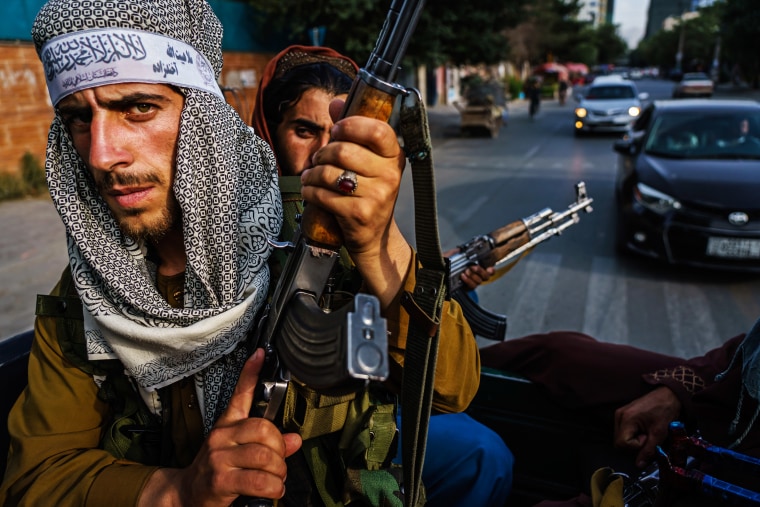
Taliban fighters in Kabul, Afghanistan, in 2021.Marcus Yam / Los Angeles Times via Getty Images file
“You separated my wife from me and now she’s married to another man and has another life,” said the man on the other end of the line. “You have to pay the price.”
Soon, Salimi heard the Taliban was looking for her. Her office was closed, as she focused on keeping a low profile and finding a way out.
She was eventually able to apply for a U.S. visa, a process she said took seven or eight months, including security checks.
As she flew to Qatar in January 2025, Salimi believed her family’s future in the U.S. was finally secure, but Trump’s return to the White House just two weeks later upended their plans, with refugee resettlement halted and Afghan nationals later barred from entering the U.S.
“Facing an uncertain future makes our mind and spirit get worse day by day,” Salimi said. “What’s going to happen to our future? What are they going to do with us?”
The U.S. government’s about-face on Afghan allies and their families has pained veterans such as retired Army Lt. Col. Mariah Smith, who served three tours in Afghanistan.
Translators such as Mohammad “were absolutely vital to success,” Smith said, making them “a primary target” of the Taliban.
“There was this expectation and promise, like, if you help us, this is a way for you to be able to come to America,” said Smith, who is vice chair of No One Left Behind, a nonprofit based in Arlington, Virginia, that advocates for Afghan and Iraqi allies.
“That’s why I think it was so heartbreaking for so many veterans when we pulled out of Afghanistan,” she said, “because so many of us felt like we were complicit in breaking that promise.”
The treatment of Afghan allies could make people in other conflict zones “less willing to work with us,” she added.
Mohammad, who grew up in Kabul, signed up as a combat interpreter for the U.S. military in 2009. That year, he was seriously wounded in Helmand province when an improvised explosive device detonated, killing the U.S. Marine right in front of him.
After recovering, he was sent to Kabul to do noncombat translation work. But every day, he said, “the task of just going from your home to the office was just, you know, life and death.”
The risk was worth it, he said, “because of the value that we saw in the international community being in Afghanistan,” such as his sisters being able to go to school.
In 2014, he received what’s known as a “special immigrant visa” and moved to Texas. He enlisted in the U.S. Army almost immediately as a way to give back to the country that had changed his life.
After finishing his service in 2016, Mohammad — now a U.S. citizen — worked as a Defense Department contractor in Afghanistan, right up until the withdrawal.
“It just happened out of the blue, and it was super chaotic,” said Mohammad, who was in Kabul at the time. “I barely managed to get to the airport, get on the plane, and get out.”
Afghan refugees arriving at Dulles International Airport in Virginia after being evacuated from Kabul in 2021.Anna Moneymaker / Getty Images file
With the Taliban now back in power, those with ties to the U.S. military and their relatives were targets. Mohammad’s family spent the next three years in hiding, his parents moving from place to place with four daughters and two sons.
“We couldn’t all be together in one place,” said his father, a history teacher also named Mohammad who also asked not to be fully identified for safety reasons. “The Taliban intelligence services were constantly after us.”
The family was evacuated to Qatar in 2024 after the younger Mohammad learned of a program to help Afghan relatives of U.S. service members. “That was a big sigh of relief for me,” he said.
When Trump returned to office, the family had been fully processed and was just waiting for their U.S. visas and plane tickets. “Now we don’t know our fate,” the older Mohammad said.
Several months ago, he said, people working at the camp started saying, “Why don’t you go back to Afghanistan? The country is calm and free now.” He said a State Department representative has since offered money for those willing to go back.
Returning would mean certain death, Mohammad and his family say. His sister Faezeh, 29, is trying to stay optimistic, and says she hopes that “in the near future Trump changes his mind.”
“Sometimes we think they’re going to send us back by force. It’s a very difficult worry,” she added. “Especially for those of us that have nothing to go back to.”