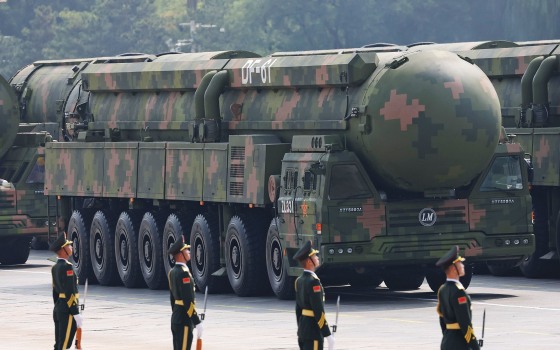
GENEVA — The United States accused Beijing on Friday of conducting a secret nuclear test in 2020 as it called for a new, broader arms control treaty that would bring in China as well as Russia.
The accusations at a global disarmament conference highlighted serious tensions between Washington and Beijing at a pivotal moment in nuclear arms control, a day after the treaty limiting U.S. and Russian missile and warhead deployments expired.
"I can reveal that the U.S. government is aware that China has conducted nuclear explosive tests, including preparing for tests with designated yields in the hundreds of tons," U.S. Under Secretary of State for Arms Control and International Security Thomas DiNanno told a Disarmament Conference in Geneva.
The Chinese military "sought to conceal testing by obfuscating the nuclear explosions because it recognized these tests violate test ban commitments. China has used 'decoupling', a method to decrease the effectiveness of seismic monitoring, to hide their activities from the world," he said.
DiNanno said China had conducted one such "yield-producing test" on June 22, 2020.
China's ambassador on disarmament, Shen Jian, did not directly address DiNanno's charge but said Beijing had always acted prudently and responsibly on nuclear issues.
"China notes that the U.S. continues in its statement to hype up the so-called China nuclear threat. China firmly opposes such false narratives," he said.
"It (the US) is the culprit for the aggravation of the arms race."
Diplomats at the conference said the U.S. allegations were new and concerning.
Global arms control faces a critical moment
The 2010 New START treaty ran out on Thursday, leaving Russia and the United States for the first time in more than half a century without any binding constraints on their deployments of strategic missiles and warheads.
U.S. President Donald Trump wants to replace it with a new agreement including China, which is rapidly increasing its own arsenal.
DiNanno told the Geneva conference: "Today, the United States faces threats from multiple nuclear powers. In short, a bilateral treaty with only one nuclear power is simply inappropriate in 2026 and going forward."
He reiterated U.S. projections that China will have over 1,000 nuclear warheads by 2030.
But Shen, the Chinese delegate, reiterated that his country would not participate in new negotiations at this stage with Moscow and Washington. Beijing has previously highlighted that it has a fraction of their warhead numbers - an estimated 600, compared to around 4,000 each for Russia and the U.S.
"In this new era we hope the U.S. will abandon Cold War thinking... and embrace common and cooperative security," Shen said.
Expiry of New START leaves arms control void
New START's expiry leaves a vacuum in arms control for the first time since 1972. Since the darkest Cold War days when the United States and the Soviet Union threatened each other with "mutually assured destruction" in the event of nuclear war, Moscow and Washington have seen arms limitation treaties as a way to prevent either a lethal misunderstanding or an economically ruinous arms race.
If nothing replaces New START, security analysts see a more dangerous environment with a higher risk of miscalculation. Forced to rely on worst-case assumptions about the other's intentions, the U.S. and Russia would see an incentive to increase their arsenals, especially as China plays catch-up.
Russia would prefer to have a dialogue with the United States after New START but is ready for any scenario, Foreign Minister Sergei Lavrov said on Friday.

