IE 11 is not supported. For an optimal experience visit our site on another browser.
Trump vows $10 billion from U.S. for his 'Board of Peace,' as he leans into global role
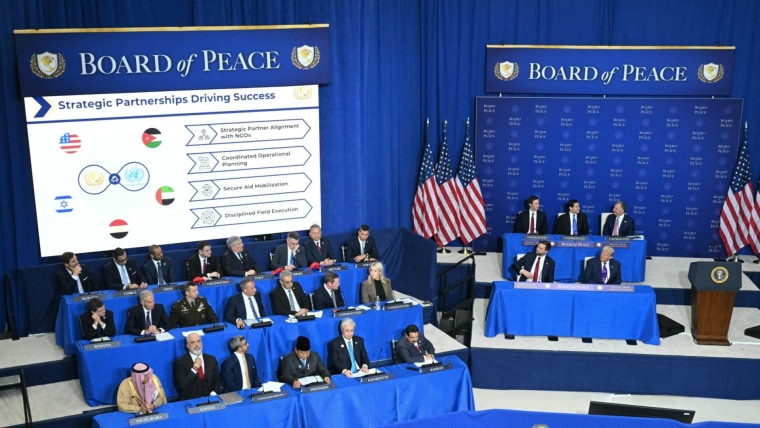
President Donald Trump expressed optimism for Gaza during Thursday's first meeting of the Board of Peace, which focused on the next steps in the fragile ceasefire.
It was an event teeming with “the greatest world leaders,” financial and troop pledges and promises of global conflicts settled, which he cast as a coda to his presidency.
The board would not only achieve peace in Gaza but also intervene in “hotspots” around the world, Trump said. “We will help Gaza," the president said. "We will straighten it out. We will make it successful. We will make it peaceful. And we will do things like that in other spots.”
Its members would be able to “do things many other people couldn’t conceive or think of,” he added, calling this first meeting featuring representatives of at least 40 countries, including heads of state, “one of, if not the, most important day of our careers.”
The president also said $7 billion had been committed by board members for reconstruction in Gaza and announced a $10 billion commitment from the United States to the Board of Peace initiative, a sum he said was small compared to the cost of war.
"It’s two weeks of fighting," he said. "Sounds like a lot, but it’s a very small number."
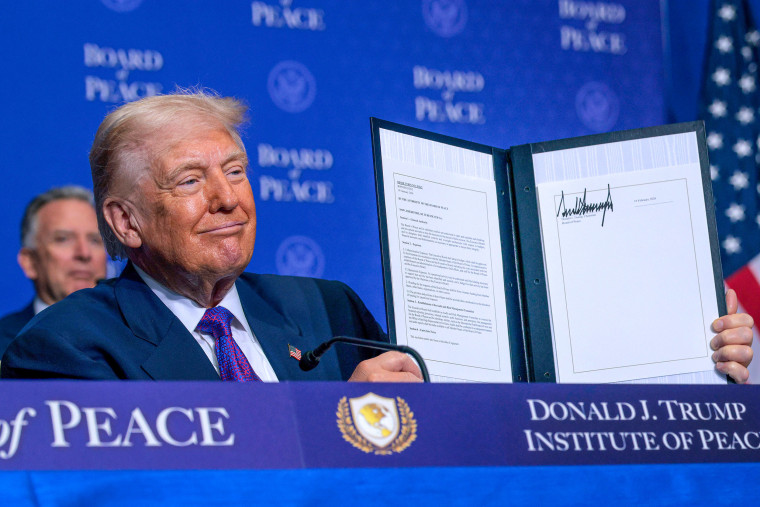
Donald Trump signs a Memorandum of Understanding during the inaugural meeting of the Board of Peace at the Donald J. Trump Institute of Peace on Feb. 19, 2026, in Washington, D.C.Chip Somodevilla / Getty Images
Trump did not say where the $10 billion would come from and the White House did not respond to an inquiry from NBC News.
Ahead of the meeting, some key U.S. allies had raised concern that Trump may hope to challenge the United Nations with his broader ambition of using the body to help resolve global conflicts. In his remarks, Trump vowed to “lift up” the United Nations, even as he said the Board of Peace “is going to almost be looking over” the historic international body “and making sure it runs properly.”
Numerous world leaders were in attendance, including Hungarian Prime Minister Viktor Orbán and Argentinian President Javier Milei, both allies of Trump. Participants were handed red MAGA-style hats emblazoned with “USA.”
Trump, speaking to the group, cast the board as a central part of his legacy, with peace a central focus in his second term. It was held at the Institute of Peace. Trump said it was Secretary of State Marco Rubio’s idea to rename it the "Donald J. Trump U.S. Institute of Peace," calling it a “surprise” that has made him work harder.
Potential 'bad things' for Iran
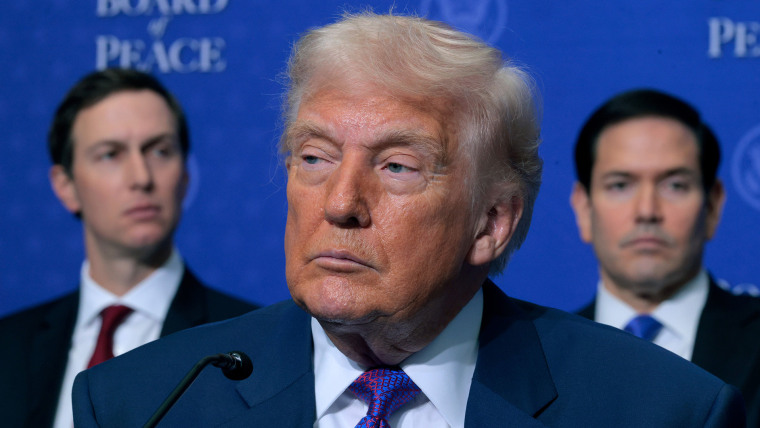
Representing the U.S. were Trump, Rubio, Vice President JD Vance, U.S. Special Envoy Steve Witkoff and the president's son-in-law and adviser, Jared Kushner.
He lavished praise on the leaders in attendance, quipping that those who had not yet joined the Board “are playing a little cute.”
While Trump highlighted his peace-making efforts around the world, at one point urging world leaders to stand up and shake hands with former adversaries, he also addressed potential U.S. strikes against Iran. Trump offered a possible ten-day timeline for when he would reveal his plans as the U.S. continues to push more weaponry into the region.
Although negotiations with Iran are ongoing, the U.S. has gathered the most air power in the region in decades. Trump warned that "bad things will happen" if they fail to reach what he called a "meaningful" deal.
"Now we may have to take it a step further," the president added. "Or we may not ... You’re going to be finding out over the next, probably 10 days.”
Trump also cast a political lens over the event, taking credit for landslide victories in other countries after he endorsed foreign leaders, name-checking Milei, Orban, and Japanese Prime Minister Sanae Takaichi as part of a global group of like-minded counterparts and examples of his sway and influence abroad.
Shifting his gaze back home, Trump praised both Rubio and Vance, members of his administration who are seen as potential successors. Speaking about Rubio’s recent remarks at a defense conference in Munich, Trump joked, “Marco, don’t do any better than you did, please, because if you do, you’re out of here.”
Plan for Gaza
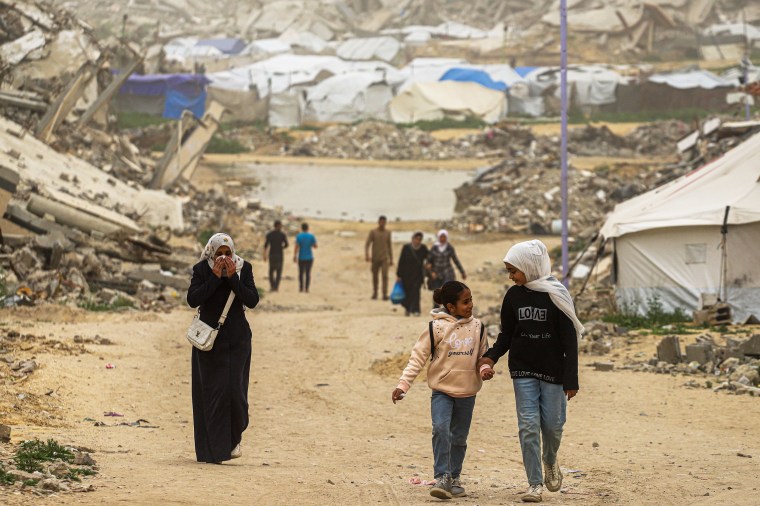
Jabalia camp in Gaza City on Friday.Ramez Habboub / Future Publishing via Getty Images
Trump announced a multi-billion-dollar reconstruction plan for Gaza, along with contributions from board members, including $75 million from FIFA to build soccer facilities in the region. Trump thanked President Gianni Infantini, who briefly wore a red MAGA-style hat as the event got underway.
Trump also unveiled details of plans for a United Nations-authorized stabilization force in Gaza, including countries such as Indonesia, Morocco, Kazakhstan, Kosovo and Albania that have committed to dedicating several thousand troops to the initiative.
The meeting included updates on a range of efforts, including humanitarian assistance, the National Committee for the Administration of Gaza and the International Stabilization Force.
A video played during the event outlined a three-year goal to rebuild Rafah, a city in the southern Gaza Strip, along with the creation of a “gateway” connecting Gaza to Egypt, Israel, Jordan, Saudi Arabia, the UAE and extending onward to India and Europe. Looking ahead, by year ten, “Gaza will be self-governed, integrated into the region with thriving industries and housing for all,” the video said.
Norway to host meeting
Trump initially pitched the body to oversee peace efforts in Gaza, before drastically expanding its remit into a U.N.-style body intended to address major world conflicts. A host of countries have committed to joining, though it remains unclear how many, if any, have committed to donating $1 billion to the initiative for permanent membership.
Certain key U.S. allies, such as the U.K., France, Norway and Sweden, have declined to join the body, with some citing concerns over its charter, which made no direct mention of Gaza, and its potential to undermine the U.N.'s role in peacekeeping efforts. Some still sent envoys, including the U.K., Norway and Italy.
Trump announced Thursday that Norway had agreed to host a Board of Peace event, though it was not immediately clear if the country's opposition to joining the group had changed. He said he was “excited to announce” the news, but voiced mock disappointment, saying he “thought they were going to say that they’re giving me the Nobel Prize.”
“This is less exciting,” he added.
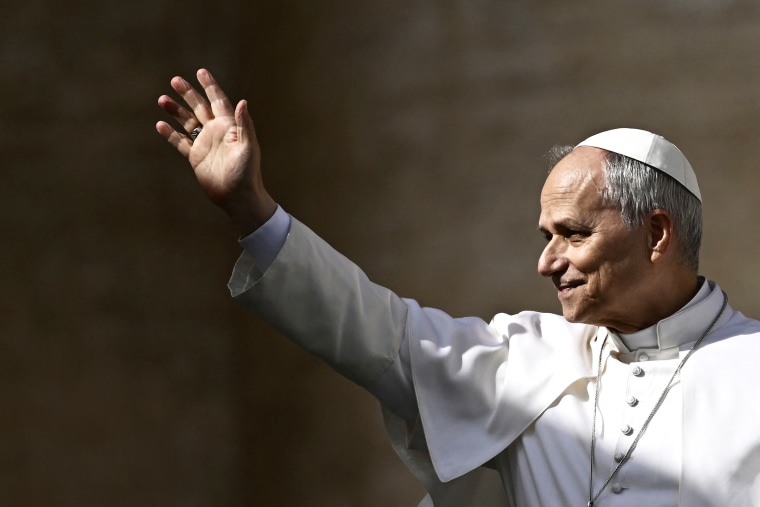
Pope Leo XIV was the latest to turn down Trump's invitation to join the board, with the Vatican expressing concern that "the U.N. is primarily responsible for managing these crisis situations."
White House press secretary Karoline Leavitt called the decision “deeply unfortunate,” adding, “I don’t think that peace should be partisan or political or controversial.”
Some world leaders have also voiced concern over Russia’s potential involvement, after an invitation was extended to the Kremlin. Russian Deputy Foreign Minister Sergey Ryabkov said earlier this week that the country would not join the first summit but is still “working out” its long-term position, according to Russian state news agency TASS.
Pope Leo XIV declined to join the Board of Peace.Filippo Monteforte / AFP via Getty Images
The European Union said it would send Dubravka Šuica, the European commissioner for the Mediterranean, to Washington for the summit, but that the E.U. will not be joining the board.
Some nations, including Italy, were also represented as observers, with Italian Foreign Minister Antonio Tajani saying the country was also prepared to help train police forces in Gaza and elsewhere in the Palestinian territories, according to Reuters.
While some U.S. allies have opted out of the initiative, at least one has been excluded from the board altogether, with Trump withdrawing Canada's invitation to join last month, shortly after Canadian Prime Minister Mark Carney delivered a speech at the World Economic Forum warning of a "rupture" in the world order.
No Palestinian representation
Human rights experts and others have condemned the Board of Peace as a colonial project, and questioned a lack of Palestinian representation on the body's Gaza executive board.
“It is a colonialist operation: others deciding for the Palestinians,” said Cardinal Pierbattista Pizzaballa, the Latin Patriarchate of Jerusalem, according to Italian newspaper Il Sole 24 Ore.
Palestinian President Mahmoud Abbas’ advisor Dr. Mahmoud Al-Habbash said it was a “temporary arrangement” that the “Palestinian leadership rejects under any circumstances,” but he said it was the “lesser of two evils,” speaking with Arabic outlet Asharq Al-Awsat.
"So far, we have not seen Gaza's interests reflected in the Board of Peace," Julie Norman, an associate fellow of Chatham House’s Middle East and North Africa Program, said in a phone interview Wednesday. "That has just been clear from the way the mandate of the board has shifted."
A separate technocratic body, supervised by the Gaza executive board, will oversee day-to-day administration in Gaza and is comprised of Palestinians and led by Palestinian official Ali Shaath.
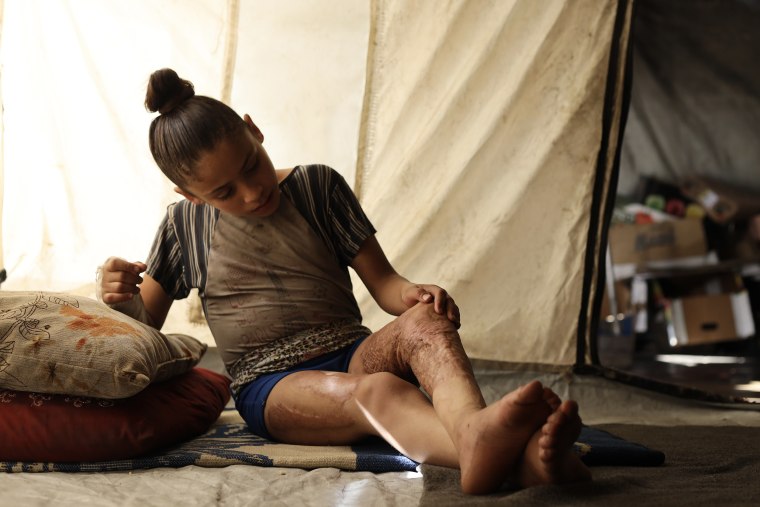
A twelve-year-old, who was seriously injured after the tent she was staying in was targeted by the Israeli army, in Rafah, Gaza on Feb. 11.Khames Alrefi / Anadolu via Getty Images
The lack of Palestinian representation could become a more divisive issue after Israel joined the Board of Peace last week. Israeli Prime Minister Benjamin Netanyahu made the announcement in a post on X last week while on a trip to Washington to meet Trump.
As it stands, the ceasefire in Gaza has continued to largely hold, despite continued Israeli airstrikes in the war-torn enclave that have seen hundreds killed amid the truce, according to Palestinian health officials, while both Hamas and Israel have traded accusations of ceasefire violations.
Meanwhile, dire conditions have persisted for Palestinians in the enclave, where most of the population remains displaced and living in tents.
Implementing the next steps of the ceasefire, including the demilitarization of Hamas, a key stipulation and sticking point in the ceasefire deal, as well as outlining plans to rebuild Gaza, where much of the enclave has been destroyed, will be a monumental task.
“We are under no illusions on the challenges regarding demilitarization, but we have been encouraged by what the mediators have reported back,” a senior U.S. official said.
Speaking at the summit on Thursday, Trump noted that when he took office, "the war in Gaza was raging with thousands of people being killed and no end in sight."
Now, he said, "the war in Gaza is over," despite what he referred to as "little flames."