BREAKING: Lou Holtz, who coached Notre Dame to its last national championship, dies at 89

Who is set to be in charge in Iran now that Khamenei is dead? A powerful hard-line military corps

Regardless of which cleric is chosen the next supreme leader, the real power is now likely to be in the hands of the heavily-armed force that propped up Khamenei for decades: the Islamic Revolutionary Guard Corps.
Get more newsWho is set to be in charge in Iran now that Khamenei is dead? A powerful hard-line military corpsNBC News LogoSearchSearchLiveNBC News LogoToday Logo | Latest News Todayon
Listen to this article with a free account

The U.S.-Israeli attack that ended Ayatollah Ali Khamenei’s iron-fisted rule of Iran also created a power vacuum in the Islamic Republic for the first time in decades, with a group of clerics convening to cast their votes on who would succeed him.

While front-runners to succeed Khamenei have emerged, including the assassinated supreme leader's second son, Mojtaba Khamenei, the real power is now likely to be in the hands of the heavily-armed force that propped up Khamenei for decades: the Islamic Revolutionary Guard Corps.

“Even if they replace the supreme leader, what is left of the regime is the IRGC. And the IRGC is going to be the last vestige remaining of the regime until the regime is overhauled, either within itself or by external forces,” said Afshon Ostovar, an Iran expert at the Naval Postgraduate School in California and the author of “Vanguard of the Imam,” a history of the Revolutionary Guards.

“Once the smoke clears, if there’s not a complete regime change, then the people who will be in charge of Iran will be associated or the actual command of the IRGC,” he said, noting that his views are not the official position of the Department of Defense.
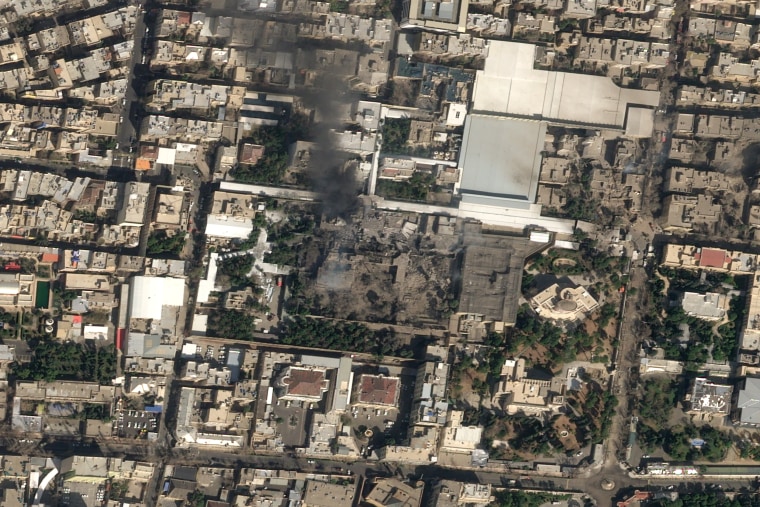
The first publicly released satellite image of the compound associated with Ayatollah Ali Khamenei in Tehran, georeferenced.

The imagery, captured by Airbus, shows multiple structures within the secured complex that appear heavily damaged or destroyed. The site is widely understood to function as the official residence and administrative compound of Iran’s Supreme Leader.
Satellite images released Saturday show destruction to Ayatollah Ali Khamenei's compound in Tehran.Airbus 2026

The Revolutionary Guard demonstrated its fealty to Khamenei most recently by orchestrating the crackdown in January that left thousands of anti-government protesters dead. Now, after his killing, it has the opportunity to seize even more power in the country, some experts say.

The U.S.-based Human Rights Activists News Agency put the number of people killed in the protests at more than 7,000 last week, with nearly 12,000 cases “under review.”

President Donald Trump told a group of reporters on Tuesday that Iran had killed 35,000 protesters.

The Guard was created after the 1979 Iranian Revolution as a parallel force to Iran’s traditional military, which the ruling clergy distrusted and suspected still had loyalties to the ousted shah, or king. Within Iran, the Guard eliminated those perceived as being anti-revolutionary and helped export its ideology across the Middle East.

The Guard's intelligence branch became the most feared repressive arm of the regime and has its own section in the notorious Evin prison in Tehran.

Under Khamenei’s watch in the 1990s, it morphed into a political and economic juggernaut, running huge foundations and companies involved in the oil, telecom, construction and other sectors worth billions of dollars.

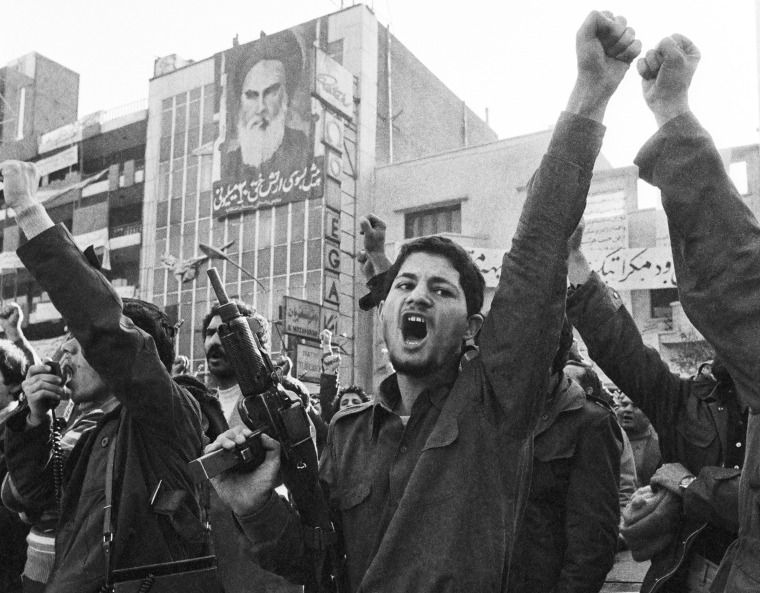
Islamic Guards Chant Anti-US Slogans
Islamic Revolutionary Guard members during a demonstration in front of the occupied U.S. Embassy in Tehran in 1979.Alex Bowie / Getty Images

“I don’t think the IRGC of today are committed ideologically to preserving the velayat-e faqih or Shi'ism or whatever it is that they think their ideology is,” said Abbas Milani, the director of the Iranian studies program at Stanford University. “They’re a mafia, like a rich corporate entity, and they want to keep their turf.”

Velayat-e faqih is the religious doctrine institutionalized by Ayatollah Ruhollah Khomeini, the first supreme leader after the revolution, which underpins theocratic rule in Iran.

The group’s commanders have also dominated the country's political class. Ali Larijani, currently the country's top national security official, served in the Guard, and Mohammad Bagher Ghalibaf, the current speaker of parliament, served as a commander in the force during the Iran-Iraq war in the 1980s.

The group remains the most powerful military force in the country, leading the war efforts against the United States and Israel by firing missiles and drones across the Middle East, making its commanders targets for both the U.S. and Israeli military.

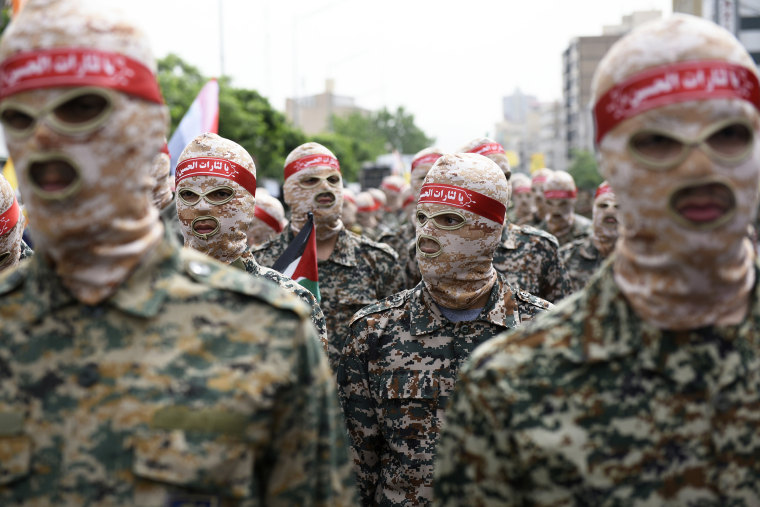
Islamic Revolutionary Guard Corps (IRGC) members march
Islamic Revolutionary Guard Corps members march during a rally in Tehran in 2022. Sobhan Farajvan / Pacific Press/LightRocket via Getty Images

During his first term, Trump ordered a drone strike that killed Maj. Gen. Qassem Soleimani, the commander of the Quds Force, the branch of the Guard that operates outside Iran’s borders, on the outskirts of the Baghdad airport. He has repeatedly pointed to the killing of Soleimani in 2020 as one of his major accomplishments.

And the Israeli military targeted senior Guard commanders in the first wave of attacks against Iran in the 12-day war last June, killing Brig. Gen. Amir Ali Hajizadeh, the commander of the Guard’s aerospace force and widely seen as the father of the country’s missile program, among others.

Last weekend, the most recent head of the Guard, Mohammad Pakpour, was killed in the U.S. and Israeli strikes, raising the question of how long the military organization can keep replacing its top commanders.

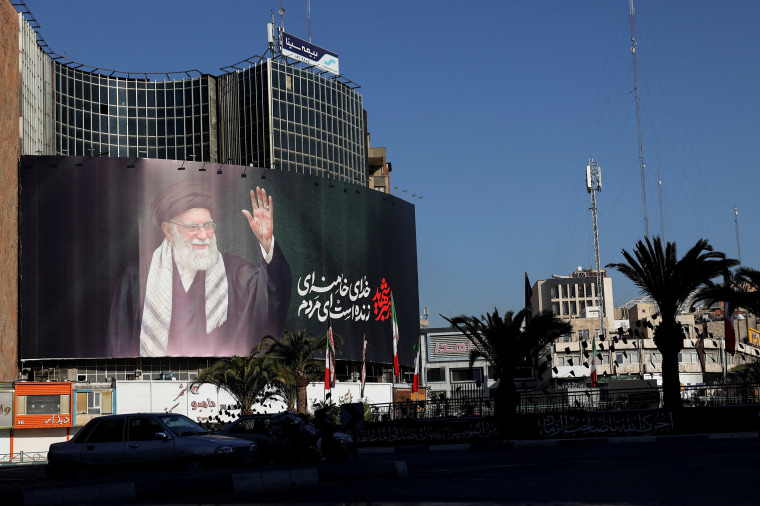
A billboard of Iran's late Supreme Leader Ayatollah Ali Khamenei on a street, in Tehran
A billboard of the late Supreme Leader Ayatollah Ali Khamenei in Tehran on Wednesday.Majid Asgaripour / Reuters

“It does not have an infinite bench on which to draw, but it is also a sprawling structure with military, economic and political elements,” said Ali Vaez, Iran project director at the International Crisis Group.

If the Guard is able to withstand the current onslaught of U.S. and Israeli attacks, it will likely crack down even harder on domestic unrest, according to Ostovar of the Naval Postgraduate School.

“It becomes far more repressive, because then the fear for the regime is that the most existential challenge remains popular upheaval, and they’ll do whatever they can to sort of fight tooth and nail,” he said. “I think whatever really happens, if the regime remains, it’s going to be equally, if not more, repressive.”