Khamenei's death met with public mourning, quiet celebrations as regime's opponents wait for an opening

Opponents of the regime, who faced a brutal crackdown in January, largely stayed off the streets this weekend, but there were some quiet celebrations alongside public mourning.
Get more newsKhamenei's death met with public mourning, quiet celebrations as regime's opponents wait for an openingNBC News LogoSearchSearchLiveNBC News LogoToday Logo | Latest News Todayon
Listen to this article with a free account

For the first time in 37 years, the sun rose on a leaderless Tehran, its streets unusually hushed as Iranians awoke to the news that Supreme Leader Ayatollah Ali Khamenei had been killed in joint U.S.-Israeli airstrikes.

In the capital, the mood was suspended between grief and disbelief.

Black-clad mourners wept for Khamenei, beating their chests and clutching portraits of the man who ruled Iran for nearly four decades. Others, beyond Tehran and across social media, celebrated his death, dancing in the streets.

Questions now hang over who will succeed the Middle East’s longest-serving head of state, and what comes next for a nation already battered by war abroad and dissent at home.

“It is announced to the martyr-nurturing people of Iran that Grand Ayatollah Khamenei, the Supreme Leader of the Islamic Revolution, was martyred in a joint attack by the criminal United States and the Zionist regime,” a semiofficial Iranian news agency reported Saturday.

Iranian President Masoud Pezeshkian vowed revenge for his killing and declared Khamenei a martyr, meaning 40 days of mourning that began to take place on Sunday.

Thousands gathered to pay their respects to Khamenei in Enghelab Square as the warm glow of the Sunday-morning sun shone across the Iranian capital. Men were seen hugging and crying, resting against shuttered storefronts, unable to contain their grief.

“God is great!” They chanted.
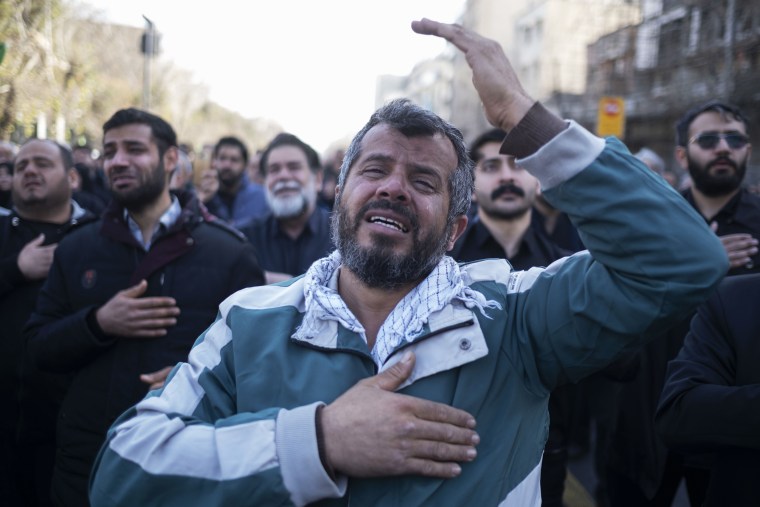
Mourning Ceremony For Iran's Supreme Leader Ayatollah Khamenei
Mourners during a rally in Tehran on Sunday.Morteza Nikoubazl / NurPhoto via Getty Images

The streets were eerily quiet elsewhere on Sunday as businesses, schools and universities shut their doors.

Opponents of the regime, who turned out in the thousands for protests that faced a brutal crackdown in January, largely stayed off the streets on Sunday, perhaps heeding advice from U.S. President Donald Trump and former Crown Prince Reza Pahlavi, a figurehead for some opponents of the regime, who urged them to wait and stay sheltered rather than attempt an uprising now.

“Stay alert and ready to return to the streets for the final action at the appropriate time,” Pahlavi said Saturday.

“Don’t leave your home. It’s very dangerous outside,” Trump advised as he announced the strikes. “When we are finished, take over your government.”

While there were no mass celebrations from the regime’s opponents, some still welcomed the U.S. and Israeli strikes.

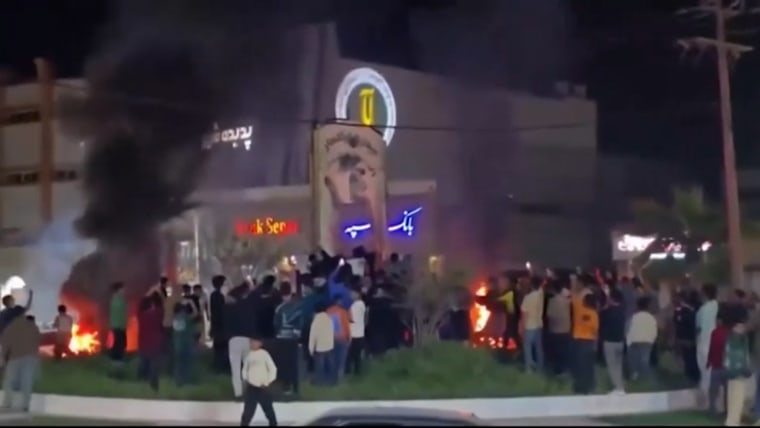
Eyewitness video showed a crowd in southern Iran toppling a monument dedicated to the Islamic Republic’s founder, Ayatollah Ruhollah Khomeini, Khamenei’s predecessor.

In the coastal city of Shahsavar in northern Iran, crowds cheered and cars honked their horns in a video verified by NBC News.

“Goodbye, ‘Moosh-Ali,’” says the cameraman, using a nickname referencing Khamenei.

Even in Tehran, where protesters face being hunted down since the violent suppression of January’s demonstrations, some shouted “Long live the shah” from the rooftops, a reference to Iran’s former king who was overthrown in 1979 during the Iranian Revolution.

In footage verified by NBC News, cheers and whistles could be heard in the capital’s Pardis neighborhood after reports of Khamenei’s death began to spread.

But questions remain over what comes next, causing a quiet anticipation in the streets of Tehran, an NBC News producer on the ground said.

Iran’s top security official, Ali Larijani, said on Sunday that “a temporary leadership council will be formed in accordance with the constitution to carry out the duties assigned to it,” as Iran kicks off the process for choosing a successor to Khamenei.

Sen. Lindsay Graham, R-S.C., a strong supporter of the strikes, said Sunday that the U.S. would not be imposing a leader on Iran and that it was for the people to decide what happens next.

“The people will pick. As to the people: choose wisely,” he told NBC News’ “Meet the Press” moderator Kristen Welker on Sunday, adding: “We want to be your friend. We’d like to have a good relationship with you going forward, but that is up to you now.”

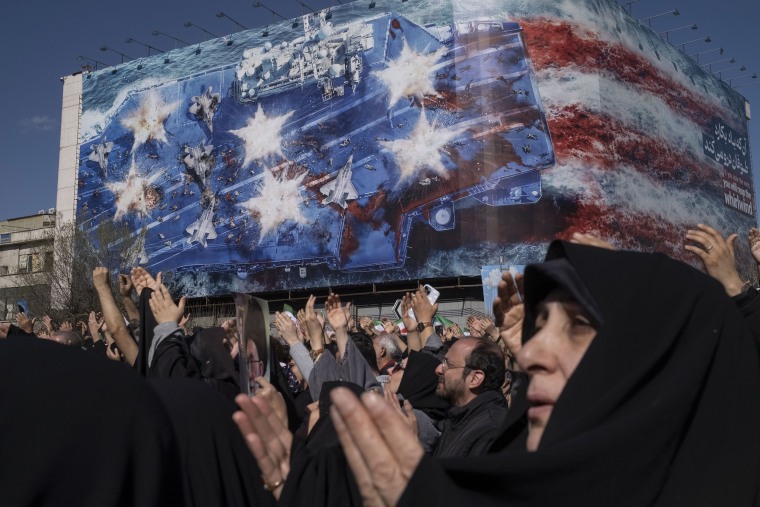
Mourning Ceremony For Iran's Supreme Leader Ayatollah Khamenei
Regime supporters pray while rallying beneath an anti-U.S. billboard in Tehran on Sunday.Morteza Nikoubazl / NurPhoto via Getty Images

Article 111 of the country’s constitution gives the job to its Assembly of Experts, an 88-member body of qualified clerics approved by voters, according to the Council on Foreign Relations. Until the assembly speaks, a three-member council of the president, the head of the judiciary and a jurist of the Guardian Council chosen by the country’s Expediency Discernment Council takes over the supreme leader’s duties.

Suzanne Maloney, a senior fellow for Middle East policy at the Brookings Institution’s foreign policy program, said that the change in leadership alone would be unlikely to topple the regime.

“Any mere change at the top of Iran’s leadership remains insufficient to topple the current system,” she said in a post on the Council on Foreign Relations website today. “Over time, a political movement capable of challenging the regime could yet emerge, but any forthcoming leadership transition in Iran is unlikely to result in a beneficial change in the regime itself.”

As to whether the regime can withstand the fall of its long-serving leader, another analyst said the regime currently appears to be intact following the strikes.

“You haven’t seen mass defections, you haven’t seen a complete breakdown in any shape or form,” H.A. Hellyer, a senior associate fellow at the Royal United Services Institute, a defense and security think tank in London, told NBC News.

“I think the system is fairly resilient at present,” he said.