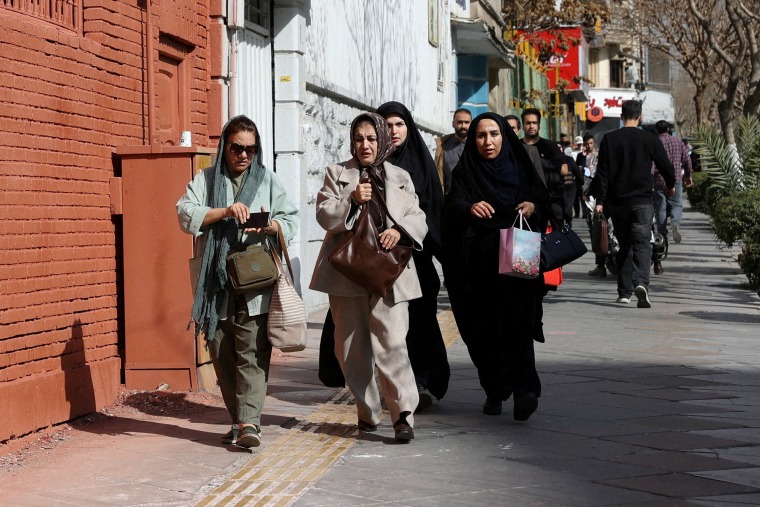
Meanwhile, more than 200 people were killed and some 747 people have been injured in the attacks on Iran, a spokesperson for the Red Crescent Society said in an interview with the Iranian Students’ News Agency.
“Twenty-four provinces across the country have been struck,” Mojtaba Khaledi said.
The United Nations Security Council held an emergency meeting Saturday during which Secretary-General António Guterres warned the attacks on Iran "carries the risk of igniting a chain of events that no one can control in the most volatile region of the world."
Earlier, Israeli Prime Minister Benjamin Netanyahu told his countrymen to “be resilient and strong.” And he urged the Iranian people, who since December have been protesting against the Islamic regime, to use this moment to finally oust the ayatollahs.
“This is an opportunity, do something. Do not sit with your arms crossed,” he said. “You have to complete this work and you have to bring down and eradicate this regime.”
Netanyahu’s office said earlier that the prime minister and Trump spoke after launching the initial attacks and released a photograph of Netanyahu on the phone.
The White House also confirmed the call, noting that Trump monitored the situation overnight from Mar-a-Lago.
Vice President JD Vance dialed into a conference line with Trump from the Situation Room in Washington, where he was joined by Treasury Secretary Scott Bessent, Director of National Intelligence Tulsi Gabbard and Energy Secretary Chris Wright, according to a source familiar with the matter.
Before the attacks, Secretary of State Marco Rubio attempted to contact a group of influential congressional leaders known as the “Gang of Eight” to give them a heads up. He was able to reach seven of the eight members.
“I implored him to be straight with Congress and the American people about the objectives of these strikes and what comes next,” Senate Minority Leader Chuck Schumer, D-N.Y., said in a statement. “Iran must never be allowed to attain a nuclear weapon but the American people do not want another endless and costly war in the Middle East when there are so many problems at home.”
Republicans have largely far expressed support for the attacks, but Democrats along with Rep. Thomas Massie and Sen. Rand Paul, both Kentucky Republicans, have expressed dismay that Trump had carried out the strikes without first seeking congressional authorization. Some members have vowed to force a war powers resolution vote to limit Trump’s ability to carry out further attacks on Iran.
Sen. Tom Cotton, R-Ark., the chair of the Senate Intelligence Committee and a member of the Gang of Eight, said the Trump administration had “more than fulfilled its responsibilities” to notify Congress of the Iran strikes.
“The objective here is fairly clear,” he told Fox News. “It’s to, once again, put an end to Iran’s nuclear ambitions.”
Trump administration officials plan to brief lawmakers Sunday on the military attack, including members of the Senate and House intelligence, armed services and foreign affairs committees, according to two sources with knowledge of the matter.
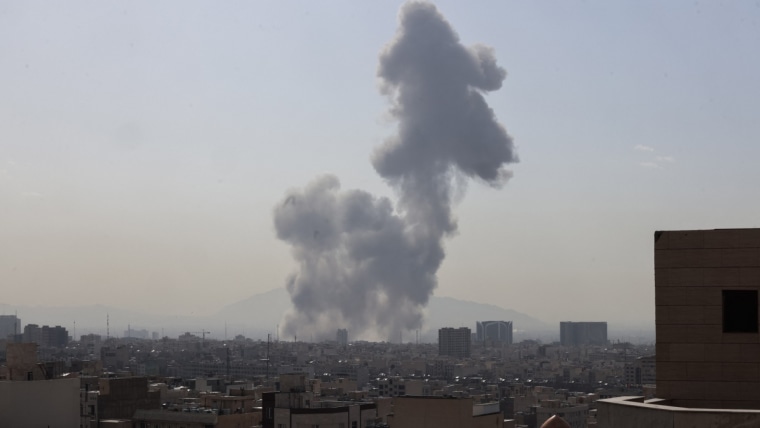
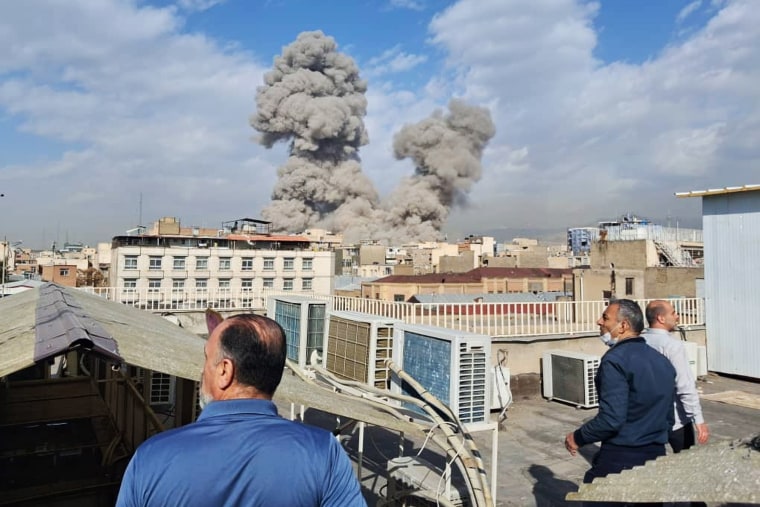
In the early hours of the attack on Iran, the sound of multiple explosions echoed through Tehran, an NBC News producer on the ground reported.
Iran quickly announced it was closing its airspace and video from the country’s semiofficial news agency Tasnim showed smoke rising above buildings in the capital city.
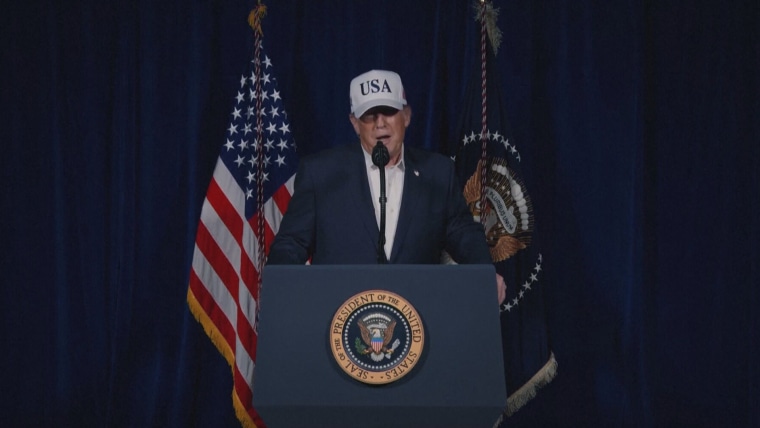
“Our objective is to defend the American people by eliminating imminent threats from the Iranian regime,” Trump said in an eight-minute video message shared on Truth Social as the bombardment was underway.
“Bombs will be dropping everywhere,” he added, addressing Iranians directly. “When we are finished, take over your government. It will be yours to take.”
The administration was taking “every possible step” to minimize the risk to U.S. personnel, Trump added, but he warned that the lives of “courageous American heroes may be lost and we may have casualties.”
“That often happens in war,” he added.
Two U.S. officials told NBC News that Israel had been tasked with targeting Iranian leaders while the U.S. went after Iran’s ballistic missile and nuclear programs.
Tehran retaliated and in Abu Dhabi at least one person was killed by falling debris after an Iranian strike, the United Arab Emirates announced Saturday.
Other U.S. allies in the region, including Qatar, Kuwait, Bahrain and Jordan, also reported Iranian missile attacks on their territory.
Iran’s powerful Islamic Revolutionary Guard Corps said on state television that it had targeted “the headquarters of the U.S. Navy’s Fifth Fleet in Bahrain, other U.S. bases in Qatar and the UAE, as well as military and security centers.”
There were no reported American casualties from Iran’s retaliatory strikes, two U.S. officials told NBC News on Saturday morning.
The officials conceded there was some damage to infrastructure in Bahrain after Iran struck the Fifth Fleet. But it was not immediately clear if the damage was on or off the base.
A military source in the General Command of the Jordanian Armed Forces told NBC News that two Iranian ballistic missiles had been shot down, while Qatar’s Ministry of Defense said it had intercepted a third wave of attacks. The U.S. Embassy in Jerusalem told government employees and their families to shelter in place until further notice.
Iran had vowed before the strikes that it would retaliate against any attack. It threatened to target Israel as well as American bases in the region.
Dozens of people were killed and scores more injured in an Israeli strike on a school in Iran’s southern county of Minab, the semiofficial Iranian news agency Mehr news reported Saturday.
The Israeli military’s situation room said it was looking into the reports of fatalities at the school. NBC News was not immediately able to confirm reports of the strike or the associated death toll.
Middle Eastern nations, including the U.S. ally Egypt, have warned that attacks could spark further conflicts in a region still reeling from the Israel-Hamas war in the Gaza Strip.
Mirjana Spoljaric Egger, president of the International Committee of the Red Cross, said military escalation was “igniting a dangerous chain reaction across the region, with potentially devastating consequences for civilians.”
“Humanitarian aid cannot match the pace or scale of suffering caused by continuous conflict,” she added.
Oman’s Foreign Minister Badr al-Busaidi, a key go-between in talks between the U.S. and Iran, said he was “dismayed” that “active and serious negotiations” had “yet again been undermined.”
“Neither the interests of the United States nor the cause of global peace are well served by this,” al-Busaidi said in a post on X, urging Washington not to “get sucked in further.”