Japan’s conservative prime minister Sanae Takaichi has won a landslide victory after she gambled on a high-stakes snap election.
Takaichi, who took office in October after being elected leader of the governing Liberal Democratic Party (LDP), surpassed the 310 seats needed for a supermajority in the 465-seat lower house, Japanese public broadcaster NHK reported from the official election count Sunday evening. The supermajority allows her ruling coalition to override the upper house, where it lacks a majority.
An NHK exit poll as voting ended earlier Sunday projected the LDP would win 274 to 326 seats. The party and its coalition partner, Ishin, were projected to win a combined 302 to 366 seats as voters turned out amid freezing temperatures in a rare winter election.
The far-right Sanseito party, which promises to put “Japanese first,” was projected to take up to 14 seats, according to the exit poll, which would quadruple its numbers but fall short of the 30 it had targeted.
Speaking from LDP headquarters as the results came in, Takaichi said her party’s coalition with Ishin would continue, adding that she would place importance on fiscal sustainability and had no plans for a major cabinet reshuffle.
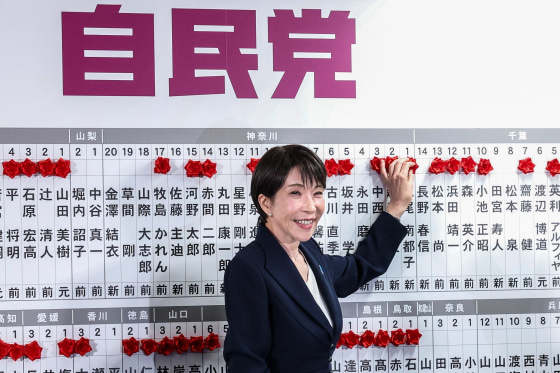
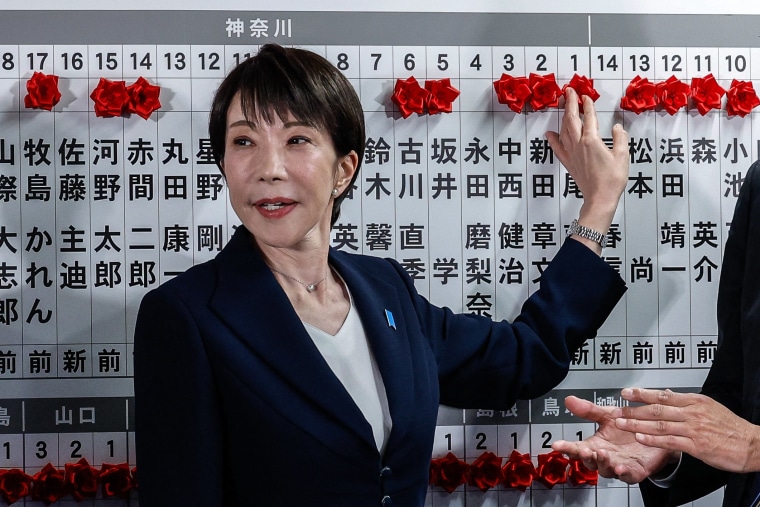
In Japanese tradition, a candidate’s victory is marked with a paper flower. The scale of the win was visible on a board behind Takaichi filled with red paper roses for LDP candidates.
Taiwanese President Lai Ching-te was among the first foreign leaders to congratulate Takaichi, saying he looked forward to promoting peace and prosperity in the Indo-Pacific.
“May your victory bring a more prosperous and secure future for Japan and its partners in the region,” Lai posted on X. Takaichi has been bullish on Taiwan, triggering a major row with China in November when she told lawmakers that a potential Chinese attack on the Beijing-claimed island could prompt a Japanese military response.
Takaichi’s snap election caught her party, the opposition, and much of the electorate off guard, but her gamble, fueled by the power of her personality and some unlikely help from young voters consumed by “Sanamania,” appears to have paid off.
The nation’s first female prime minister had sought direct public backing in her bid to increase Japan’s defense capabilities and boost its influence on the world stage.
Her ambitious agenda reflects a growing sense of urgency in Japan, which faces security threats from China and North Korea even as the U.S., its most important ally, shifts attention to the Western Hemisphere and avoids antagonizing China ahead of reciprocal visits by U.S. President Donald Trump and Chinese leader Xi Jinping.

Among world leaders, Takaichi appears to have one of the most positive relationships with Trump, hitting it off with the U.S. president when he visited Japan days after she took office in October.
Trump endorsed Takaichi in a Truth Social post on Thursday, calling her “a strong, powerful, and wise” leader.
“In my visit to Japan I, and all of my Representatives, were extremely impressed with her,” Trump said, adding that he and Takaichi would meet at the White House on March 19.
U.S. presidents do not typically endorse candidates in other countries’ elections, but Trump has done so on multiple occasions.
George Edward Glass, the U.S. ambassador to Japan, congratulated Takaichi on what he called an “impressive win” and said he looked forward to deepening ties with her government.
Relations with China have been less positive over her remarks about Taiwan. Nationalists cheered Takaichi for her intervention on the issue, which went much further than sitting Japanese leaders have gone previously, while others criticized it as reckless.
China, one of Japan’s biggest trading partners, responded by reimposing a ban on Japanese seafood imports, implementing restrictions on rare-earth mineral exports and warning Chinese nationals against traveling to Japan.