Mobile internet blackouts sweep Moscow, leaving residents feeling 'powerless'

One Muscovite told NBC News she was concerned that the Kremlin was cutting off communications using the “veneer” of security.
Russia Internet Clampdown
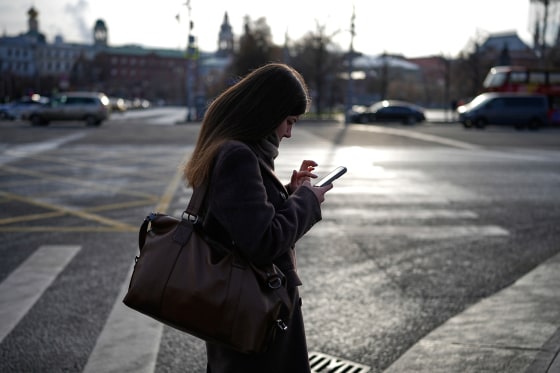
A woman looks at her smartphone in Moscow. Government-enforced internet outages have affected many people in the Russian capital.Alexander Zemlianichenko / AP file
Listen to this article with a free account

Moscow is in the throes of a major mobile internet blackout as the Russian government tightens restrictions it has touted as necessary to ensure the “security” of its citizens.

The Russian capital has been more or less spared from a wave of systematic mobile internet outages that have hit the country since May, which authorities have said are necessary to counter the threat of Ukrainian drones.

But since the first week of March, Muscovites have also found themselves without connectivity on their phones. The restrictions have disrupted the daily lives of millions of residents and hit businesses that rely on mobile internet, leading Muscovites to revert to cash — and some are questioning whether their government is doing it deliberately.

“No one is happy about this. No one understands why it’s happening, or rather, everyone seems to understand why,” Lera, a Moscow resident who works in the arts industry, told NBC News in a text message Monday. “We feel powerless and unable to influence it. We expect a complete blackout within six months.”
NBC News agreed not to use the last names of those interviewed because they were wary of speaking to foreign media about a sensitive security topic and did not want their personal details shared, fearing possible repercussions.

The outages come against the backdrop of increasing restrictions on what Russians can and cannot do online in what has been a widening crackdown on free speech since President Vladimir Putin launched his invasion of Ukraine in February 2022.

Most recently, the Telegram messaging app has been slowed down and a ban has been mooted by authorities in the country, where it is widely used for both news and everyday information.
Russia has blocked the popular messaging service WhatsApp over its failure to comply with local legislation, the Kremlin said on February 12, 2026, urging its 100 million Russian users to switch to a domestic alternative.
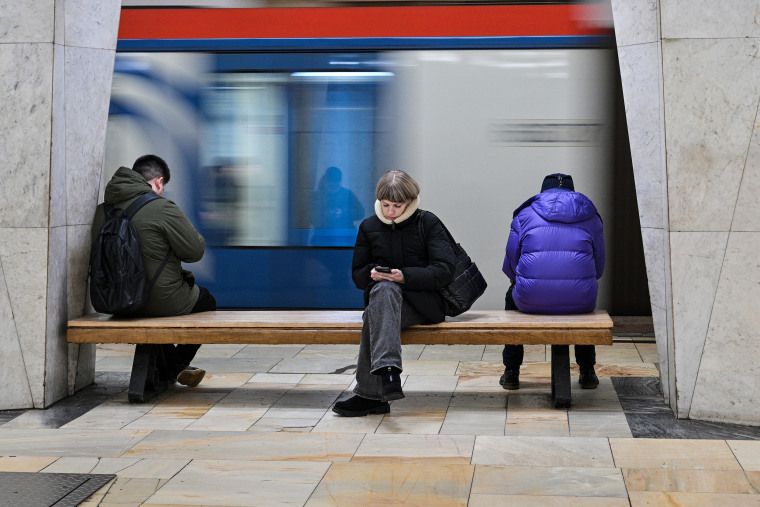
People use their smartphones at a metro station in Moscow last month.Hector Retamal / AFP via Getty Images

The Kremlin has tried to steer people to a state-backed alternative known as MAX, which was created by the state-controlled company VK, and some fear it could be used for surveillance.

Moscow residents reported that the mobile internet outages in the capital appeared to worsen nearer the center, although they have since improved.

Lera said that she had problems using her bank card to pay for meals in the center of the capital and that staying in touch with loved ones had proved tricky. “I didn’t realize there was no internet, and my relatives thought something had happened to me,” she said.

She added that she suspected the outages are not about security but that they are, instead, part of a bigger ploy by the Russian government "to cut us off from the internet, prevent our people from communicating and force us to use the government messenger.”

Alexandra, a media worker, said she had encountered problems loading videos and media files on Telegram, which she circumvented by using a virtual private network — one of the only ways Russians can access censored content online.

“Everything worked great for me,” she said in an audio message.

Her experience appears to be increasingly rare, as the Russian business newspaper Kommersant estimated in a report last week that just five days of outages caused 3 billion to 5 billion rubles ($37 million to $62 million) in damages to Moscow businesses.

Courier services, taxis and car-sharing and retail businesses were among the most affected by the outages, it said, quoting a beauty salon manager who said he had had to ask customers to pay with cash because card machines were not working without mobile internet on people’s phones. The president of an association of fitness clubs also told the paper that people were used to doing everything online and had “stopped picking up the phone.”

The Russian news outlet RBC also reported increased demand for walkie-talkies, pagers, landline phones and paper maps.

Russia Daily Life in Moscow, Russia. Russia is stepping up its tests of systems designed to keep millions of people from accessing information online in times of political unrest, shutting off mobile internet access in the capital in recent days.
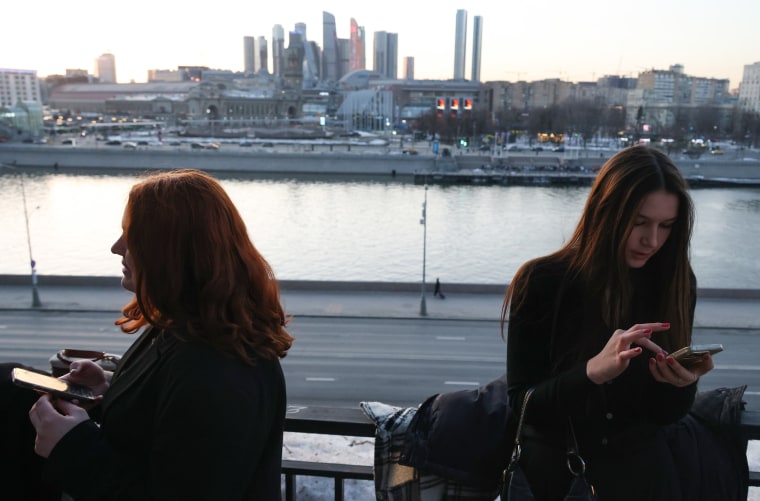
People try to browse the internet on their smartphones along the Rostov Embankment in Moscow on Sunday.Getty Images

The Kremlin acknowledged the negative effect on businesses last week. Spokesperson Dmitry Peskov said the measures were being taken “to ensure the safety of citizens” because Ukraine is using “increasingly sophisticated attack methods.”

That forced Russia to use “more technologically advanced countermeasures,” he said, without elaborating on what the threats were but making it clear they would remain for “as long as necessary.”

The work of the Kremlin was not affected, as it uses “stationary phones,” Peskov added.

Ukrainian drones regularly strike regions close to the border, and some have caused damage thousands of miles inside Russia's territory. Authorities have turned off mobile internet in a bid to jam the ones that use the technology for navigation.

Moscow Mayor Sergey Sobyanin said Monday that about 250 drones were destroyed on their way to the capital over the weekend. He also reported several new intercepts Monday, saying emergency services were dealing with the debris.

But while some, like Alexandra, agreed the drone threat was real, there have nonetheless been questions about the real motivations behind the outages, as people point to the release of the “whitelist” of websites that could still be accessed while the rest of web was down.

Released last year by Russia's digital ministry, the government-approved portals severely limit what people can see on their devices, and some fear the most recent outages are part of a permanent rollout of the “whitelist” of approved sites.

While Alexandra said she was not against restrictions to safeguard people’s security, she said she was concerned that the Kremlin was cutting off communications using the “veneer” of security “and ridding many people of their income, the standard of life they have become used to and their ability to get uncensored information.”