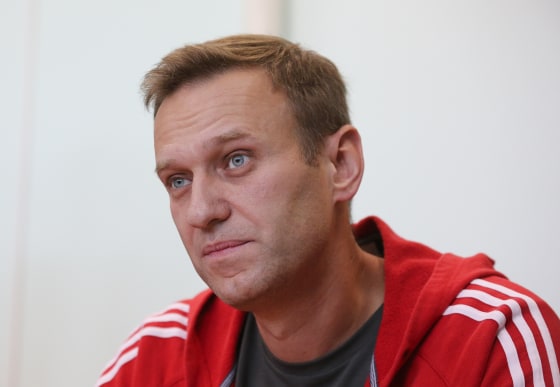
Russian opposition leader Alexei Navalny died in prison after being poisoned with a deadly toxin found in Ecuadorian dart frogs, the U.K. and other allies claimed Saturday.
There is no possible explanation other than a deliberate poisoning, European officials said, noting that the frogs are not found in Russia.
Russia’s prison service reported in February 2024 that Navalny died after having felt unwell following a walk around the high-security facility in a remote town above the Arctic Circle where he was serving a combined 30½-year jail sentence.
He was 47.
“The U.K., Sweden, France, Germany and the Netherlands are confident that Alexei Navalny was poisoned with a lethal toxin,” the British foreign ministry said in a joint statement Saturday, citing “analyses of samples from Alexei Navalny.”
“Epibatidine is a toxin found in poison dart frogs in South America,” the statement added. “It is not naturally found in Russia.”
It is not clear how the toxin was administered to Navalny.
Yulia Navalnaya, the Russian dissident’s widow, appeared at a press conference on the sidelines of the Munich Security Conference to announce the results of a Western analysis into his death, flanked by the foreign ministers of European nations.
Remembering the day she found out about her husband’s death, Navalnaya said she “was sure that it was a murder.” She added: “Today, these words have become scientifically proven facts.”
“Only the Russian government had the means, the motive and the opportunity to use that toxin against Alexei Navalny in prison,” said British Foreign Secretary Yvette Cooper. “We are here today to shine a spotlight on the Kremlin’s barbaric attempt to silence Alexei Navalny’s voice.”
Britain has informed the Organisation for the Prohibition of Chemical Weapons alleging a breach of the Chemical Weapons Convention, a press release said.
“We now know that Vladimir Putin is prepared to use biological weapons against his own people in order to remain in power,” French Foreign Minister Jean-Noël Barrot said in a post on X.
Since Navalny died, Navalnaya has taken up his struggle against official corruption and Putin’s government.
In September, Navalnaya said she had managed to have lab tests conducted in a bid to confirm the suspicion that he died at the hands of the Kremlin.
“We managed to transfer Alexei’s biological materials abroad,” Navalnaya wrote, without giving any further details about the tests or which countries were involved.
News of Navalny’s death drew outrage from the West, where many leaders blamed Putin. Then-President Joe Biden said he was “both not surprised and outraged.” The Kremlin at the time dismissed what it said were “absolutely rabid statements.”
Navalny’s team said afterward that his mother and lawyers were denied access to his body and were told the probe into what killed him had been extended.
Navalnaya accused the Kremlin of hiding his body to cover up having killed him. He had previously been poisoned with a military nerve agent while on a business trip in Russia in 2020 — an attempt on his life that he blamed directly on Putin.