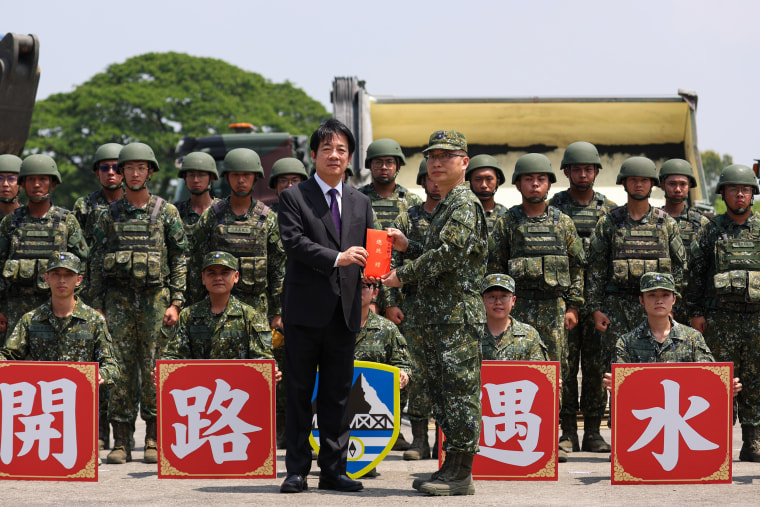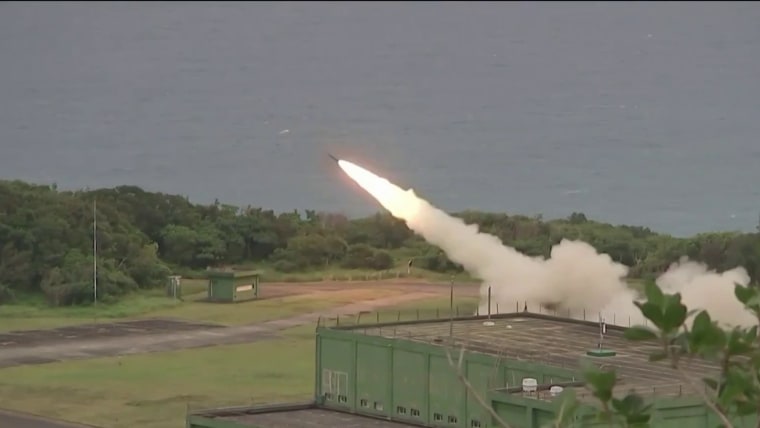
PINGTUNG COUNTY, Taiwan — Below a windy lookout, three U.S.-made mobile rocket launchers lurched forward at a military base in Taiwan, preparing for their first live-fire test on the Beijing-claimed island.
“3, 2, 1... launch,” a Taiwan military officer counted down over a loudspeaker. A total of 33 rockets were then fired toward the Pacific Ocean, in the opposite direction from the Chinese mainland. Making a thunderous sound, each erupted in bursts of flame and trailed white smoke that arced high into the air.
The historic test of the High Mobility Artillery Rocket System, or HIMARS, took place this month at an undisclosed location in Pingtung County, on the southern tip of Taiwan, as Taipei scrambles to overhaul its military and get President Donald Trump’s backing amid growing military threats from China.
The rocket system could be crucial if Taiwan ever came under attack from Beijing, which has not ruled out the use of force in annexing the self-governing democracy.
Manufactured by U.S. defense contractor Lockheed Martin, HIMARS mobile launchers are equipped with guided rockets that have a range of about 185 miles — far enough to reach coastal targets in the southern Chinese province of Fujian on the other side of the Taiwan Strait.
It is the same rocket system that Ukrainian forces have been using to target Russian positions — though unlike Ukraine, Taiwan paid the United States more than $1 billion for the weaponry.
The island has received 11 of the 29 HIMARS launchers it has purchased, with the rest expected to arrive ahead of schedule next year.
Though the U.S. has no formal diplomatic ties with Taiwan, which rejects Beijing’s sovereignty claims, it is the island’s biggest weapons supplier. Billions of dollars in arms deals with the U.S. have helped Taiwan build up asymmetric tools such as drones, missiles and upgraded fighter jets.
As China ramps up military and other pressure, Taiwan has also extended compulsory military service to one year from four months, doubled mandatory annual refresher training for reservists to two weeks, and pledged to increase its defense budget to more than 3% of its gross domestic product.
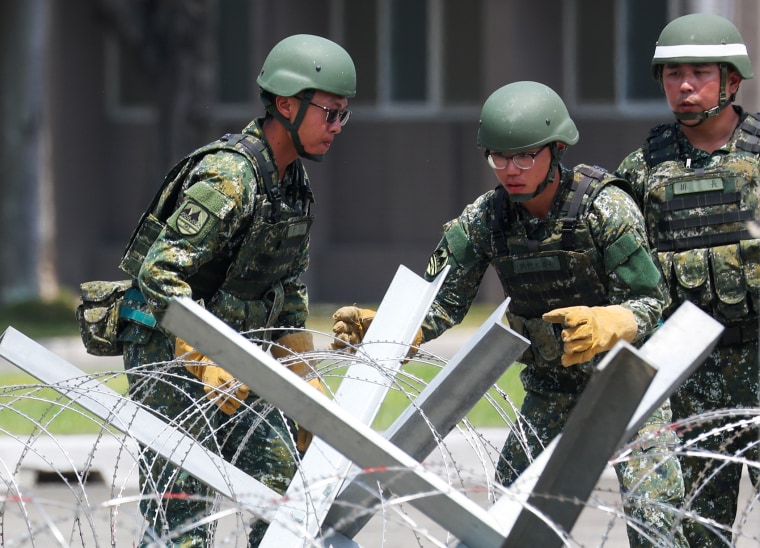
While the U.S. remains a “very important” strategic partner, Taipei “fully recognizes” the need to strengthen its own defense capabilities, said Sun Li-fang, a spokesperson for the Taiwanese National Defense Ministry.
“Ensuring Taiwan’s security is our responsibility and our top priority,” he said. “We take this matter very seriously.”
But it is difficult for Taiwan to build a modern fighting force, Sun said, in the face of “inherently disproportionate” threats from China, whose 2.8-million-strong military is more than 18 times larger than Taiwan’s number of active-duty personnel.
In the year since Taiwanese President Lai Ching-te took office, China has held several rounds of large-scale military exercises that Adm. Samuel J. Paparo, the head of U.S. Indo-Pacific Command, warned this month are not drills but “rehearsals.”
The Chinese military also sends warplanes and ships toward Taiwan on near-daily sorties and in recent days held an amphibious landing drill in the Taiwan Strait.
To deal with such “tangible and real” threats, it is “crucial” that the U.S. and Taiwan continue their military cooperation, Sun said.
In addition to HIMARS, the U.S. and Taiwan have advanced their cooperation with an intelligence sharing deal that Sun called a “game-changer.”
“We typically don’t go into detail because intelligence and information sharing are sensitive,” Sun said in his government’s first public comments on the subject.
“That said, this kind of intelligence exchange is extremely helpful for us in understanding threats from the enemy and making appropriate defensive deployments.”