'Difficult' peace talks spotlight Putin's chief negotiator and Ukraine antagonist

To many in Ukraine and outside observers of the war, the lack of progress in U.S.-led negotiations should be no surprise, given the man leading the Kremlin's team in Geneva.
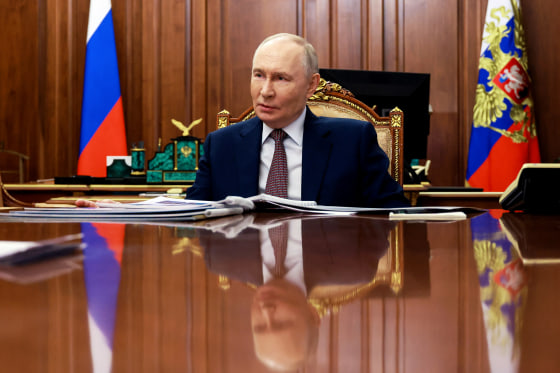
Image: BESTPIX - RUSSIA-POLITICS
Russian President Vladimir Putin attends a meeting in Moscow on Feb. 11.Vyacheslav Prokofyev / AFP via Getty Images
Listen to this article with a free account

Russia and Ukraine don’t agree on much, but both sides left the latest round of U.S.-led peace talks Wednesday describing the negotiations as “difficult.”

Moscow — and increasingly President Donald Trump — have blamed Ukraine for the absence of a deal, while Kyiv argues it is instead the Kremlin that is stalling.

The future of territory in Ukraine's east is a key sticking point as the fourth anniversary of Russia’s full-scale invasion approaches next week, with Vladimir Putin’s hard-line demands fueling doubts over whether he actually wants to strike a deal.

To many in Ukraine and outside observers of the war, the lack of progress should be no surprise given the man Putin sent to Geneva this week as his chief negotiator.

The Russian delegation at the first two rounds of recent trilateral talks in Abu Dhabi was led by the country's chief of military intelligence, Adm. Igor Kostyukov. But Kremlin aide Vladimir Medinsky led Moscow's team in the Swiss city this week.

“Russia is trying to drag out negotiations,” Ukrainian President Volodymyr Zelenskyy said in a post on X on Wednesday. He later told reporters the talks were not easy, with the two sides still not aligned on “sensitive” topics.

Medinsky described the two-day talks as “difficult but businesslike.”

The two sides indicated they would meet again, and Zelenskyy said some progress was made on military issues, particularly America's role in monitoring any future ceasefire.

Medinsky led Russia in the first direct peace talks with Ukraine in Istanbul in March 2022, just weeks after the invasion. Those talks did not lead to a deal, with Kyiv choosing to fight on with the military backing of its Western allies.
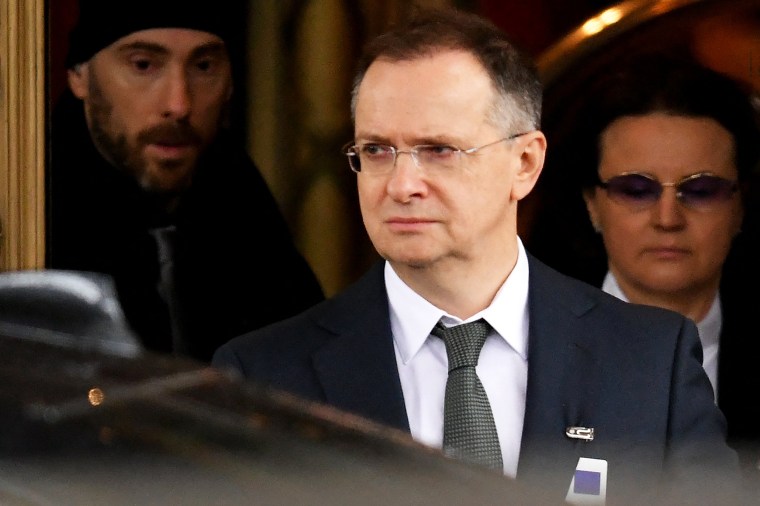
Image: SWITZERLAND-US-UKRAINE-DIPLOMACY
Vladimir Medinsky, center, leaves after two hours of talks wrapped in Geneva on Wednesday.Harold Cunningham / AFP via Getty Images

Medinsky, 55, an aide to Putin since 2020, is known as a loyal lieutenant, with interpretations of Ukrainian history that mirror those of the Russian leader himself.

The Kremlin has weaponized history to bolster its invasion, asserting that much of Ukraine has always been part of Russia, rather than an independent state. “It would seem obvious to anyone with an elementary school history background: Russians and Ukrainians are historically one people,” Medinsky wrote in a November op-ed in the Komsomolskaya Pravda newspaper.

After Medinsky's brief statement on the state of the peace talks Wednesday, a Russian reporter asked: “Were there any history lessons at least?”

Those on the other side of the table seemed to be expecting similar.

“On the road, together with colleagues, we will discuss the lessons of our history and look for the right conclusions,” Zelenskyy’s new chief of staff, Gen. Kyrylo Budanov, said in a post on X on Sunday as he made his way to Geneva.

“We don’t have time for all this s---,” Zelenskyy told Axios in an interview Tuesday, when asked about Medinsky's tendency to philosophize about the “historical roots” of the war.

NATO chief Mark Rutte suggested that the re-introduction of Medinsky into the peace process may betray Putin’s intentions.

“Is he serious, Putin, about all of this?” Rutte said at the Munich Security Conference last week. “He is again sending this historian next week to do the talks in Geneva.”
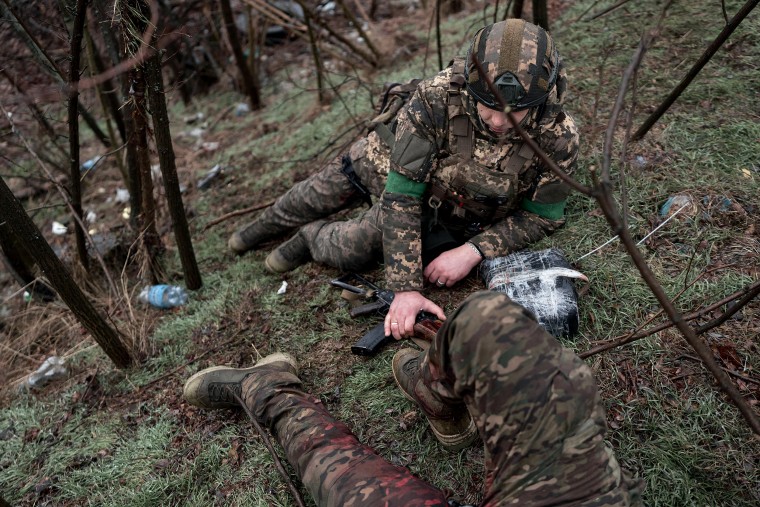
Evacuations Continue Along Kostyantynivka Frontline Corridor Under Threat Of Russian Drone Attacks
Two wounded Ukrainian soldiers lie on a road between Druzhkivka and Kostyantynivka awaiting evacuation Friday.Kostiantyn Liberov / Getty Images

Born during the Soviet era in what is now Ukraine, Medinsky studied in Moscow and holds a doctorate in history, according to his biography on the Kremlin’s website.

Medinsky has authored a number of historical books, including a hastily-written 2023 history textbook for high school seniors that echoes Kremlin justifications for its war in Ukraine and has been described by several history teachers NBC News spoke with as state propaganda.

“The fact that Medinsky is expounding these theories in supposed peace talks simply shows the gap between the outcomes that would be acceptable to either side,” said Keir Giles, author and Russia researcher at Chatham House, a London-based think tank.

“It is still the case that Russia wishes to cease the existence of Ukraine as a meaningful independent state, and Ukraine wants to survive, and the search for any common ground between those two is unlikely to produce a sustainable solution,” Giles added.

Kremlin spokesman Dimitry Peskov said Monday that Medinsky has always been the head of the Russian negotiating team, but that the first two rounds in Abu Dhabi focused on security issues and were thus led by Kostyukov. The talks in Geneva are about “a broader range of issues,” including territory, so Medinsky’s presence was “now essential,” Peskov said.

“Medinsky is essentially Putin’s hand puppet: he has no angle or agenda of his own, but can simply be relied on to convey Putin’s message faithfully and report back faithfully,” said Mark Galeotti, the British-based director of the consultancy Mayak Intelligence who has authored several books about Putin and Russia's military history.

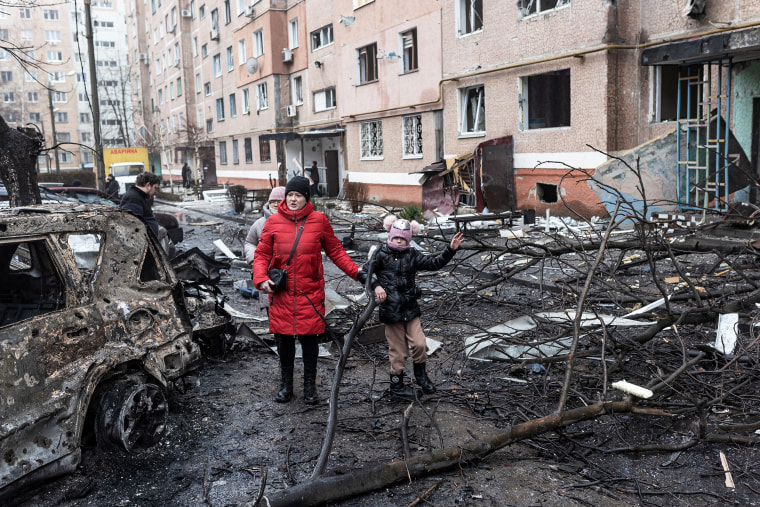
Aftermath of Russian air strike in Kramatorsk
A mother and her daughter leave their home that was damaged after a Russian airstrike in Kramatorsk, Ukraine, on Feb. 8.Diego Herrera Carcedo / Anadolu via Getty Images

The fate of Ukraine’s eastern Donbas region, which Putin insists he wants in its entirety, remains a key dividing line.

Kyiv still holds some territory in the Donbas and has ruled out ceding the land voluntarily, with Zelenskyy telling Axios that Ukrainians would never allow or forgive such an agreement.

Putin has vowed to take the land by force if diplomatic efforts fail, insisting his army has the upper hand on the battlefield. But it may not have quite the advantage he is trying to portray.

Ukraine recaptured 78 square miles of territory from Russia last week in its biggest territorial gain in the last 2 ½ years of war, according to an AFP analysis of data from the Washington-based Institute for the Study of War, which provides daily assessments of the battlefield situation.