'Money today or blood tomorrow': Europe faces crunch decision on using frozen Russian assets for Ukraine

The meeting Thursday is seen as a critical test of the group’s strength in the wake of President Donald Trump calling them weak.
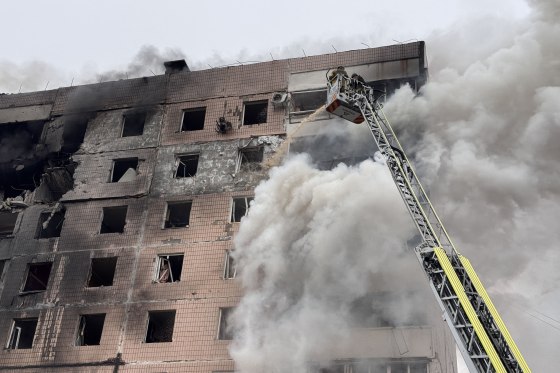
A Russian strike on an apartment in Zaporizhzhia
Firefighters tackle a blaze following a Russian strike on an apartment in Zaporizhzhia, Ukraine, on Wednesday.Darya Nazarova / AFP - Getty Images

European Union leaders will decide whether to use frozen Russian assets to lend billions of euros of cash to Ukraine to keep its war effort afloat at a summit on Thursday seen as a critical test of the group’s strength.

The E.U. sees Russia’s war as a threat to its own security and wants to keep Ukraine financed and fighting if there is no peace deal.

“We just can’t afford to fail. We have to show that we are strong,” E.U. foreign policy chief Kaja Kallas said, adding that leaders would stay as long as needed at the Brussels summit to find a solution.
The European Commission has proposed using frozen Russian central bank assets that are mostly held in a Belgian clearing house to secure a huge loan to Kyiv. But Belgium is deeply concerned about legal and financial risks, and other states including Italy have also expressed worries.

E.U. leaders arriving at the summit said it was imperative they find a solution. They were also keen to show European countries’ strength and resolve after President Donald Trump last week called them “weak.”

“Now we have a simple choice — either money today or blood tomorrow. And I am not talking about Ukraine only, I am talking about Europe,” Polish Prime Minister Donald Tusk said. “All European leaders have to finally rise to this occasion.”

European Commission chief Ursula von der Leyen said she would not leave the summit without agreement on how to finance Ukraine over the next two years.

Ukrainian President Volodymyr Zelenskyy was due to participate in the summit in person. He had previously been expected to join by video call, underlining the urgency of the situation as seen from Kyiv.
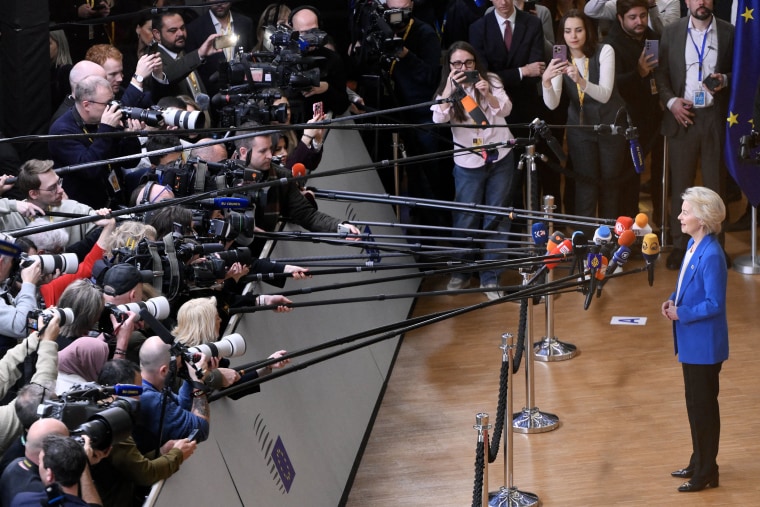
European Commission President Ursula von der Leyen at the European Council meeting in Brussels on Thursday.
European Commission President Ursula von der Leyen at the European Council meeting in Brussels on Thursday.John Thys / AFP - Getty Images

Belgian Prime Minister Bart De Wever told his country’s parliament early on Thursday that he had not yet seen guarantees that answered his concerns on legal and liquidity risks and that financing plans were still changing “as we speak.”

Russia’s central bank has said the E.U. plans to use its assets are illegal and reserved the right to use all available means to protect its interests. It filed a lawsuit in Moscow this week seeking $230 billion in damages from clearing house Euroclear.

The stakes are high because without the E.U.’s financial help Ukraine will run out of money in the second quarter of next year and most likely lose the war to Russia, which the E.U. fears would bring closer the threat of Russian aggression against the bloc.

Kallas said she saw chances of a deal on the assets at 50/50. German Chancellor Friedrich Merz said: “My impression is that we can come to an agreement.”

Sweden’s Prime Minister Ulf Kristersson said this was the most important E.U. summit since the war in Ukraine started.

“I believe and hope that we can find technical solutions to the issues that Belgium still has outstanding, but I would like to emphasize that we are not there yet,” he said.

One of the financing options could be for the E.U. to borrow the needed amount against the security of the E.U. budget and then lend the money on to Ukraine, but such a move would require unanimity among the 27 E.U. countries and Moscow-friendly Hungary has already said it would veto it.

Another option would be for each willing E.U. country itself to raise money on the market and pass it on to Kyiv, but that would mean a rise in the already high debt and deficit levels and a lack of longer-term financing certainty for Ukraine.

Diplomats said the use of the Russian assets was therefore in practice “the only game in town” and favored by most countries because it ensured a large sum for Ukraine without increasing national debts or any immediate fiscal effort.

But to use it, E.U. leaders first need to convince Belgium, which holds 185 billion euros of the total 210 billion euros frozen in Europe, that they will not leave it alone with the bill if Russia successfully sues in international courts over the plan.

The discussions among leaders on Thursday would focus on narrowing down the scope of the guarantees Belgium is asking for to a form that would also be acceptable to other E.U. countries, diplomats said, stressing a financing solution for Ukraine would be found.