CARACAS, Venezuela — At a protest last week in front of Venezuela’s Supreme Court, relatives of political prisoners held photos of their loved ones and wore white T-shirts that read “Free all political prisoners.”
While demonstrators stood hand in hand in a semicircle chanting, “Justice, justice, justice, and freedom. All are innocent. None are criminals,” police stood by and watched — something unthinkable just a couple of months ago.
“Here at the courts, they still haven’t told us where Nahuel is being held. We only know unofficially, through people who’ve been imprisoned and later released,” said Yalitza García, the mother-in-law of jailed Argentine national Nahuel Gallo.
“That’s why I’m here today — raising my voice and overcoming my fear, because fear won’t get us anywhere,” García said outside the Supreme Court, wearing a shirt that read “Freedom for all political prisoners” and clutching a photograph of her son-in-law.
Since the Jan. 3 U.S. attack on Venezuela that ousted then-President Nicolás Maduro, some Venezuelans have been more emboldened to speak out.
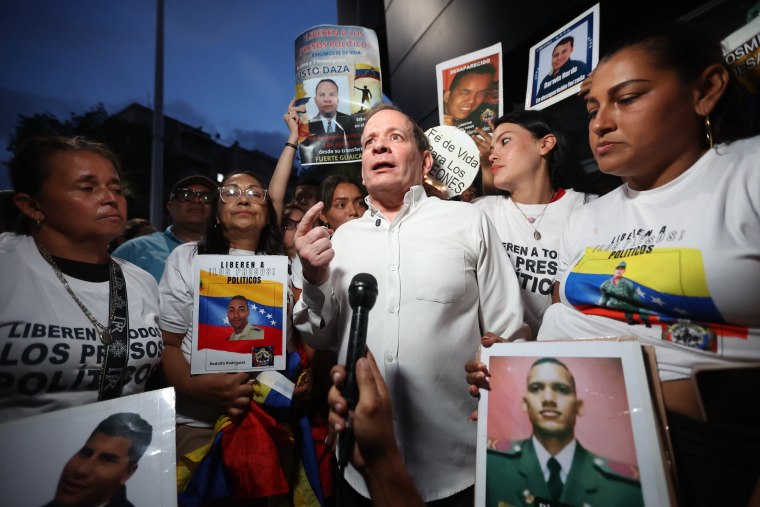
Testing their limits of the interim government, headed by acting President Delcy Rodríguez, families of political prisoners are protesting outside jails. Venezuelan broadcast channel Venevisión aired statements from opposition leader María Corina Machado while she was in the U.S. — remarks that would not have been on the air before. Other opposition figures have emerged after months of hiding and have spoken to international media.
“This type of demonstration couldn’t have happened here before. Little by little, people are losing their fear — I’ve certainly lost mine, and I’ve come to voice my outrage and demand the release of all political prisoners,” García said.
“I’m here representing my daughter, who’s in Argentina. I risk being detained myself, yet here I am,” she said, adding that what they’re doing to political prisoners “is a terrible injustice” and questioning why the government hasn’t released them as it had pledged to do.
Gallo, an Argentine national security officer who García says is innocent, was arrested in 2024 and charged with espionage and terrorism after crossing the Colombian-Venezuelan border to reunite with his partner and young son. He has been held incommunicado since then, as his family insists on his innocence and appeals to the international community and even the Vatican for his release.
In the month since the January attack, life in the country has returned to a semblance of normalcy, with more activity on the street — and more chatter about the rapid pace in which changes are taking place. While many are struggling economically, there’s a sense of hope that things are turning around for the better.
News of the U.S. Embassy reopening or international airlines returning to Venezuela has become the talk of the day for people in the country.
Vigils and protests, amid the uncertainty
At the same time, it’s unknown whether reprieves like these will last or if the interim government will eventually embrace freedom of expression. But for now, many are taking advantage. The government’s announcement that political prisoners would be freed and that the notorious El Helicoide prison, dubbed a torture center by rights activists, would be closed infused hope among many after years of self-silencing.
But there’s reason to still be cautious and on guard. Juan Pablo Guanipa, a prominent opposition leader, was freed Sunday from El Helicoide — only to be taken back into custody hours later. He’s now under house arrest after allegedly not complying with conditions imposed by the court. The confusion over his arrest dampened the mood among those who hoped the interim government would give up repressive tactics.
“What happened with Juan Pablo Guanipa demonstrates that while there is an attempt at opening — evidenced by prisoner releases — all political actors are carefully testing the boundaries,” said Lissette González, a research coordinator with the Venezuelan human rights organization Provea.
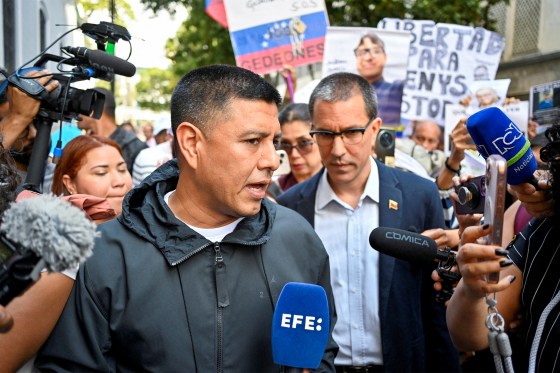
González attended a demonstration outside the National Assembly on Tuesday and said the crowd reached the building’s entrance, where they stood face-to-face with military personnel — an unthinkable scene just three months ago. Jorge Arreaza, a lawmaker and former minister of foreign affairs, went outside and allowed some families of political prisoners inside to hear their complaints.
González said there is still fear and noted the sustained protests are those led by families of political prisoners.
Outside El Helicoide, where there are constant protests, many families participate in a nightly vigil that lasts until midnight. On Jan. 8 when the release of prisoners was announced, José Mendoza traveled almost 500 miles from the state of Zulia to the capital, Caracas, demanding proof that his son is alive. He has joined the vigil ever since.
Mendoza said such a vigil would have been unthinkable before.

