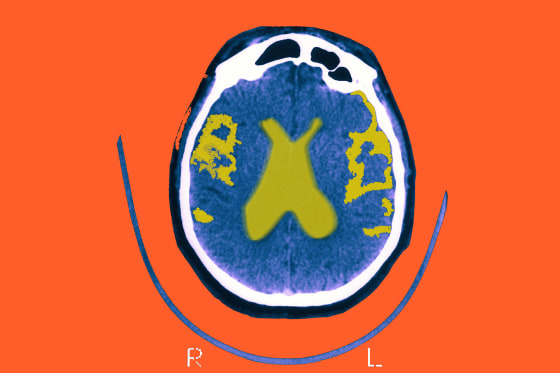
Being overweight in midlife has been linked to greater risk of developing Alzheimer’s disease or dementia, and a new study shows that brain changes in obese people mirror some of those with Alzheimer’s.
Scientists at McGill University in Montreal analyzed brain scans of more than 1,300 people in the first research to directly compare the patterns of brain shrinkage in obese people and in Alzheimer’s patients.
The scans revealed similar brain thinning in regions involved in learning, memory and judgment in both groups, according to the report published Tuesday in the Journal of Alzheimer’s Disease.
Obesity can cause changes in the body that are associated with raising the risk of Alzheimer’s, including damage to the brain’s blood vessels and the accumulation of abnormal proteins, earlier studies have found. The new research takes it a step further.
“We showed that there is a similarity between the brains of people who are obese and those with Alzheimer’s,” said the study’s first author, Filip Morys, a postdoctoral neuroscience researcher at McGill University. “And it boils down to the thickness of the cerebral cortex.”
The cerebral cortex, which in humans is responsible for higher brain functions such as speech, perception, long-term memory and judgment, is the outer layer of the brain.
Thinning in that brain region might reflect a decrease in the number of brain cells, Morys said.
The McGill researchers suspect that obese people, and possibly those who are overweight — a BMI of 25 to 25.9 — might be able to slow cognitive decline if they can get closer to a healthy weight.
Morys wasn’t able to identify a target weight.
Latest stories on weight loss
- What's it like to take Ozempic or Wegovy? From severe side effects to losing 50 pounds.
- What happens when you stop taking a weight loss drug? Many gain the weight back.
- Doctors urged to give weight counseling to women over 40. Some aren't happy about it.
Why is obesity hazardous to the brain?
The science isn't clear. Other conditions that are bad for the brain — including high blood pressure, high cholesterol and type 2 diabetes — are also connected to obesity, Morys notes.
To take a closer look at the impact of obesity on brain structure, Morys and his colleagues scrutinized brain scans from 341 Alzheimer’s patients and 341 obese individuals with a BMI of 30 or more, along with scans from 682 healthy individuals.
All of the brain scans and other information came from two large health databases: the U.K. Biobank and the Alzheimer’s Disease Neuroimaging Initiative, a program that recruits participants across North America and is funded in part by the National Institutes of Health.
Cognitive tests taken by the obese individuals in the study did not reveal obvious mental deficits, but it’s possible that subtle changes in cognition related to the thinning seen on the brain scans might not be picked up on the types of tests used to evaluate mental status, Morys said.
The new research “showed us something we didn’t know before,” said metabolism researcher Sabrina Diano, director of the Institute of Human Nutrition at the Columbia Irving Medical Center.
“The study showed that obese individuals and those with Alzheimer’s disease have common areas of the brain that are smaller in size, possibly due to a neurodegenerative process,” meaning that the nerve cells in these regions may be experiencing damage and could be dying, Diano said.
The scans can’t show that obesity is causing the thinning of these areas, but it makes sense that controlling body weight might be a way to reduce the risks, she said.
“We know that if you take a mouse that has a genetic predisposition to develop Alzheimer’s and you put that mouse on a diet rich in carbohydrates and fat —similar to the Western diet — you can induce increases in body weight in the animal and as they gain weight cognitive impairment and the brain degeneration is accelerated," Diano said.
Could weight loss reverse the damage?
The study opens the door to further exploration of whether weight loss might reverse some of the brain changes, said Dr. Joseph Malone, an assistant professor of neurology in the cognitive disorders division at the University of Pittsburgh. Malone was not involved with the study.
