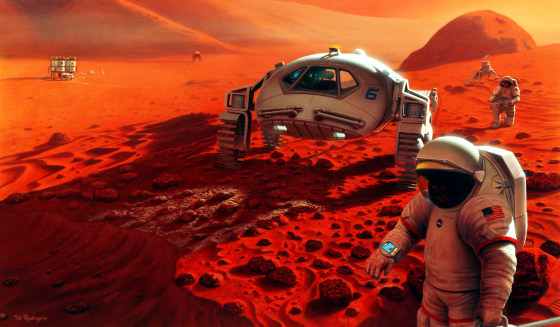
To say Robert Zubrin is passionate about Mars is a bit of an understatement. The 66-year-old aerospace engineer has devoted the better part of his life to thinking about and encouraging the exploration of Mars.
In 1998, Zubrin co-founded The Mars Society, a Lakewood, Colorado-based nonprofit, and in the years since has become an outspoken advocate for the establishment of a permanent settlement on Mars — and a harsh critic of what he considers NASA's stagnant human spaceflight program.
Recently, NBC News MACH spoke with Zubrin about why he feels so strongly that humans should colonize Mars and that NASA shouldn't build a lunar "spaceport" — and why Mars exploration is so deeply personal to him.
The interview has been edited for clarity and brevity.

MACH: NASA has sent robotic landers and rovers to Mars. Why is it important to send humans?
Zubrin: Humans are vastly more effective as explorers than robots. The most important questions about Mars are on the search for life, past and present. So we're interested in fossil hunting and we're interested in extinct life. Fossil hunting on Earth requires hiking long distances through difficult terrain, involves digging and pickaxe work. It involves delicate work, intuition, following up on clues. This is way beyond the ability of robots.
At the Mars Society, we've built two practice Mars stations: one in the desert in Utah and one in the Canadian high arctic. In the Utah station, on one of our earliest excursions, we were practicing exploring the desert as if it was Mars. We climbed down into this small box canyon and we explored it thoroughly and found this very curious-looking rock. We brought it back to the habitat and thin-sliced it, and it was definitely dinosaur bone.
We reported it to the [Bureau of Land Management]. A few years later the BLM gave the data to some professional paleontologist who came and dug the place, and it's now the largest dinosaur bone find in North America in decades. I have to tell you, no wheeled rover could have even gotten into that canyon because it was a two-meter drop to climb down into it.
As far as looking for extant life, we just discovered subsurface water on Mars — a subsurface lake. If there's life on Mars today, it's in the subsurface water. So you’d need to set up drilling rigs. Drilling down a kilometer — that's like drilling a deep oil well on Earth. These rovers can't do that. And bringing up the water, and putting it on culture mediums and trying to culture any organisms that are in it and then examining them under microscopes and doing biochemical testing — this is light-years beyond the capability of robotic rovers. If you really want to solve the problem and find the answer to the truth about life on Mars, we're going to have to send people.
A mission to Mars is one thing, but why should humans settle the Red Planet?
We should settle Mars in order to establish a new branch of human civilization or several new branches of human civilization. That will add to the strength and vitality of human culture as a whole. If you think about the spreading of western civilization to the Americas, the establishment of societies including the one that lead to the United States — Europeans got some profit, the Spanish got some gold from the Aztecs and there were some profits to be made growing tobacco in Virginia.
But the real value that Europe and the rest of the world got out of the United States was a new branch of human civilization that demonstrated the value of democracy and invented electricity and the steamboat and the telegraph and the light bulb, and essentially generated electrical power and airplanes and nuclear power and computers and iPhones.
Related

In other words, we created a new creative society that has added tremendously to human civilization as a whole. We don't terraform Mars in order to abandon the Earth. We terraform Mars to have an additional Earth.
What is the goal of the Mars Society?
To further the exploration and settlement of Mars by both public and private means. That means supporting both robotic exploration and human exploration. And it mean supporting base building, settlement, the development of technologies that enable settlement and ultimately terraforming. It also includes supporting the development of launch technologies, transportation systems that allow us to get to Mars, power systems for use on Mars.
What do you say to those who think we should settle the moon first?
I disagree with that argument, but I can respect it. I can respect the people who say, "We should go to the moon, it's closer, we know how to do it, and there's a water ice near the lunar south pole which we could make use of to help us explore the moon.” If you did do that, it would certainly restore a sense of confidence and accomplishment to the human spaceflight program.
But the Trump administration isn't doing that. If you're saying that you need to go to the moon before you go to Mars, then go to the moon. Instead, they come up with this ridiculous idea that before they go to the moon they will put a space station in orbit around the moon. You do not need a space station in orbit around the moon to go to the moon. You do not need a space station around the moon to go to Mars.
If you build such a station, the bureaucracy would unquestionably impose a requirement on all lunar missions that they go there on the way to the moon because otherwise it would look ridiculous that you built this space station that you never actually use. That will make moon missions harder to do because it's easier to go straight to the moon. It's like somebody saying: Let's build an airport in Sherbrooke, Canada, and anyone leaving New York City has to stop there on their way to London. And sure, you could do that on your way to London but it's not helping you get to London. To say nothing of all the money you're wasting on this airport in an out-of-the-way place.
The Apollo program generated tremendous excitement and fostered a sense of national unity. Could a mission to Mars do the same?
When I was growing up, the government was able to do great things. My parents, my uncles, they all participated in World War II. While I was a kid, we were building an interstate highway system, and as a teenager, we were going to the moon. You had a political class that was united around such purposes. Since then it has severely degenerated. There's a real problem here. It goes way beyond the problems of the space program in terms of fixing the American political class.
We could not build the interstate highway system today. Different factions would sabotage each other and prevent things from getting done. So it's going to take some real statecraft to put Humpty Dumpty back together again, in the terms of the U.S. government's capacity to undertake great projects. Of course, part of the reason why the American political class, in the period from the ‘40s to the ‘60s, was able to do great things was because they had been forged in the furnace of war. People understood how to get things done and how to work together. And while some of the people who did Apollo understood it as a step to human expansion to space, for much of the political class it was to win the Cold War.
Perhaps we need that sort of challenge. Maybe if we're challenged by the Chinese or the Russians, or someone takes it seriously and they rally the nation that we are going to continue to be the vanguard of humanity, and we're going to celebrate our good deeds in newspapers and not in museums, maybe they can rally the nation.
What role should commercial spaceflight companies play?
