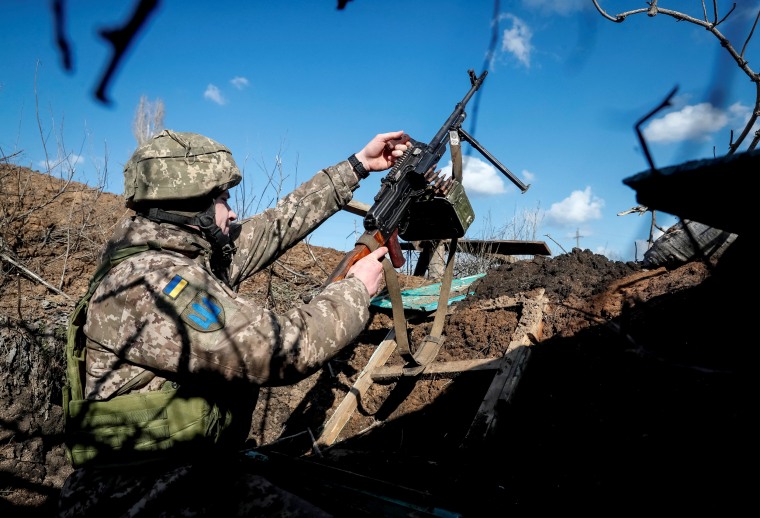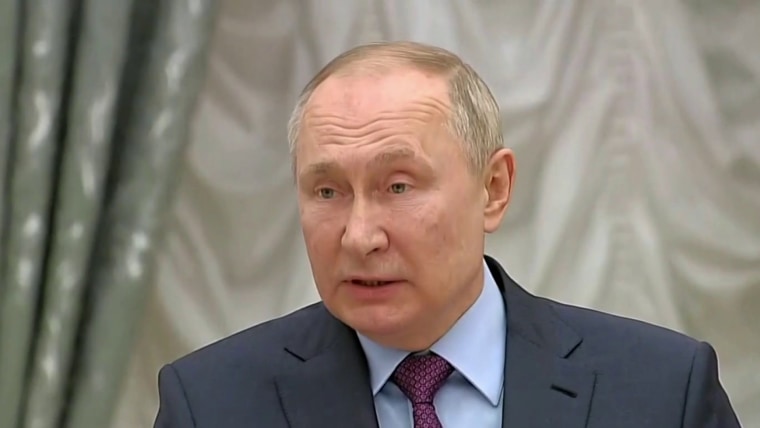
Even seasoned Kremlinologists were alarmed by Russian President Vladimir Putin's belligerent tone as he offered a monologue on why Ukraine has no right to exist.
In a lengthy televised speech Monday, Putin formally recognized the independence of two regions in eastern Ukraine — the self-proclaimed “Donetsk People’s Republic” and “Luhansk People’s Republic.” He later ordered troops to roll over the border under the guise of being “peacekeepers.”
Putin made no attempt to hide his motivations.
He described Ukraine as “historically Russian land” that was stolen from the Russian empire and has since fallen into the hands of neo-Nazis and corrupt “puppets” controlled by the West. The Russian president reiterated his claim that Ukraine was subjecting Russian speakers to “genocide” — an assertion for which there is no evidence, and which international monitors on the ground reject.
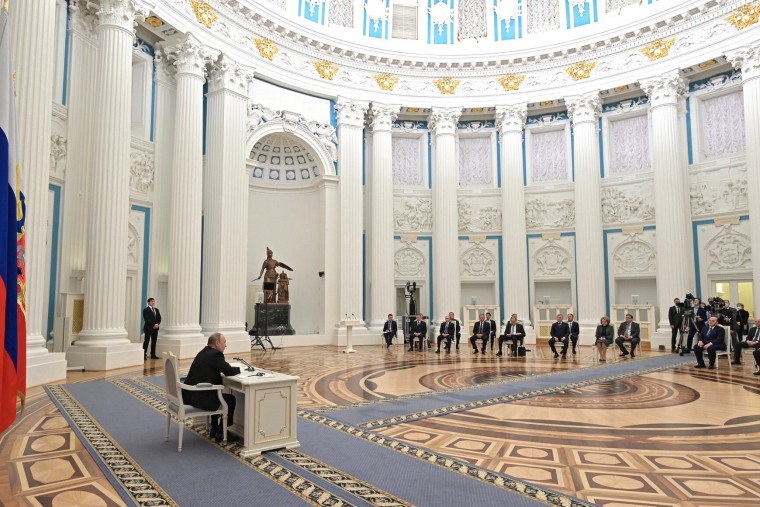
After promising to start with just "a few words about the history of this issue," he gave a lengthy revisionist account in which he claimed that Ukraine was merely a region of the old Russian empire. The modern-day country, he argued, was artificially created by Soviet leader Vladimir Lenin after the Communist revolution of 1917.
In one line that some seasoned Ukraine observers saw as an open threat, he suggested that Ukrainians who have toppled statues of Lenin were erasing their country's basis for existing.
“You want decommunization?” he said. “Very well. We are ready to show what real decommunization would mean for Ukraine.”
While Ukraine struggles with corruption and has a neo-Nazi far right, it is a democracy and the picture on the ground is nuanced. A popular uprising overthrew its pro-Russia leader in 2014, and today most Ukrainians support its path of Western integration, polls show.
In all, Putin’s not-so-brief summary of Ukraine’s past was dismissed as revanchist and inaccurate by historians, and amounted to “a screed of ahistorical grievances,” the former chess champion and arch Putin critic Garry Kasparov tweeted.
Timothy Snyder, a history professor at Yale University, told MSNBC on Monday that Putin's take was "surreal."
"It’s very strange," he said, "when you’re surrounded by the reality of Ukrainian history, to hear a distant tyrant declare that the thing doesn’t exist. Obviously he’s wrong."
Ukraine as a modern and independent country came into being in 1991 after the fall of Communism and it ceased to be a Soviet republic.
Snyder explained that Lenin did not create Ukraine, but rather his recognition of it as a distinct Soviet republic came about precisely because he recognized there was an existing national identity that needed to be addressed.
Ukrainian nationalism went back 100 years before the beginning of the Soviet Union, and elements of Ukrainian history go back to the Middle Ages, Snyder said.
“This kind of language, that another nation doesn’t exist, is something we need to pay attention to because it usually precedes atrocious actions,” he added.
On Tuesday, the U.S. Embassy in Kyiv shared a meme based on the fact that Kyiv predates Moscow as a city.
It is not clear what those actions might be. Will Russian troops remain confined to the Moscow-backed separatist regions in the country’s east, itself widely seen as a violation of international law? Or is this just the opening salvo in a broader war on the rest of Ukraine?
There are some, such as Dmitri Trenin, director of the Carnegie Moscow Center, a think tank, who believe that there will be “no major war.” The “stabilization of the frontline” in eastern Ukraine is Putin’s short-term goal, he tweeted.