Nuclear program, missiles or regime change: Trump struggles to define Iran war goals
Trump and senior figures in his administration castigated previous presidents for dragging the U.S. into protracted wars in Iraq and Afghanistan. His administration says this time will be different.
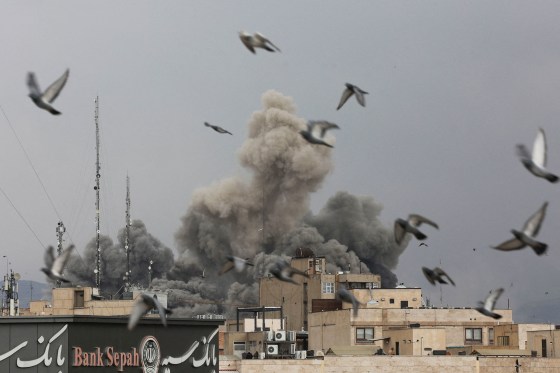
Smoke rises after an explosion Monday in Tehran.Majid Asgaripour / WANA via Reuters
President Donald Trump’s strikes on Iran were decisive, killing the country’s supreme leader and many of his lieutenants. His rationale for launching the war and definition of victory have been less clear.
Among his reasons for launching the strikes: Trump said he wanted to eliminate “imminent threats” to the United States; he accused Tehran of trying to rebuild the nuclear program he said had been “obliterated” in June; and he warned that its ballistic missiles could soon strike the U.S. Referring to Iran’s proxy forces, which have targeted Americans dating back to the 1980s, he said that “this was our last, best chance to strike.”
Senior administration officials have also offered varied explanations for the strikes, and struggled to coalesce around a narrative. Defense Secretary Pete Hegseth said the operation was not about regime change, even though Trump invited Iranians to “seize control of your destiny.” And Secretary of State Marco Rubio on Monday said Israel was about to attack Iran, and Tehran would then retaliate — so the U.S. had to act pre-emptively.
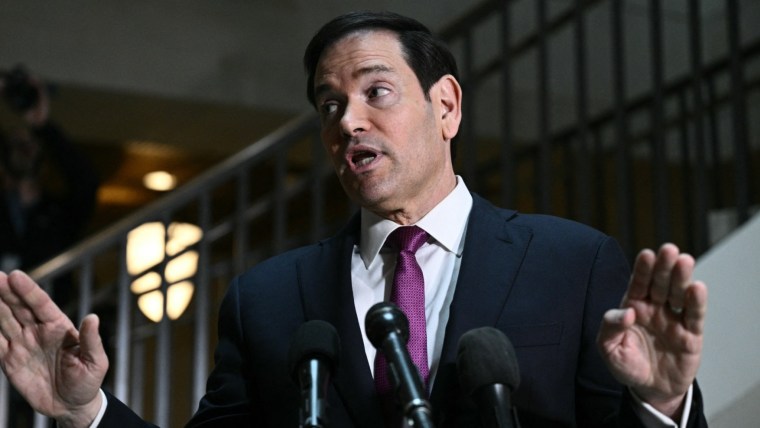
“We were not going to sit there and absorb a blow before we responded,” Rubio told reporters before a briefing to congressional leaders Monday.
The assault on Iran came after weeks of diplomatic efforts and threats by the president, but in the long windup to war, Trump did not devote much time to making the case to the American people — or to Congress, which is set to vote on a war powers resolution this week, after the battle has already started. Now, Trump is facing pushback from right-wing political commentators, and must strike a balance with supporters who elected him because he was opposed to “forever wars.”
Democrats have condemned the decision, saying the president and his deputies have failed to make a case why the U.S. needed to attack Iran, calling it “a war of choice” that lacked a clear endgame. Meanwhile, the conflict widens in the Mideast with no end in sight, as the U.S. and Israel continue to launch airstrikes and Iran retaliates.
“The president has been all over the place,” Sen. Richard Blumenthal, D-Conn., said. “He’s in effect workshopping a war. It’s like he’s a kid with a puzzle trying to fit the pieces together in a way that creates a picture.”
President Donald Trump meets with Secretary of State Marco Rubio, White House chief of staff Susie Wiles and others at Mar-a-Lago on Saturday.Daniel Torok / White House via Getty Images
Sen. Mark Warner, D-Va., the vice chairman of the Senate Intelligence Committee, said “there was no intelligence that showed an immediate, imminent threat.” He added: “That should be normally the criteria.”
Trump and his deputies are gambling that America’s formidable air power will deliver success and cripple Iran, reducing if not removing the threat once posed by a regime that has been a thorn in the side of the United States for nearly 50 years.
Underscoring the uncertainty and risks associated with the campaign, Trump and Hegseth refused to rule out the possibility of deploying ground troops to wage war against Iran. And even as the effects of the war spread across the region, with Iranian retaliatory strikes causing casualties in Israel and Arab states and pushing up oil prices, Trump said the war could last at least four to five weeks or possibly longer.
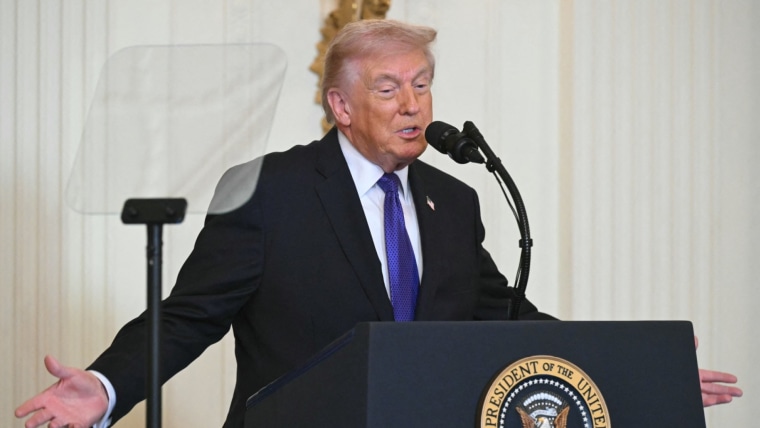
“Whatever it takes,” the president said at a Medal of Honor ceremony at the White House on Monday.
But this time, Trump has backed a much larger attack on Iran with a list of ambitious goals that have raised questions about the prospects for success and the rationale for launching it.
In his speech posted online Saturday announcing the aerial assault on Iran, Trump outlined several objectives: to prevent Iran from ever having a nuclear weapon, to ensure it cannot threaten the U.S. or its allies with ballistic missiles, to degrade Tehran’s proxy forces, destroy its navy and to trigger the collapse of the Iranian regime.
“The administration has put up a pretty high bar” for success, said Mark Cancian at the Center for Strategic and International Studies.
Some of the objectives are within reach, he said.
Waves of aerial attacks by U.S. and Israeli forces could seriously damage Iran’s missile arsenal, further damage its nuclear program and deal a blow to its navy, Cancian and other defense analysts said. It could weaken Iran for months or years, making the nation less of a danger to the U.S. and its allies in the region.
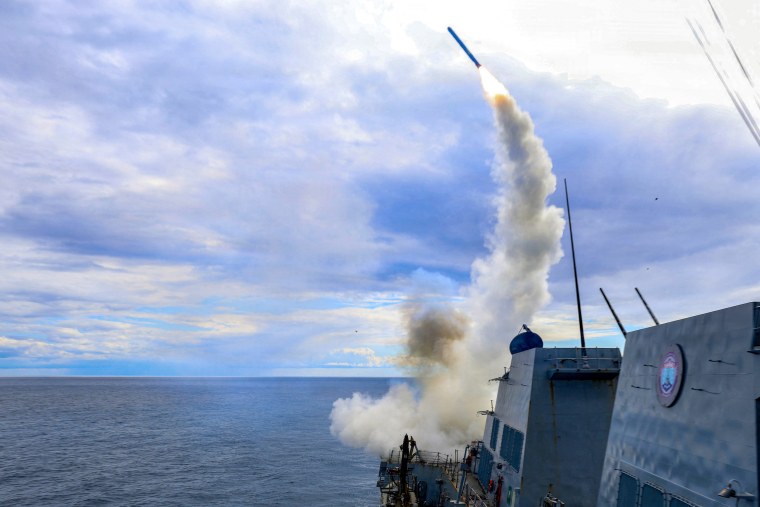
A Tomahawk missile fires Sunday from the USS Thomas Hudner.U.S. Navy via AFP - Getty Images
Some former officials and military officers said the operations were going reasonably well at this initial stage; Iran’s retaliatory strikes had been mostly deflected and there was a realistic chance of destroying much of Iran’s missile and naval assets.
But it’s less clear how airstrikes alone would cause Iran to cut off its support for proxies in Iraq, Lebanon or Yemen, or whether the targeting of Iran’s leadership would cause the regime to unravel, as Trump has predicted, experts said.
Without an armed opposition on the ground, airstrikes alone likely cannot topple a regime that has shown it is ready to gun down protesters by the thousands, experts on Iran and former intelligence officials said.
Trump, however, appears open to a scenario that unfolded in Venezuela in January, when after American special forces captured the president, Nicolas Maduro, U.S. officials forged a pragmatic understanding with the regime’s vice president who succeeded Maduro, Delcy Rodriguez. Maduro and his wife are being held in the U.S. and have pleaded not guilty to drug conspiracy charges.
“What we did in Venezuela, I think, is the perfect, the perfect scenario,” Trump told the New York Times.
During George W. Bush’s presidency, as his administration headed for a possible invasion of Iraq, his secretary of state, Colin Powell, warned of the perils of ousting a regime, saying: “Once you break it, you are going to own it.”
But Trump appears to have a different view, that removing a regime leader doesn’t have to impose any burdens of ownership.
He promised the Iranian people over the weekend that “the hour of your freedom is at hand,” telling them to “seize control of your destiny and to unleash the prosperous and glorious future that is close within your reach. This is the moment for action. Do not let it pass.”
Iran’s government, with its Revolutionary Guard Corps as its backbone, is less malleable than Venezuela’s regime and will oppose capitulating to U.S. demands, according to Danny Citrinowicz, senior researcher at the Israel-based Institute for National Security Studies think tank.
“Iran is not Venezuela. There is no Delcy Rodriguez,” Citrinowicz said. “Iran is not based on one significant leader … No one in this regime will work with the U.S. especially after the killing of Khamenei.”
For the moment, the clerical regime in Iran appears determined to dig in and absorb the blows of much more powerful adversaries, with the overarching goal of hanging on to power at all costs, former officials and analysts said.
“This is not Iraq. This is not endless,” Hegseth said.
“Trump “called the last 20 years of nation building wars dumb, and he’s right,” Hegseth told reporters. “This is the opposite. This operation is a clear, devastating, decisive mission, destroy the missile threat, destroy the Navy, no nukes.”
But Trump has kept his vision of victory ambiguous, stopping short of articulating exactly what would represent a successful campaign.
“There are many outcomes that are good,” Trump told NBC News on Sunday. “Number one is decapitating them, getting rid of their whole group of killers and thugs. And there are many, many outcomes. We could do the short version or the longer version,” he said.