Live updates: Trump vows new tariffs after 'deeply disappointing' Supreme Court decision
The Supreme Court's decision does not affect all of Trump's tariffs but invalidates those implemented using a 1977 law called the International Emergency Economic Powers Act.
What to know
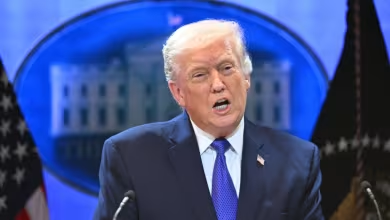
- TRUMP RESPONDS: President Donald Trump called the Supreme Court's decision to strike down his power to impose sweeping global tariffs under a national security law, "deeply disappointing" at a news conference this afternoon. The president said he was "ashamed" of some of the justices over the ruling and that they were "very unpatriotic and disloyal to our Constitution." He also announced that he would impose a temporary 10% global tariff under the Trade Act of 1974, a different law from the one that the court said did not grant him tariff authority.
- COURT OPINION: The Supreme Court ruled that Trump exceeded his authority when imposing sweeping tariffs using a law reserved for a national emergency. The decision does not affect all of Trump’s tariffs, but invalidates those implemented using a 1977 law called the International Emergency Economic Powers Act (IEEPA).
- 6-3 RULING: Conservative Chief Justice John Roberts wrote for the majority that Trump had asserted "extraordinary power to unilaterally impose tariffs of unlimited amount, duration and scope,” but had pointed to no statute that said the IEEPA could apply to tariffs. In dissent, fellow conservative Justice Brett Kavanaugh said the decision probably would not restrict presidential tariff authority going forward, but would create a “mess” for the government, including by requiring billions of dollars in refunds to businesses.
- U.S. AND GLOBAL REACTION: Democrats and some Republicans lauded the ruling as a victory for U.S. consumers and an affirmation of the separation of powers, while other GOP lawmakers pledged to help Trump re-establish his tariffs. Small business groups and their allies also applauded the ruling, with some calling for refunds for their tariff payments. But reaction from U.S. trading partners was mixed, with some saying they were reviewing the opinion and emphasizing the need for economic stability.
Thune says Senate will ‘continue working’ with Trump administration
Senate Majority Leader John Thune, R-S.D., reacted to the Supreme Court’s decision in a post on X, writing, "Senate Republicans will continue working with the administration and our colleagues in the House to advance our shared goal to strengthen rural America, including South Dakota’s farm and ranch communities, and the broader U.S. economy.”
Thune has been selectively outspoken regarding his opposition to the use of tariffs, but wrote in his post, "Tariffs can be an important and effective tool to address unfair trade practices and help level the playing field with foreign competitors.”
FACT CHECK: Trump's remarks on the Supreme Court's IEEPA decision
FACT CHECK: “Very powerful alternatives that have been approved by this decision.”
TRUMP: “But it doesn’t matter, because we have very powerful alternatives that have been approved by this decision. You know, they’ve been approved by the decision.”
While the Court didn’t “approve” any alternatives, Associate Justice Brett Kavanaugh did explain that the president has other options to tariff in his dissent: “Although I firmly disagree with the Court’s holding today, the decision might not substantially constrain a President’s ability to order tariffs going forward. That is because numerous other federal statutes authorize the President to impose tariffs and might justify most (if not all) of the tariffs at issue in this case—albeit perhaps with a few additional procedural steps that IEEPA, as an emergency statute, does not require. Those statutes include, for example, the Trade Expansion Act of 1962 (Section 232); the Trade Act of 1974 (Sections 122, 201, and 301); and the Tariff Act of 1930 (Section 338). In essence, the Court today concludes that the President checked the wrong statutory box by relying on IEEPA rather than another statute to impose these tariffs.”
FACT CHECK: “I’m not allowed to charge even $1”
TRUMP: “To show you how ridiculous the opinion is, however, the court said that I’m not allowed to charge even $1. I can’t charge $1. Can’t charge $1 “
This is correct. Trump cannot use the International Emergency Economic Powers Act to tariff other countries for even $1.
FACT CHECK: “I GUESS IT HAS TO BE LITIGATED FOR THE NEXT TWO YEARS”
TRUMP: “Wouldn’t you think they would have put one sentence in there saying that, keep the money, or don’t keep the money, right? I guess it has to get litigated for the next two years.”
It’s more complicated than this, but in layman’s terms, the federal government can just refund, using tariff receipts. They don’t HAVE to get into litigation here.
FACT CHECK: “We have a right to do pretty much what we want to do”
QUESTION: “Mr. President, the 122 tariffs, that 10% is that going to be for 150 days? Or do you want to charge that indefinitely?”
TRUMP: “We have a right to do pretty much what we want to do, but we’re going to charge it starting effectively. I think it’s three days from now.”
The Trump administration does not have a right to do “pretty much what we want to do.” Section 122 of the Trade Act of 1974 allows the president to institute a “temporary import surcharge” of up to 15% if he finds there are “large and serious” balance-of-payments deficits, to prevent an “”imminent” and “significant” depreciation of the US dollar in foreign exchange markets. This is temporary, though — these are not to exceed 150 days unless extended by Congress.
FACT CHECK: “FOREIGN INTERESTS,” TRUMP SAYS, “HAVE A LOT OF INFLUENCE OVER THE SUPREME COURT”
QUESTION: What did you mean a moment ago when you said that the Supreme Court has been swayed by foreign interests?
TRUMP: Well, I think that foreign interests are represented by people that I believe have undue influence. They have a lot of influence over the Supreme Court, whether it’s through fear or respect or friendships, I don’t know, but I know some of the people that were involved on the other side, and I don’t like them. I think they’re real slime balls, and got to do what’s right for the country.
There is currently no publicly available evidence Supreme Court justices are being influenced by foreign actors.
SBA administrator says Trump's tariffs are 'essential' to address what she described as a 'national emergency'
Kelly Loeffler, the administrator of the Small Business Administration, said Trump's tariffs are a necessary response to what she considers a "national emergency."
In a post on X, Loeffler said she believes tariffs are needed to fix “decades of predatory foreign trade barriers imposed against American workers and small businesses.”
"Fair trade is a matter of national and economic security. America cannot continue to yield our national strength through dependency on countries like China," she said.
"Small businesses want FAIR trade. Our adversaries want nothing more than a return to the status quo. We ARE a nation of builders once again — it’s why fair trade is the only path forward," she added.
Vance decries ruling as 'lawlessness' by the Supreme Court
Vice President JD Vance described the Supreme Court's ruling as "lawlessness" in a post on X.
"Today, the Supreme Court decided that Congress, despite giving the president the ability to 'regulate imports,' didn’t actually mean it. This is lawlessness from the Court, plain and simple," he said.
Vance said the only effect of the decision is to "make it harder for the president to protect American industries and supply chain resiliency."
"President Trump has a wide range of other tariff powers and he will use them to defend American workers and advance this administration’s trade priorities," he said.
Bessent: Reimposing tariffs under other legal authorities will result in 'virtually unchanged' revenue
Treasury Secretary Scott Bessent, speaking in Dallas, echoed Trump in saying that the administration is going to rework the administration's sweeping import taxes under other legal authorities after the Supreme Court's ruling earlier today.
"This administration will invoke alternative legal authorities to replace the IEEPA tariffs," he said. "We will be leveraging Section 232 and Section 301 tariff authorities that have been validated through thousands of legal challenges."
Bessent added that an estimate calculated by the Treasury Department found that using these other authorities will "result in virtually unchanged tariff revenue in 2026."
Trump criticizes Justices Gorsuch and Barrett over tariff ruling
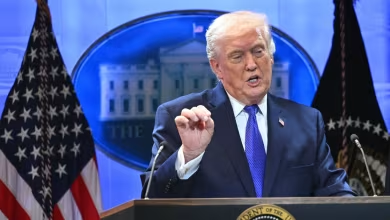
Trump blasted Justices Neil Gorsuch and Amy Coney Barrett when he was asked if he regrets nominating them to the Supreme Court after this decision.
"I think their decision was terrible," he said. "I think it’s an embarrassment to their families, you want to know the truth, the two of them."
Trump suggests he won't refund companies that paid for tariffs
Trump suggested that the administration doesn't plan to refund companies that paid for his tariffs over the last year because the Supreme Court didn't address that in the ruling.
"I guess it has to get litigated for the next two years. So they write this terrible, defective decision, totally defective. It's almost like not written by smart people," he said.
Asked if he doesn't plan to honor refunds to companies, Trump told reporters, "I just told you the answer, right? I told you the answer. It's not discussed. We'll end up being in court for the next five years."
Trump again suggests 'foreign interests' influenced court's ruling
Trump again, without evidence, claimed that foreign interests influenced the court's decision.
"I think that foreign interests are represented by people that I believe have undue influence," he said. "They have a lot of influence over the Supreme Court, whether it’s through fear or respect or friendships, I don’t know."
"But I know some of the people that were involved on the other side, and I don’t like them," Trump added. "I think they’re real slimeballs."
The president suggested that without tariffs, foreign countries have been and will continue to outperform the U.S. in certain industries, including the automobile industry.
"This should have been done by presidents many years ago," Trump said. "They allowed our country to be eaten alive."
10% global tariff is a big downgrade of Trump's sweeping duties
If implemented as Trump described it in his press conference, a 10% global tariff would be a major downgrade of the president's sweeping import duties.
Moving all global trading partners to a 10% levy would cut tariffs on nearly all foreign nations except the U.K., which secured a 10% tariff last year.
However, that global tariff would not cut the duties on semiconductors, autos, car parts or pharmaceuticals, which have been imposed under other legal authorities.
Trump says he doesn't need Congress to enact his tariffs
Trump said he doesn't need Congress to enact the tariffs struck down today by the Court, and that he would do so through the executive branch.
However, when asked about getting Congress to enact the tariffs, Trump said: "I would ask Congress, and probably get it."
Trump says he will sign an order today imposing a 10% global tariff
Trump announced in his remarks that he will sign an order today to "impose a 10% global tariff under Section 122."
He said this would be "over and above our normal tariffs already being charged."
"We’re also initiating several sections, 301 and other investigations to protect our country from unfair trading practices of other countries and companies," he said.
Section 122 allows the president to temporarily institute a “temporary import surcharge” of up to 15% if he finds there are “large and serious” balance-of-payments deficits, to prevent an “imminent” and “significant” depreciation of the U.S. dollar in foreign exchange markets.
Trump praises Justice Brett Kavanaugh
Trump praised and thanked the three justices who dissented today, Justices Kavnaugh, Thomas and Alito, in an unusual fashion that defies presidential norms.
Trump particularly had strong words for Kavanaugh, suggesting that the justice lost money in the stock market today.
"I would like to thank justice Kavanaugh for his, frankly, his genius and his great ability," he said. "Very proud of that appointment in actuality."
Kavanaugh wrote the court's dissenting opinion on the tariff case.
Trump accuses Supreme Court justices of being 'swayed by foreign interests'
Trump accused the Supreme Court justices responsible for striking down his power to impose sweeping tariffs as being "swayed by foreign interests."
"It’s my opinion that the court has been swayed by foreign interests and a political movement that is far smaller than people would ever think," Trump said, addressing reporters in a briefing today. "It’s a small movement."
Trump went on to further criticize the court, saying the ruling means he cannot charge any country $1 under the International Emergency Economic Powers Act.
"This must have been done to protect those other countries, certainly not the United States of America, which they should be interested in protecting," Trump said. "That’s what they’re supposed to be protecting."
Trump ties tariff ruling to voter fraud
Trump, unprompted, brought up voter fraud, a frequent talking point of his, when denouncing the tariffs ruling.
"I won by millions of votes. We won in a landslide. With all the cheating that went on, there was a lot of it, we still won in a landslide too big to rig," he said.
"But these people are obnoxious, ignorant and loud," Trump added. "They’re very loud, and I think certain justices are afraid of that. They don’t want to do the right thing. They’re afraid of it."
Trump called the justices "lap dogs for RHINOS and the radical left" and “very unpatriotic and disloyal to our Constitution.”
Trump bashes decision, admonishes justices who ruled against tariffs
In his remarks in the White House briefing room, Trump denounced the Supreme Court decision striking down his tariffs and admonished the six justices who ruled against them.
Trump called the decision "deeply disappointing" and said he's "ashamed of certain members of the court, absolutely ashamed for not having the courage to do what's right for our country."
He praised the three conservative justices who dissented.
"I'd like to thank and congratulate Justices Thomas, Alito and Kavanaugh for their strength and wisdom and love of our country, which is, right now, very proud of those justices," he said.
He added about the justices who struck down the tariffs, "They're against anything that makes America strong, healthy and great again. They also are a, frankly disgrace to our nation, those justices, they're an automatic no."
Trump is now speaking
Trump is addressing reporters about the tariffs decision, which he calls a "shame."
Gov. Hochul says Trump's tariffs 'hit New Yorkers hard'
New York Gov. Kathy Hochul said during a briefing after attending a governors' breakfast hosted by Trump that his administration's policies on tariffs have "hit New Yorkers hard."
"My rural communities have been hit hard by this," Hochul said. "The farmers with additional costs for everything from their feed and their fertilizer that only comes from places like Canada and Ukraine, they have been struggling enormously for the last year, as well as the cost of so many products in our stores and groceries going up and up and up."
Hochul said these are among the reasons that New York and other states brought a lawsuit against Trump's administration to the Supreme Court.
"I think the Supreme Court, many of whom are appointees by the president, sided with supporting the Constitution and doing what's right," Hochul said. "So, we support this decision, and hope that we can continue to find ways to work together to drive down costs, not do the opposite, as we saw tariffs do in our state."
Mitch McConnell says 'no room for doubt' Trump tariffs were 'illegal'
Sen. Mitch McConnell, R-Ky., a former longtime leader of his party in the Senate and frequent Trump critic, said in a statement on the Supreme Court's ruling that the decision "reaffirmed authority that has rested with Congress for centuries."
“As a matter of policy, the empty merits of sweeping trade wars with America’s friends were evident long before today’s decision," McConnell's statement said. "The American people already know that when Washington throws up artificial barriers, building and buying here at home become more expensive. Kentuckians whose livelihoods depend on auto manufacturing, agricultural commodity markets, or demand for bourbon whiskey understand this painful reality better than most."
McConnell added that the Constitution — and the court's decision — had now left "no room for doubt: the use of IEEPA to circumvent Congress in the imposition of tariffs — already without precedent — is also illegal. "
“If the executive would like to enact trade policies that impact American producers and consumers, its path forward is crystal clear: convince their representatives under Article 1,” the statement said.
Shipping company DHL says it would play role in potential refunds
Shipping company DHL said it would help ensure that its customers receive any refunds following the Supreme Court's tariffs decision.
"We are closely monitoring the legal developments regarding IEEPA tariffs to ensure our customers are positioned to exercise their full rights under the law," the company said in a statement. "We would play a technical role in the process, leveraging our customs brokerage technology to track filings to ensure that if refunds are authorized, our clients receive their capital back accurately and efficiently."
House speaker pledges to help Trump implement more tariffs
House Speaker Mike Johnson, R-La., praised Trump's tariffs in a post on X, saying Congress and the administration would "determine the best path forward in the coming weeks" in response to the tariffs ruling.
Trump's tariffs have "brought in billions of dollars and created immense leverage for America’s trade strategy and for securing strong, reciprocal America-first trade agreements with countries that had been taking advantage of American workers for decades," Johnson wrote.
Rep. Abe Hamadeh, of Arizona, also backed Trump's tariffs, saying the policy "has been extraordinary successful.” He added that he would “continue to work with the Administration on ensuring President Trump’s tariff policy continues, whether through existing executive action, or through Congress.”
But other House Republicans offered more mixed responses to the ruling. Rep. French Hill, of Arkansas, who chairs the Financial Services Committee, said that while "tariffs can be a useful tool when applied in a targeted way," the Supreme Court decision "underscores the need for Congress to play a role in trade policy."
Business Roundtable says Trump administration should 'recalibrate' tariffs approach
The Business Roundtable, which represents the top CEOs across many industries, said that the Trump administration should now "recalibrate its approach to tariffs, focusing on targeted actions to address specific unfair trade practices and national security concerns."
The group also encouraged "coordination between the United States and its allies." Still, its CEO, Joshua Bolten, said "the Administration has made significant strides to strengthen America’s competitiveness."
"A stable trading system with more focused tariffs would help unleash America’s full economic potential," Bolten added.
The group's board is stacked with major executives from every U.S. industry, from JPMorgan Chase CEO Jamie Dimon to General Motors CEO Mary Barra. CEOs of The Home Depot, the Nasdaq stock exchange, Hilton, FedEx and other household-name companies are also a part of the group.
Trump learned of tariffs decision during speech to governors
According to a governor in the room with Trump, the president was speaking at the podium and he was handed a note about the Supreme Court's tariffs decision. He commented on the outcome to the room and called it “a disgrace.” Then he left.
Trump to hold a press conference on SCOTUS decision
Trump will hold a press conference at 12:45 p.m. ET today on the Supreme Court's ruling, White House press secretary Karoline Leavitt said in a post on X.
It does not appear that the press conference was previously scheduled.
A brief history about tariffs in the First Congress of 1789
In the majority opinion, Chief Justice John Roberts noted that the first major piece of legislation that Congress passed in 1789 was a tariff law.
Indeed, tariffs were top of mind for Congress when it met for the first time under the new Constitution that year. The federal government had been weak under the Articles of Confederation, with no power to tax, impose tariffs or regulate commerce.
The new Constitution gave Congress the power to “lay and collect Taxes, Duties, Imposts and Excises.” So when the First Congress met in 1789, its first major bill enacted in July imposed tariffs on imported goods. The Journal of the House shows that Congress spent considerable time debating and working on the tariff legislation.
The legislation said “it is necessary for the support of government, for the discharge of the debts of the United States, and the encouragement and protection of manufactures, that duties be laid on goods, wares and merchandises imported.”
Trump administration official downplays ruling
U.S. Chief of Protocol Monica Crowley downplayed the Supreme Court's ruling in a post on X, in one of the first public reactions to the decision from members of the Trump administration.
"President Trump has plenty of tools in the tariff toolbox," Crowley said. "Don’t be a Panican! Trust Trump."
GOP senator wants Republicans to reinstate tariffs, but that will be difficult
Sen. Bernie Moreno, R-Ohio, is calling on Republicans to use the procedure called reconciliation to craft a piece of legislation to reinstate Trump’s tariffs with just a simple majority, the same process that the GOP used to pass his "big beautiful bill."
Moreno’s idea could likely hit a dead end in Congress for two reasons:
The Senate has twice voted in a bipartisan fashion to undo Trump’s tariffs — once in relation to tariffs imposed on Brazil and again for tariffs on Canada. During both votes, a group of Republicans joined Democrats in passing those resolutions, which never became law.
For his part, Trump has said he is not interested in using reconciliation again after he enacted the One Big Beautiful Bill using the tactic.
In addition, pursuing Moreno's strategy may not be politically beneficial for Republicans ahead of this year's midterm election, where affordability will be top of mind for voters. Democrats would likely be more than happy for Republicans to have an extended debate in Congress about whether to vote to increase prices for consumers to allow Trump to proceed with his trade strategy.
Canadian trade minister says Supreme Court ruling reinforces that tariffs are "unjustified"
Dominic LeBlanc, Canada's top official for U.S.-Canadian trade matters, said in a post on X that today's ruling "reinforces Canada’s position that the IEEPA tariffs imposed by the United States are unjustified."
He added that Canada is "working to create growth and opportunities on both sides of the border, while strengthening our collaboration with reliable trading partners and allies around the world."
LeBlanc added that Canada would still work to support businesses facing tariffs under other statutes that remain in place.
'It's huge': Stationery store thrilled about tariff ruling
Nearly everything Chaya Cohen Tamir sells at her stationery store in Brooklyn, New York, comes from overseas — and she said she's paid thousands of dollars in tariffs.
So she says the Supreme Court's tariff ruling today is huge.
"This is an incredible win for the American people," said Tamir, owner of The Analog Stationer. "Small businesses like ours have either eaten the cost or have passed the cost on to consumers by raising the prices. And as it is, we're working with really small margins."
Notebooks, fountain pens, mechanical pencils, calendars and planners are just some of the items they get from abroad.
"The supply chain is six countries long," said Tamir. "It’s not like you make it in your backyard."
"Everything is coming from everywhere, because that’s how the system is" she added.
Tamir said she still gets multiple tariff bills a week, sometimes for hundreds of dollars. She said she has had to pass some of the cost on to her customers.
"Usually what I'll do is I'll raise the price of a single item like by $1 so it's negligible, and I'll eat some of the cost," said Tamir. "I hope this changes things. I hope it takes effect very, very quickly."
White House confirms dates of Trump's trip to China
Trump's trip to China will take place between March 31 and April 2, a White House official confirmed this morning.
Trump's tariffs on China are one of the largest he imposed using the method that was struck down today.
Top E.U. lawmaker: Supreme Court ruling "positive signal for the rule of law"
Bernd Lange, the chair of the E.U. parliament’s international trade committee, said the Supreme Court ruling today was a “positive signal for the rule of law.”
“Judges have shown that even an U.S. president does not operate in a legal vacuum,” Lange said.
He also wrote that “the era of unlimited, arbitrary tariffs” may soon “be coming to an end."
Lange said the European Union's parliament will hold an emergency meeting Monday regarding the trade deal Trump inked with the bloc last summer.
The E.U. parliament has been working for months to fully implement the terms of the trade deal that would have lowered tariffs for U.S. and European businesses.
Rep. Don Bacon calls the ruling 'common sense'
Bacon, one of the six House Republicans who recently voted to undo U.S. tariffs on Canada, praised the Supreme Court's ruling.
“The Constitution’s checks and balances still works. Article One gives tariff authority to Congress. This was a common sense and straight forward ruling by the Supreme Court," he said in a statement.
Bacon, who's not running for re-election, said he feels "vindicated" because he's been making the same argument over the last year.
"In the future, Congress should defend its authorities and not just rely on Supreme Court," he said. "Besides the Constitutional concerns I had on the Administration’s broad-based tariffs, I also do not think tariffs are smart economic policy. Broad-based tariffs are bad economics.”
U.S. Chamber of Commerce applauds tariffs ruling
The U.S. Chamber of Commerce applauded today's ruling as "welcome news for businesses and consumers."
“We encourage the administration to use this opportunity to reset overall tariff policy in a manner that will lead to greater economic growth, larger wage gains for workers, and lower costs for families," the group said.
The group filed an amicus brief in the case on behalf of small businesses suing the Trump administration.
Sen. Rand Paul says ruling will prevent a future president from using powers to 'enact socialism'
Sen. Rand Paul, R-Ky., a frequent critic of Trump, said in a post on X that "the Supreme Court struck down using emergency powers to enact taxes.”
"This ruling will also prevent a future President such as AOC from using emergency powers to enact socialism," he wrote.
He also wrote in another post on X that the justices ruling against the tariffs "makes plain what should have been obvious."
Trump called Supreme Court decision a 'disgrace' but said he has a backup plan
Trump was informed of the Supreme Court’s decision to strike down most of his tariff policy while he was meeting with a bipartisan group of governors and called the ruling a “disgrace,” according to a person familiar with his reaction. He also told the room this morning that he had a backup plan, per this person.
The White House has yet to comment formally.
Ruling 'provides much-needed certainty for U.S. businesses and manufacturers,' retail trade group says
The National Retail Federation, one of the top trade groups for retailers and manufacturers, says that today's ruling "regarding tariffs provides much-needed certainty for U.S. businesses."
"Clear and consistent trade policy is essential for economic growth, creating jobs and opportunities for American families," the NRF said, while adding: "We urge the lower court to ensure a seamless process to refund the tariffs to U.S. importers."
"The refunds will serve as an economic boost and allow companies to reinvest in their operations, their employees and their customers.”
More than $130 billion in tariffs have been collected under the IEEPA law, which the Supreme Court struck down.
British government says it will work with Trump administration to 'understand how the ruling will affect tariffs'
The British government says it will get in contact with the Trump administration to figure out how today's Supreme Court ruling will impact trade with the U.S.
"This is a matter for the U.S. to determine but we will continue to support U.K. businesses as further details are announced," a government spokesperson said in an emailed statement.
"The U.K. enjoys the lowest reciprocal tariffs globally, and under any scenario we expect our privileged trading position with the U.S. to continue."
The spokesperson said that Prime Minister Keir Starmer's government "will work with the Administration to understand how the ruling will affect tariffs for the UK and the rest of the world."
Democrats vow to still attack House Republicans on tariffs in midterm elections
A spokesperson for House Majority PAC, which is aligned with House Democratic leadership, today vowed that the group would continue to campaign against Republicans for their support of tariffs, saying that though the tariffs are struck down, the Supreme Court decision doesn’t “rewrite history.”
“The Supreme Court’s decision clarifies the law, but it doesn’t rewrite history. Vulnerable House Republicans repeatedly voted to enable Trump’s tariffs, which raised prices and wreaked economic havoc on American families and businesses,” HMP spokesperson Katarina Flicker said. “Their constituents have paid the price, and House Majority PAC will ensure Republicans are held accountable for their votes come November.”
In a separate statement, a spokesperson for the Democratic Congressional Campaign Committee, the campaign arm for House Democrats, blasted Trump and House Republicans for “wreak[ing] havoc” on Americans, saying that they’re committed to taking the House back in November.
“Americans deserve a Congress that will put people before politics — which means no longer bending the knee to an out-of-touch President and rolling back these reckless tariffs — which will happen when Democrats re-take the House majority in November,” Courtney Rice, a DCCC spokesperson, said.
Sen. Bernie Moreno calls Supreme Court a 'betrayal'
In a post on X, Sen. Bernie Moreno, R-Ohio, a close ally of the president, called the Supreme Court decision a "betrayal" as he voiced disagreement with the ruling, which he called "outrageous."
"SCOTUS’s outrageous ruling handcuffs our fight against unfair trade that has devastated American workers for decades. These tariffs protected jobs, revived manufacturing, and forced cheaters like China to pay up. Now globalists win, factories investments may reverse, and American workers lose again," Moreno wrote. "This betrayal must be reversed and Republicans must get to work immediately on a reconciliation bill to codify the tariffs that had made our country the hottest country on earth!"
Sen. Elizabeth Warren says Americans 'should get their money back'
Sen. Elizabeth Warren, the top Democrat on the Senate Banking Committee, said in a post on X that Americans should "get their money back" after paying for the tariffs.
"No Supreme Court decision can undo the massive damage that Trump's chaotic tariffs have caused," the Massachusetts senator wrote.
Warren, the former head of the Consumer Financial Protection Bureau which protects American consumers, added, "The American people paid for these tariffs and the American people should get their money back."
'A big win': American farmer calls tariff ruling 'wake-up call'
When the Supreme Court struck down Trump’s tariffs today, one farmer said he felt immediate relief.
“I got a big win,” John Boyd, president and founder of the National Black Farmers Association, told NBC News in a phone interview. “The Supreme Court is still the law of the land. And I think they got this one right.”
Boyd described the ruling as a “personal victory,” calling it a long-overdue pushback after months of what he characterized as economic turmoil.
“This is a relief from a man-made crisis,” he said. “The president made the crisis.”
Boyd said Trump’s tariffs drove up general input costs — including fertilizer, diesel and machinery parts — and hurt heavily produced commodities such as corn, wheat and soybeans by disrupting export relationships with major buyers like China.
“We lost all of our export buyers in this country,” Boyd said, adding that the industry lost close to $57 million. If refunds are provided, he said, he would use the money to pay off outstanding bills.
Still, Boyd cautioned the ruling “doesn’t fix everything” but that the decision sends an important message for the future.
“This is a wake up call to this president that you can’t run this country like the Wild Wild West,” he said. “The damage has been done but we still got to go forward in this country … I think in the long run that this Supreme Court decision will help with that.”
Plaintiffs in tariffs case applaud ruling for small businesses
Some of the plaintiffs in the tariffs case are lauding the high court's decision this morning, saying that it will eventually help small businesses that were hurt by the president's trade policies.
Sara Albrecht, chair of the Liberty Justice Center, which led the fight on tariffs for small businesses, said in a statement, "We intend to help small businesses navigate the refund process, including developing a centralized database, information portal, and referral network to connect affected companies with qualified attorneys to pursue potential refund claims.”
MicroKits LLC founder David Levi said that he's been in a "constant state of worry" since the president imposed his tariffs in 2025. "How much will my next tariff bill be? Does it even make sense to run my workshop and do final assembly in the U.S.? I had to cut production just to survive, and that meant thousands of kids across the country missed out on a new educational musical toy under their Christmas tree," he said.
“It will take time to recover from these tariffs, but with this new legal clarity I can finally start growing my business again," he continued. "I’ll have a lot of catching up to do in 2026!”
The CEO of Terry Precision Cycling, Nik Holm, said that the ruling is a relief for his employees in Burlington, Vermont, and at his manufacturing facility in Washington state.
"Though it will be many months before our supply chain is back up and running as normal, we look forward to the government’s refund of these improperly-collected duties," he said. “We’re grateful to the Liberty Justice Center and the legal team for their zealous and effective advocacy. The stakes were monumental, and the rule of law won.”
E.U. reviewing Supreme Court ruling, seeking 'clarity' from White House
The European Union, America's largest trading partner, says it is "carefully" analyzing today's ruling.
"We remain in close contact with the U.S. Administration as we seek clarity on the steps they intend to take in response to this ruling," said Olof Gill, the European Commission's trade spokesman. The European Commission negotiates international trade matters on behalf of the E.U.'s 27 member countries.
"Businesses on both sides of the Atlantic depend on stability and predictability in the trading relationship. We therefore continue to advocate for low tariffs and to work towards reducing them," he added.
Trump could reimpose tariffs using several other statutes
Although the Supreme Court has struck down the president's tariffs, several U.S. statutes would allow Trump to reimpose tariffs if he chooses to do so.
Those include Section 338 of the Tariff Act of 1930, Section 232 of the Trade Expansion Act of 1962, Section 201 of the Trade Act of 1974, Section 301 of the Trade Act of 1974 and Section 122 of the Trade Act of 1974.
In his dissent of today’s decision, Justice Brett Kavanaugh pointed to at least one of these statutes — Section 232 of the Trade Expansion Act of 1962 — as one way the president could get around today’s decision.
“With respect to tariffs in particular, the Court’s decision might not prevent Presidents from imposing most if not all of these same sorts of tariffs under other statutory authorities,” Kavanaugh, a conservative justice, wrote.
Congress could also act to reimpose the president's tariffs, though the Senate has voted to rebuke Trump's tariffs on Canada, and it's unlikely that Democrats in either chamber would vote in favor of imposing tariffs.
Major small-business group lauds decision
The Main Street Alliance, an organization that represents 30,000 small-business owners, applauded the court's decision and called for refunds.
"The administration framed these tariffs as strength. What our members experienced was chaos. Rates jumping overnight. No phase in. No planning horizon," the group wrote in a statement. "The Court just reminded everyone that emergency powers are not a blank check. Now the focus should be on refunding the businesses that were effectively taxed under an unlawful framework."
Small businesses, which don't have the cash reserves or scale of much larger companies, bore the brunt of much of Trump's tariff policies, which raised prices on imported goods. Those higher costs, along with other strains, forced small businesses to shed tens of thousands of jobs last year.
Justice Gorsuch warns about separation of powers
Justice Neil Gorsuch, who was one of three justices appointed by Trump, warned about the separation of powers in his concurrence striking down the president's tariffs.
"And without doctrines like major questions, our system of separated powers and checks-and-balances threatens to give way to the continual and permanent accretion of power in the hands of one man," he wrote. "That is no recipe for a republic."
Sen. Chuck Schumer calls for an end to Trump's trade war in light of Supreme Court decision
Senate Minority Leader Chuck Schumer, D-N.Y., praised the Supreme Court's ruling on tariffs this morning, writing in a post on X that it's a "victory for the wallets of every American consumer."
"Trump’s illegal tariff tax just collapsed — He tried to govern by decree and stuck families with the bill," Schumer said. "Enough chaos. End the trade war."
What action has Congress taken on tariffs?
On Feb. 11, the House voted to terminate the national emergency that Trump declared last year when he implemented tariffs on Canada.
The vote was 219-211. Six Republicans voted with almost all Democrats to approve the measure, including Reps. Thomas Massie of Kentucky, Kevin Kiley of California, Jeff Hurd of Colorado, Don Bacon of Nebraska, Dan Newhouse of Washington and Brian Fitzpatrick of Pennsylvania. One Democrat voted against it: Rep. Jared Golden of Maine.
The joint resolution led by Democratic Rep. Gregory Meeks of New York is now in the Senate. Meeks had vowed to bring more measures like this for other tariffs when the House returns next week.
Republicans had passed language last year that turned off the House’s ability to terminate these national emergencies but that language expired at the end of January. Republicans then tried and failed to extend that ban until late July.
Top Democrats on financial committees celebrate ruling as 'victory' for American public
The top Democratic lawmakers on key financial committees in the House are celebrating the Supreme Court ruling, declaring it a "victory" for the American people.
"Congress writes trade law, and today’s ruling restores that fundamental truth. The Constitution is clear, and no president can invent powers they do not have," Rep. Richard Neal, D-Mass., ranking member on the House Ways and Means Committee, wrote on X. "Democrats fought hard for this win for the American people, but our work to lower costs doesn’t stop here."
In a statement, Rep. Brendan Boyle, D-Pa., ranking member on the House Budget Committee, said the high court rejected what amounted to a "national sales tax on hardworking Americans."
"Trump’s tariffs weakened our economy, hurt American workers, and made it harder for families to make ends meet," he said. "Trump will try to do this again another way because he is intent on continuing his unhinged economic sabotage. Today’s decision is an important step toward protecting families and restoring basic economic fairness."
Trump lamented over Supreme Court in days leading up to decision
Speaking with reporters yesterday, Trump lamented about the Supreme Court potentially overruling his tariffs.
"We’re taking in hundreds of billions of dollars," Trump said. "We’re going to be taking in next year $900 billion in tariffs, unless the Supreme Court said you can’t do it. Can you believe it? That I have to be up here, trying to justify that?"
Calling the policy "common sense," Trump pointed to the $12 billion in economic revenue he said it funded for farmers who were “taken advantage of by many, many foreign nations.”
"Without tariffs, this country would be in so much trouble right now,” he argued.
In his dissent, Justice Kavanaugh warns refunds of billions of dollars would have 'significant consequences' for U.S. Treasury
In his dissent, Justice Brett Kavanaugh wrote that the court's decision is "not likely to greatly restrict Presidential tariff authority going forward," but he warned that it will cause a "mess" for the government.
"But the Court’s decision is likely to generate other serious practical consequences in the near term. One issue will be refunds. Refunds of billions of dollars would have significant consequences for the U. S. Treasury," he wrote.
"The Court says nothing today about whether, and if so how, the Government should go about returning the billions of dollars that it has collected from importers. But that process is likely to be a 'mess,' as was acknowledged at oral argument," he added.
Small-business coalition calls for immediate tariff refunds
We Pay the Tariffs, a coalition of more than 800 small businesses from around the U.S., responded to the Supreme Court decision by demanding immediate refunds to businesses for the tariffs they’ve paid.
“A legal victory is meaningless without actual relief for the businesses that paid these tariffs. The administration’s only responsible course of action now is to establish a fast, efficient, and automatic refund process that returns tariff money to the businesses that paid it," the group said in a statement. "Small businesses cannot afford to wait months or years while bureaucratic delays play out, nor can they afford expensive litigation just to recover money that was unlawfully collected from them in the first place. These businesses need their money back now."
The statement added that businesses have had to freeze hiring or take out loans to offset the cost of tariffs over the last year.
Chief Justice Roberts cites lack of historical precedent in ruling against tariffs
The Supreme Court, in a 6-3 decision, has ruled against Trump's tariffs he imposed using IEEPA. Chief Justice John Roberts wrote the majority opinion with Justices Clarence Thomas, Samuel Alito and Brett Kavanaugh dissenting.
“The Government reads IEEPA to give the President power to unilaterally impose unbounded tariffs and change them at will,” Roberts writes in his opinion. “That view would represent a transformative expansion of the President’s authority over tariff policy."
Roberts said it was "telling that in IEEPA’s half century of existence, no President has invoked the statute to impose any tariffs, let alone tariffs of this magnitude and scope." He said the lack of historical precedent, "coupled with the breadth of authority that the President now claims, suggests that the tariffs extend beyond" Trump's authority.
Thomas, in his dissent, wrote that “neither statutory text nor the Constitution provide a basis for ruling against the President."
He said, “The Court has long conveyed to Congress that it may vest the president with large discretion in matters arising out of the execution of statutes relating to trade and commerce with other nations.”
U.S. stocks jump after Supreme Court strikes down most of Trump’s tariffs
U.S. stocks rose today in the minutes after the Supreme Court said that President Donald Trump could not impose sweeping tariffs under the International Economic Emergency Powers Act.
In the moments after the decision, the broad-based S&P 500 went from trading in the red to jumping 0.5%. The Nasdaq, which more closely tracks tech companies, soared 0.6%.
The yield on U.S. Treasury bonds jumped across maturities. Yields on the 10-year bond, which mortgage rates often track closely, rose to 4.09%. The 30-year Treasury yield rose to 4.74%.
The U.S. dollar jumped against other currencies, such as the British pound, Euro and Japan’s yen, a signal that investors are taking the Supreme Court decision favorably. The dollar’s strength can often correlate to trust in U.S. assets and stability.
What is the International Emergency Economic Powers Act?
The legal question at the heart of the ruling is whether a 1977 law called the International Emergency Economic Powers Act, or IEEPA, which allows the president to regulate imports when there is an emergency, extended to the power to impose global tariffs of unspecified duration and breadth.
The Constitution states that the power to set tariffs is assigned to Congress. IEEPA, which does not specifically mention tariffs, says the president can “regulate” imports and exports when he deems there to be an emergency, which occurs when there is an “unusual and extraordinary threat” to the nation.
Until Trump began his second term in January, no president had ever used the law to tariff imports.
During arguments, justices had appeared skeptical of Trump's tariffs
Prior to today's ruling, lower courts had ruled against the Trump administration, with both sides asking the Supreme Court to issue a definitive ruling.
During arguments last year, Chief Justice John Roberts, one of the court’s conservatives, noted that “the imposition of taxes on Americans” has always “been the core power of Congress,” a fact that was echoed by other justices in their questioning.
“The statute doesn’t use the word tariff,” Roberts said.
Or as liberal Justice Elena Kagan told Solicitor General D. John Sauer: “It has a lot of actions that can be taken under this statute. It just doesn’t have the one you want.”
Supreme Court strikes down most of Trump’s tariffs in a major blow to the president
Delivering a major blow to Trump, the Supreme Court ruled that he exceeded his authority when imposing sweeping tariffs using a law reserved for a national emergency.
The justices held that Trump’s aggressive approach to tariffs on products entering the United States from across the world was not permitted under a 1977 law called the International Emergency Economic Powers Act (IEEPA).
It is a rare setback for the administration at the Supreme Court, which has a 6-3 conservative majority, since Trump began his second term in January.
