President Donald Trump’s administration has emerged as a staunch defender of Alternative for Germany, a political party with Nazi echoes that has risen in popularity — and that German intelligence officials recently classified as a “proven right-wing extremist organization.”
The party is known by its German initialism, AfD, and it has included leaders who have embraced old Nazi slogans and minimized the atrocities of Adolf Hitler and the Holocaust.
Vice President JD Vance and Secretary of State Marco Rubio have criticized the German government’s efforts to isolate and investigate AfD, arguing that such actions amount to undemocratic persecution of a rival political group.
“It’s one thing to say that a particular set of views is gross ... or somehow outside the Overton window, outside the bounds of reasonable discourse,” Vance said in an interview last week in Rome, where he attended Pope Leo XIV’s inaugural Mass. “I think that it is very, very dangerous to use the neutral institutions of state — the military, the police forces ... the intel services — to try to delegitimize another competing political party. I think that’s especially true when that political party just got second in an election and is, depending on which poll you believe, either the [most] popular or the second-most popular party.”
Meanwhile, billionaire Elon Musk, a Trump confidant who has wielded significant White House power, has gone further than Vance and Rubio, having campaigned with AfD ahead of elections in February, when the party finished in second place and further established its popularity.
“Only the AfD can save Germany,” Musk posted on X, his social media site, in December.
The Rubio-led State Department reinforced the Trump administration’s line Tuesday.
In a post on Substack, Samuel Samson, a senior adviser in the department’s Bureau of Democracy, Human Rights and Labor, wrote that the German government “has established elaborate systems to monitor and censor online speech under the guise of combating disinformation and preventing offense.”
Samson specifically cited the recent decision to label AfD as extremist. He also raised concerns about the treatment of far-right parties and leaders in other European countries, including Marine Le Pen, whose recent embezzlement conviction in France could prevent her from running for president in a 2027 race she had been favored to win.
“Americans are familiar with these tactics. Indeed, a similar strategy of censorship, demonization, and bureaucratic weaponization was utilized against President Trump and his supporters,” Samson wrote. “What this reveals is that the global liberal project is not enabling the flourishing of democracy. Rather, it is trampling democracy, and Western heritage along with it, in the name of a decadent governing class afraid of its own people.”
Samson added that “Europe’s democratic backsliding not only impacts European citizens but increasingly affects American security and economic ties, along with the free speech rights of American citizens and companies.”
“Our hope,” he continued, “is that both Europe and the United States can recommit to our Western heritage, and that European nations will end the weaponization of government against those seeking to defend it.”
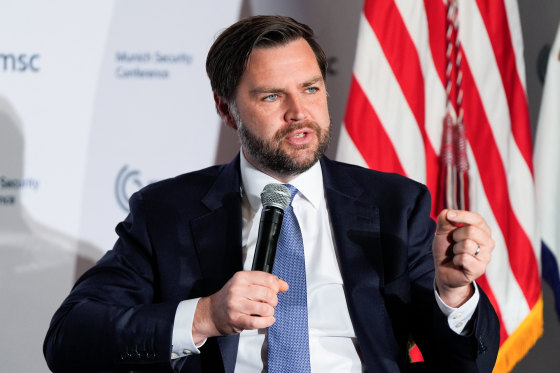
Vance emphasized similar themes in a speech in February at the Munich Security Conference, where he chastised German leaders for, among other things, refusing to include AfD in the country’s governing coalition despite its electoral gains. While he was in Germany, Vance met with Friedrich Merz, now the chancellor, and with Alice Weidel, a co-chair of the AfD.
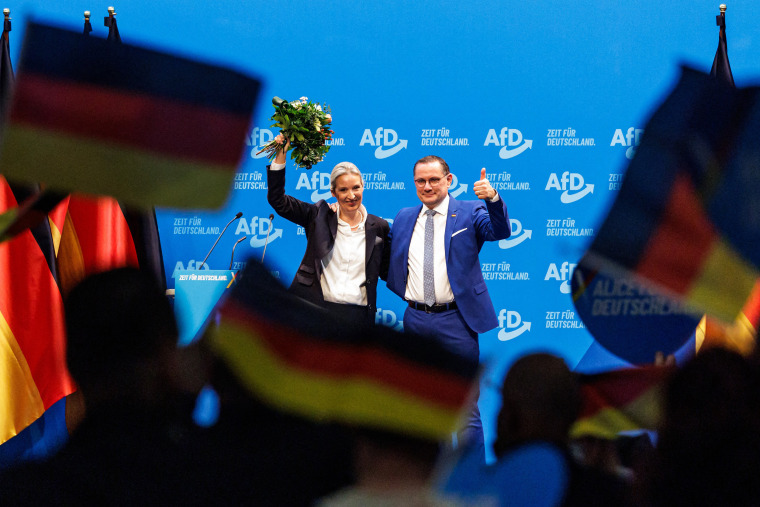
An AfD spokesperson did not respond to a request for comment. The party has long denied the charge that it is an extremist group, and it sued Germany’s Federal Office for the Protection of the Constitution over the intelligence agency’s recent classification. A spokesperson for the agency, citing the lawsuit, declined to comment.
During last week’s interview, Vance emphasized that he has not endorsed AfD or encouraged Germans to support it. He described his and Rubio’s advocacy as a matter of democratic principles.
Trump’s first campaign for president in 2016 fed on chants by his supporters to “lock her up!” — a reference to his Democratic rival, Hillary Clinton, who had not been charged with any crime. More recently, he and his allies accused former President Joe Biden, who beat Trump in his 2020 re-election bid, of weaponizing the Justice Department against Trump and other Republicans.
The Trump administration launched an investigation this month of former FBI Director James Comey, a Trump critic who had shared on social media a photo of seashells arranged to spell out “8647.”
Trump allies interpreted the message as an assassination threat, noting that “86” can be a slang term for getting rid of something and that Trump is the 47th president. Trump’s director of national intelligence, Tulsi Gabbard, has called for Comey to be imprisoned over the post. But the number 86 does not always have violent connotations; it’s use in the hospitality industry can refer to removing or refusing service to a customer.

