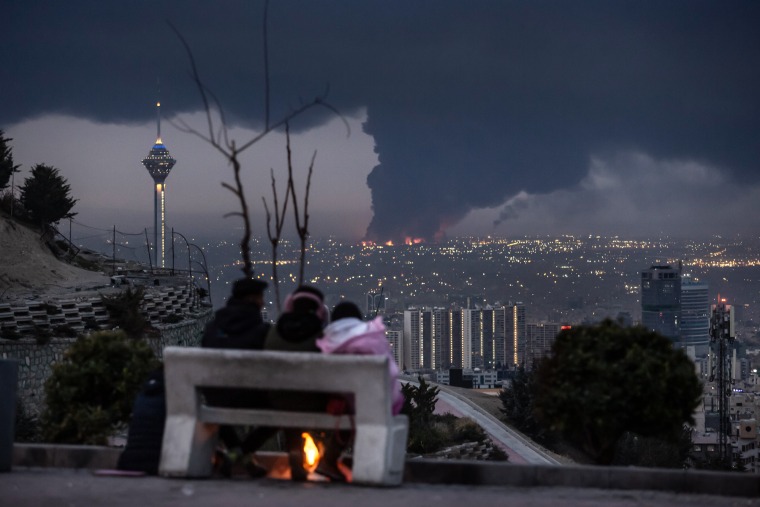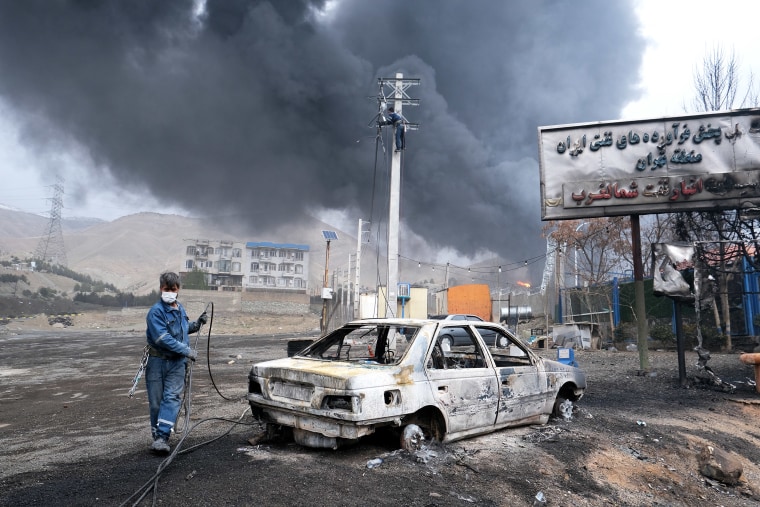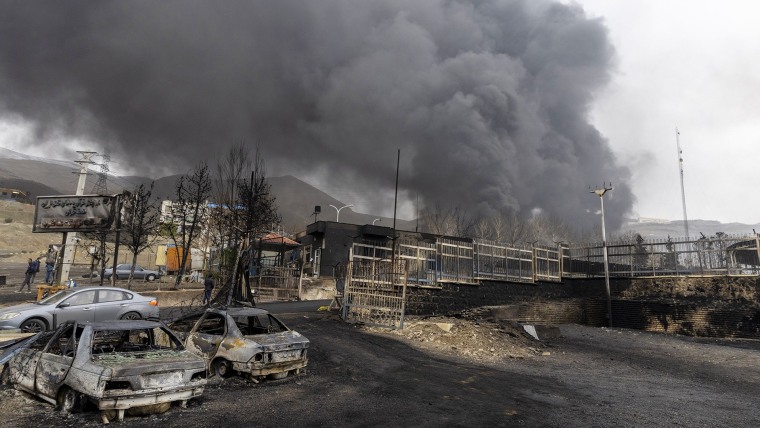
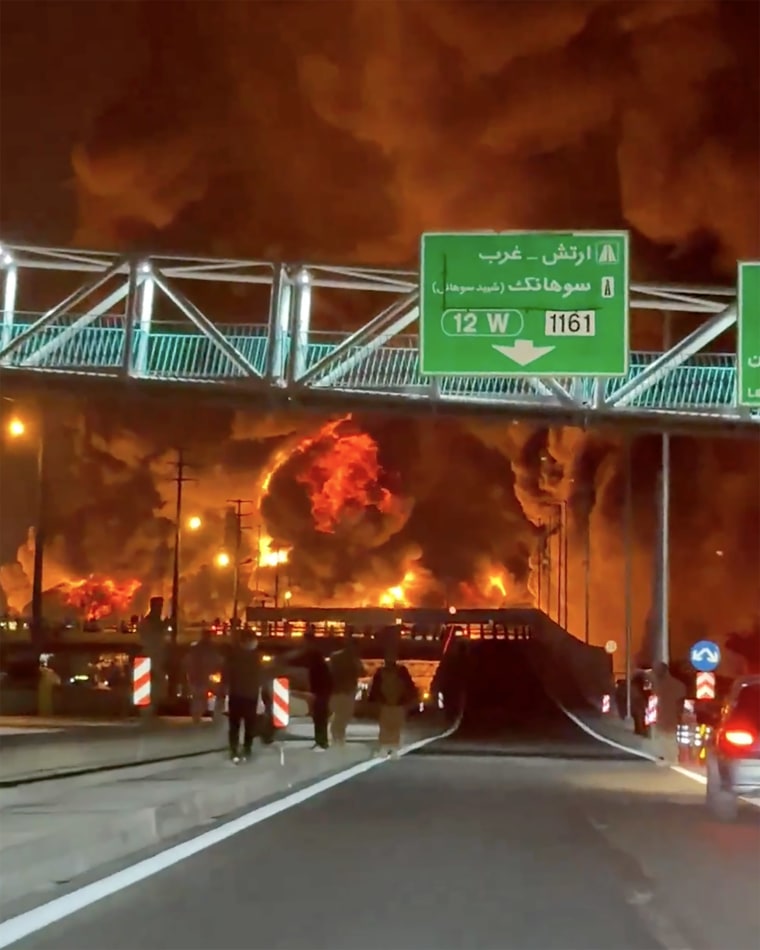
Thick black smoke billowed into the sky, making day seem more like night. Toxic rain mixed with oil fell from the air, while a central boulevard was lined by a wall of flame.
This was the scene in Tehran on Sunday following a night of Israeli airstrikes on the city’s oil facilities. It may also capture the mood of international markets as the intensifying war in the Middle East sends energy prices soaring and threatens a period of global economic uncertainty.
In the Iranian capital, authorities said Israeli strikes hit a number of oil and gas facilities in and around the city. In one video geolocated by NBC News, roiling orange flames and belching smoke could be seen rising from the Aghdasieh fuel depot in the city’s northern Tajrish district.
The cloud of smoke blanketed the Iranian capital to such an extent that noon looked more like 10 p.m., according to residents. They reported the smoke left them unable to leave their homes — and barely able to breathe inside.
“I am sitting at home with a headache, and my mouth tastes bitter,” Armita, 42, told NBC News on Sunday from inside the city. “It was terrible,” said Mina, 70, who reported that even after the rain had dispersed much of the worst of it, “you can still smell the smoke.” NBC News is only using their first names, given the tense security situation inside the country.
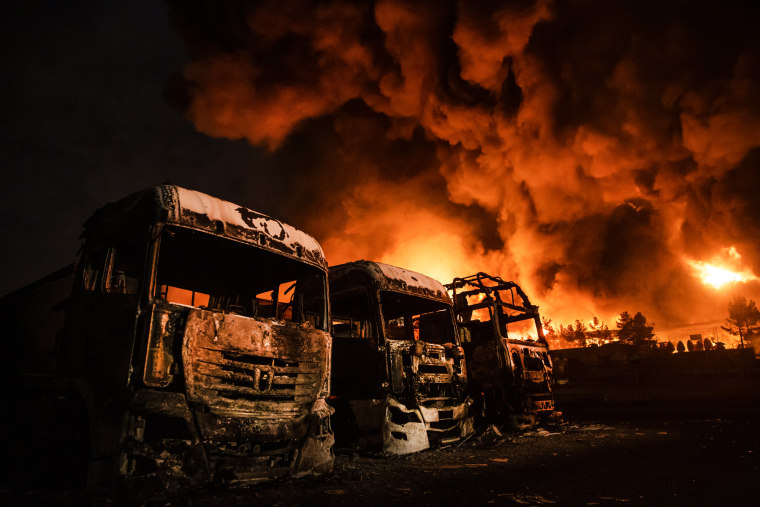
The Israel Defense Forces confirmed in a statement that on Saturday night, it had bombed fuel storage facilities in Tehran.
The Iranian Environmental Protection Organization warned people to stay indoors, as the explosions had released large amounts of toxic hydrocarbons and sulfur and nitrogen oxides.
The rainfall that followed could be “highly acidic and dangerous, causing chemical burns to the skin and severe lung damage,” it said. “If the rain contacts skin, do not rub it, rinse immediately with cold running water.”
Along with the precipitation, the oil itself ejected into the air by the explosions fell on cars and people. In at least one street, oil ran into the gutter of Koohsar Boulevard, in the city’s Shahran neighborhood, according to videos geolocated by NBC News.
Iranian Foreign Ministry spokesman Esmaeil Baqaei said the attacks amounted to no less than intentional chemical warfare.
“The aggressors are releasing hazardous materials and toxic substances into the air, poisoning civilians, devastating the environment, and endangering lives on a massive scale,” Baqaei wrote on X.
Tehran has been a focal point of the war, slammed by strikes from the United States and Israel that have shaken windows and given residents sleepless nights. Some have taken to standing on rooftops to watch the incoming attacks.
As the sky filled with black smoke Sunday, security forces directed traffic while wearing special coats and masks to protect themselves.
Carried out by the Israeli military, the attacks may show that “the risk appetite in the U.S. and Israel in terms of the mission is different,” according to Michael Stephens, a senior associate fellow at the Royal United Services Institute, a think tank based in London.
He said it was a recurring theme throughout this conflict: “There are different U.S. and Israeli timelines, mission goals and objectives, and a lack of alignment” on the risks they were prepared to take, he said.
The White House did not immediately respond to NBC News’ request for comment.
But Agnes Callamard, the secretary general of Amnesty International, questioned whether the refineries were legitimate military targets and whether the Israeli military took “all feasible precautions to prevent collateral harm to civilians.”
“The incidental harm to civilians, including the release of toxic substance, appears to indicate that too little precautions were taken and that the incidental harm to civilians is disproportionate,” she said in a text message Monday.