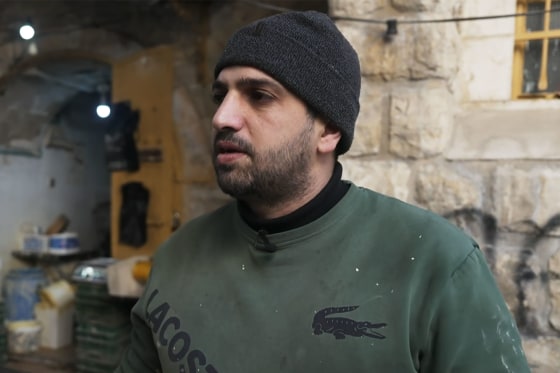
HEBRON, West Bank — Surrounded by fenced off streets and barbed wire in Hebron’s Old City, Monzer Shawamla said he still remembers a time when the streets were packed, and even Israeli soldiers used to line up at his bakery for the bagel-like bread known as ka’ak.
But in the years since the October 7 attack sparked an unprecedented Israeli crackdown, Shawamla’s store is one of the few to survive in the heart of this UNESCO World Heritage site. Nearby, the shells of hundreds of old stores which have shut down over the years, some through lack of custom, others closed by Israeli forces in the name of security.
As he pounded wheat pancakes next to an almost empty market street, Shawamla told NBC News earlier this week that Palestinians have endured “unbearable harassment” and regular humiliation at the hands of Israeli soldiers and Jewish settlers since Hamas launched its multipronged assault on Israel.
“We are like someone standing on ice,” said Shawamla, 35. “While others warm themselves by the fire and the heater, we are left standing on ice.”
For Palestinians in Hebron and throughout the West Bank, the political climate appears likely to get even colder after Israel’s Security Cabinet approved measures last week to tighten the country’s control over the territory and make it easier for Jewish settlers to buy land there.
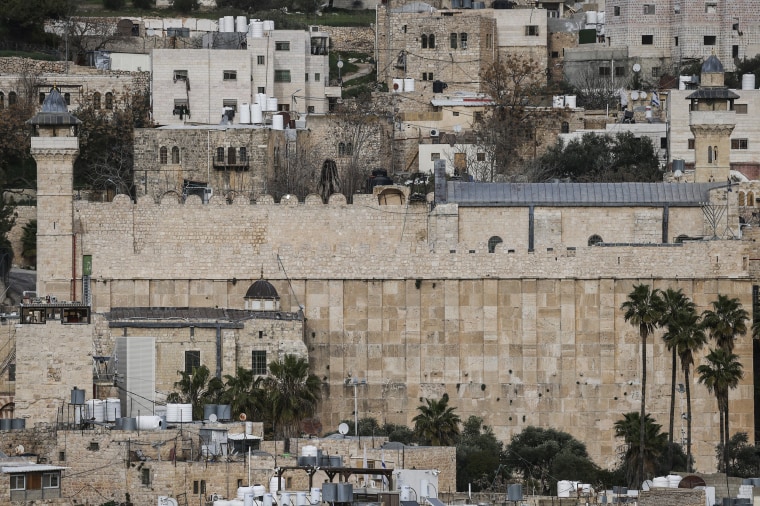
For Hebron, a uniquely ancient community in the West Bank that has Jewish settlements in the heart of the city, the new rules will ease settlement expansion in the area around the contested Ibrahimi Mosque, near to the Old City which is believed to house the tombs of Abraham and is a key site for Islam, Judaism, and Christianity. The decision strips the local Palestinian governorate of planning and building authority, handing it to Israeli officials.
The Ibrahimi Mosque in Hebron.Hazem Bader / AFP - Getty Images
Then on Sunday, ministers voted in favor of starting a land registration process for the first time since 1967 when Israel captured the territory from Jordan during the Six-Day War with a coalition of its Arab neighbors.
Israel’s Foreign Ministry defended the move on Sunday. It said on X that the move was an “administrative measure” that would allow for a transparent and thorough clarification of rights to resolve legal disputes.” This would protect “the property rights of Israelis and Palestinians alike,” the ministry added.
Within Hebron, the separation has long been enforced not only by Israeli barriers but also by military checkpoints and curfews intended to protect the Jewish settlers living within the city’s most historic and religiously important areas, who number in the hundreds.
The moves were roundly condemned by Palestinians who see the West Bank as vital for a future independent state.
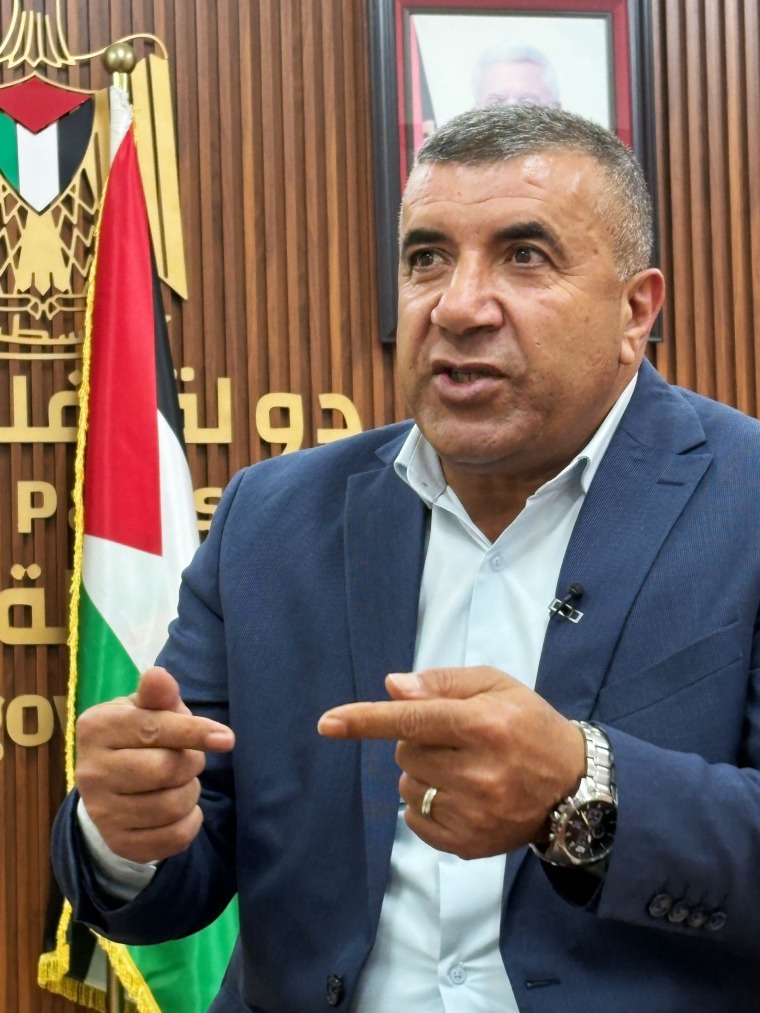
Khaled Dudin, the Palestinian governor of Hebron, speaking to NBC News. Khaldoun Eid / NBC News
“The measures on the ground constitute annexation in every sense of the word,” Khaled Dudin, the Palestinian governor of Hebron, said in an interview last week. “Although it is not publicly announced. In other words, the real annexation exists on the ground while the media talks about non-annexation.”
After taking control of the territory, Israel discontinued the process of land registration that had previously been in place. Under Jordanian rule, land was registered as a state or private property, but only about a third had been formally registered and many Palestinians had no documentation or other ways of proving ownership and some had lost their documents in the short but violent conflict.
Peace Now, an Israeli humanitarian organization, said the new legislation would require Palestinian “landowners to prove ownership under conditions that are nearly impossible for them to meet.” Failure to do so would lead to the land automatically getting registered in the state of Israel’s name, the group added.
To this day the international community overwhelmingly considers Israeli settlement construction to be illegal and an obstacle to peace.
President Mahmoud Abbas, the leader of the Western-backed Palestinian Authority which administers parts of the West Bank, also called the moves serious violations, saying in a statement Sunday that a “decisive stance” was required “from the U.S. administration and the international community.”
Israel’s move also attracted widespread statements of concern from Western governments and condemnation from throughout the Middle East.
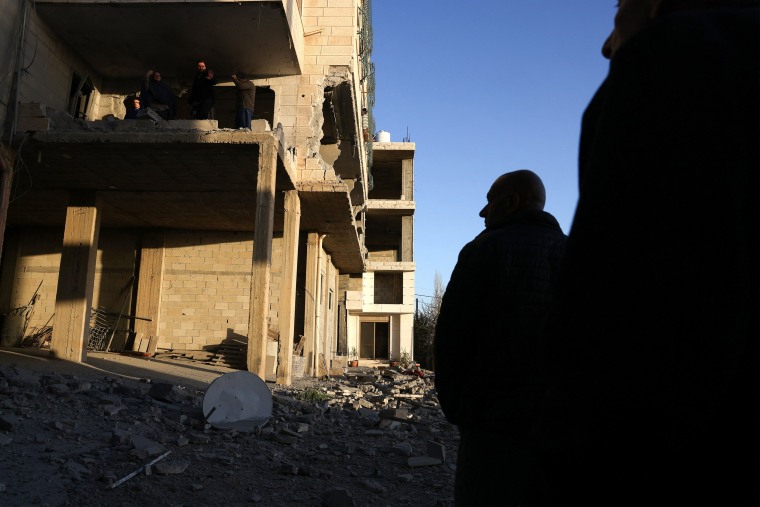
Israeli forces clear Palestinian homes in the village of Halhoul, which sits to the north of Hebron earlier this month.Hazem Bader / AFP - Getty Images
While previous American administrations have condemned Israeli expansion in the West Bank, neither the White House or the State Department have issued statements on the new measures and it is unclear whether the issue came up when Israeli Prime Minister Benjamin Netanyahu met with President Donald Trump last week in Washington, their seventh meeting in the past year.
In an interview with Axios last week, Trump said that he was opposed to annexation, although he didn’t directly address the new rules. “We have enough things to think about now,” he said. “We don’t need to be dealing with the West Bank.”
Netanyahu, who is facing an election later this year, deems the establishment of any Palestinian state a security threat and his ruling coalition, which has a large voter base in the settlements, includes many members who want Israel to annex the West Bank.
Far-right politicians like Finance Minister Bezalel Smotrich “certainly want to use this in the Israeli domestic political sphere with their base,” Michael Koplow, the chief policy officer at the Israel Policy Forum, an American organization that works towards a two-state solution, or the establishment of an independent Palestinian state alongside the state of Israel.
A member of the settler community who has long claimed the West Bank for Israel, Smotrich’s Religious Zionism Party currently holds seven seats in the Israeli Knesset or parliament, and he is “trying to do as much as he can while he’s still in a position to do so,” Koplow added. A poll published Wednesday by Maagar Mohot and Stat-Net polls projected that the party would win no seats if elections were held today.
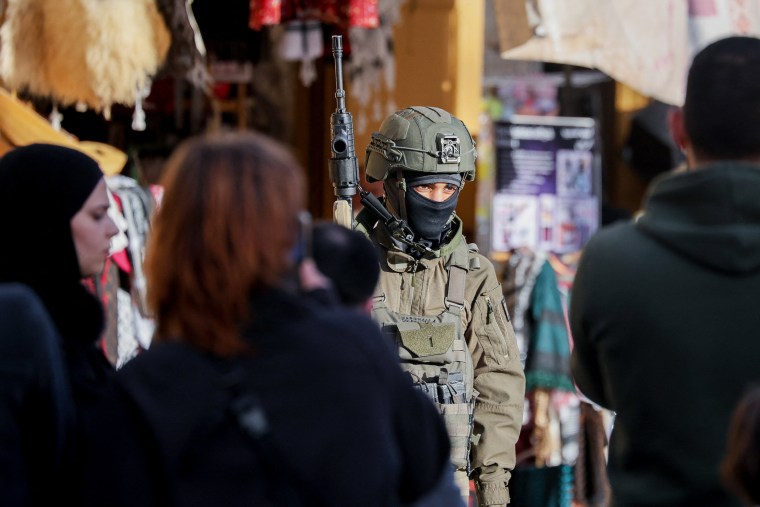
An Israeli soldier stands in front of civilians in the Old City of Hebron. Mosab Shawer / Middle East Images / AFP via Getty
Smotrich has vowed to double the settler population in the West Bank and in December he was part of the cabinet which approved a proposal for 19 new settlements in the territory. Israel is also preparing to build a controversial settlement project near Jerusalem, known as E1, which would effectively sever the northern and southern West Bank.
Along with the settlement expansion, the United Nations recorded over 1,800 attacks by Jewish settlers that caused casualties or property damage in 2025, the highest daily average since it began recording settler attacks in 2006.
It’s one reason why news of the new cabinet decisions seemed to have gone largely unnoticed by the few people who strolled last week through Hebron’s Old City, which is designated as a UNESCO World Heritage Site and borders the Al Ibrahimi Mosque, known to Jews as the Cave of the Patriarchs.
That may change as under the newly approved powers, Israel has said it will take over planning authority at the site and other areas of archeological interest.
“Everyone has heard about the new law, but in reality, people were already experiencing it firsthand because it was already in effect,” Dudin said. “Apartheid now exists in every sense of the word.”
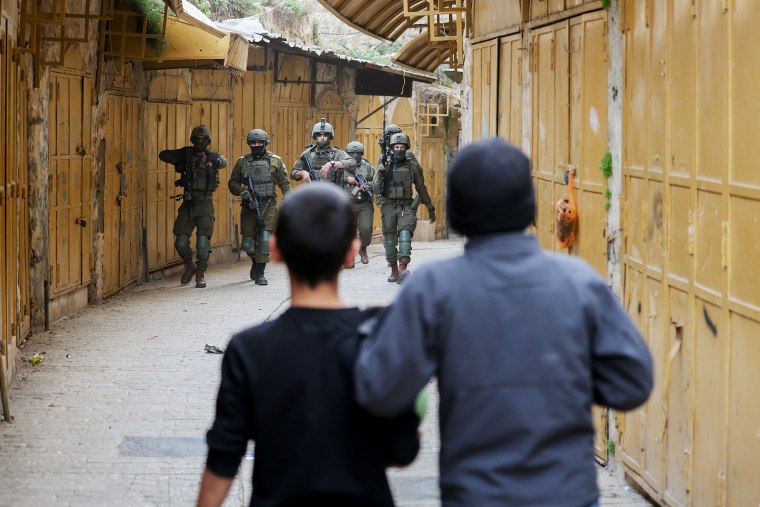
Israeli soldiers patrol an alley in the Old City of Hebron on Saturday.Mosab Shawer / Middle East Images / AFP via Getty
Nearby apartment blocks occupied by Jewish settlers towered over several Old City streets, which were covered by nets meant to catch the rocks and debris the settlers have thrown on the Palestinian pedestrians below.
But Shawamla, the baker, said he was determined to carry on with the business his father started, aided by the flour and semolina Dudin’s governorate gives Old City shops to keep them afloat.
“If institutions continue to support us, we will keep working until our very last breath,” he said. “We will go on, even with our last strength, to preserve our birthplace — our shops. We live here. We were born in the Old City.”