Look back at our archive of previous Meet the Press blog posts.
For the latest posts from the journalists at NBC News and the NBC News Political Unit, click here.
AARP launches ads in W.Va. urging Manchin to support reconciliation bill

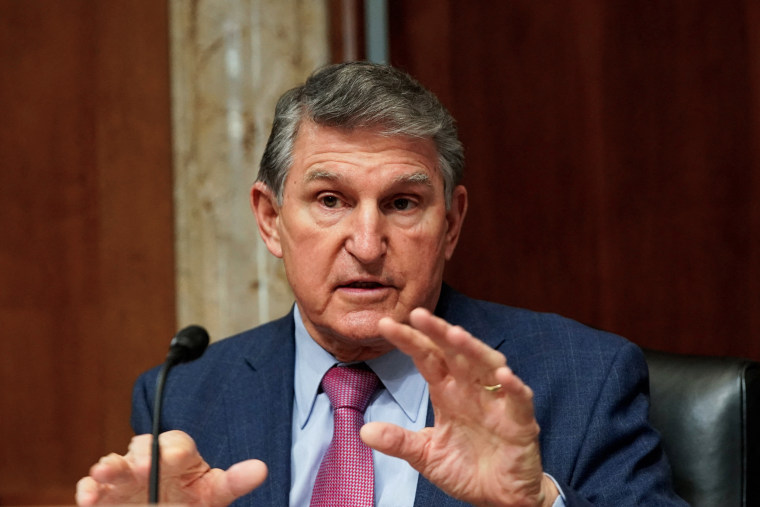
WASHINGTON — AARP, the advocacy group for Americans over fifty, is launching new cable and broadcast TV ads in West Virginia urging centrist Sen. Joe Manchin, D-W.Va., to support a budget reconciliation bill that includes a major prescription drug savings policy.
The new TV ad, first reported by NBC News, is slated to run in West Virginia starting this Wednesday through at least July 5. An AARP spokesperson said it is part of a multi-million-dollar ad campaign that will include radio and print ads.
"Everybody knows Joe Manchin cares about West Virginians. And he knows too many of us are struggling to pay for our medicine. That's why he supports letting Medicare negotiate lower drug prices," says a narrator in the ad, which ends with: "Joe Manchin, keep fighting to lower drug prices."
It focuses on a priority of AARP's: allowing Medicare to negotiate drug prices, which Manchin has publicly endorsed. And it comes at a crucial stretch: In recent weeks, the senator has held private negotiations with Senate Majority Leader Chuck Schumer, D-N.Y., about a bill that can bypass Republicans, who oppose the idea of allowing Medicare to negotiate drug prices.
“We know we have the votes to pass Medicare negotiation through reconciliation, and we are committed to pushing back whenever PhRMA and their allies try to mislead the public and block Congress from lowering prescription drug prices," said Nancy LeaMond, the chief advocacy officer for AARP.
Manchin has said he would be open to a package that includes drug savings, energy investments and tax hikes on high earners and corporations.
The recent Manchin-Schumer negotiations have been tight-lipped and the West Virginia Democrat, who scuttled the House-passed Build Back Better Act, is facing conflicting pressures on striking a narrower reconciliation deal over tax and spending policy that can bypass the filibuster. The new AARP ad campaign is designed to push back on drug industry opposition to the savings policy and aims to give Manchin political cover to support the bill.
David Perdue lags far behind Gov. Kemp in ad spending Georgia's GOP primary

Ahead of Georgia’s May 24 primary, former Sen. David Perdue, R-Ga., is falling behind in the race for the state's GOP gubernatorial nomination.
He’s spent no money on ads since April 29, according to AdImpact, an ad tracking firm. In total, he’s spent $1.2 million on ads, a relatively low amount for that race.
Perdue is backed by former President Donald Trump and is challenging Gov. Brain Kemp, who drew ire from Trump in 2020 when he refused to overturn the results of the presidential election in the state, which was carried by President Joe Biden.
So far this cycle, Kemp has spent over $5 million on ads. He’s recently pivoted his focus to the general election this fall, where Democrats are leading in ad spending by the millions, rather than spending money against Perdue.
Recent polls show that Kemp not only leads Perdue, but he also could clear 50 percent of the primary vote, meaning he would avoid a runoff election. A runoff would take place on June 21 if neither candidate clears that 50 percent threshold.
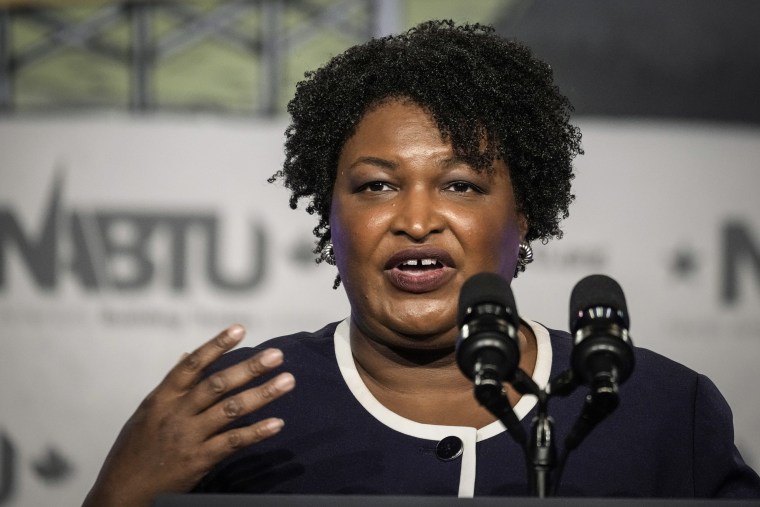
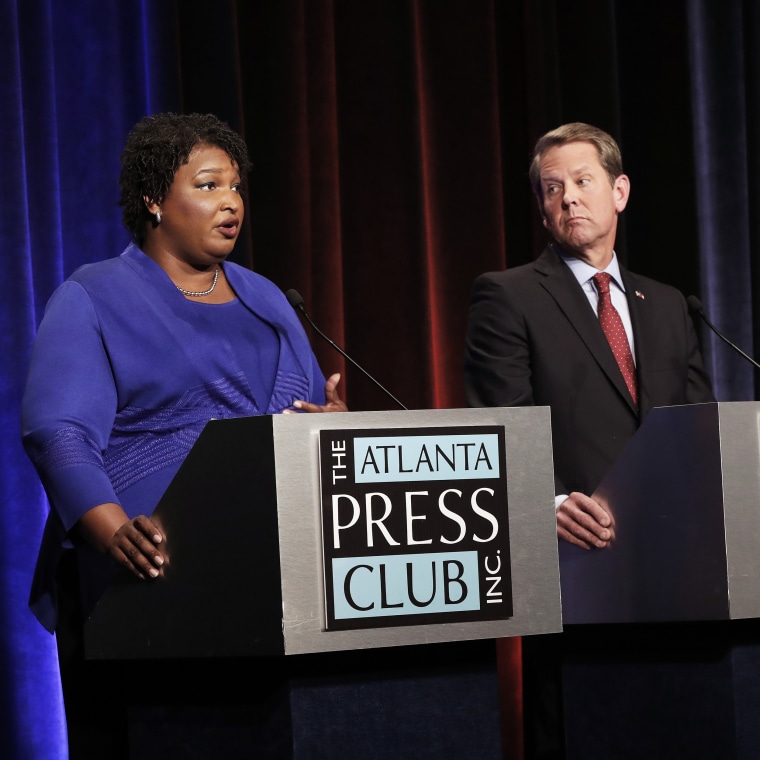
If he wins outright, Kemp will face Democrat Stacey Abrams in a rematch of their 2018 election, where Abrams lost by less than two percentage points. Abrams is already the de facto Democratic nominee, facing no challengers in the primary contest.
On top of Kemp’s ad spending, the Republican Governors Association has spent on his behalf, pouring over $4.6 million on the airwaves to back Kemp.
But Abrams and her allies are far and away the leaders in ad spending in the race so far. Abrams’ campaign has spent $7.8 million on the airwaves and Fair Fight Action has spent an additional $6.6 million on ads supporting Abrams.
Midterm Roundup: A busy primary night


Tuesday's primaries across the country featured some key races in places like Pennsylvania, Kentucky, Oregon, Idaho and North Carolina. In Oregon, President Joe Biden's endorsement doesn't seem to have helped Rep. Kurt Schrader. Though the race hasn't been called yet, he's trailing his challenger, Jamie McLeod-Skinner by over 20 percentage points.
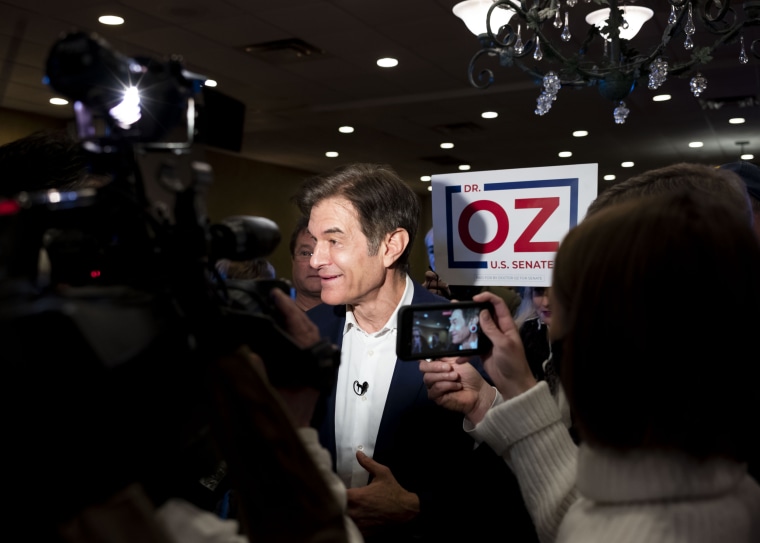
And in Pennsylvania, former President Donald Trump's endorsed candidate for Senate, Mehmet Oz, hasn't run away with it. The race is still too close to call, and former hedge fund manager David McCormick is trailing Oz by only 0.20 percentage points.
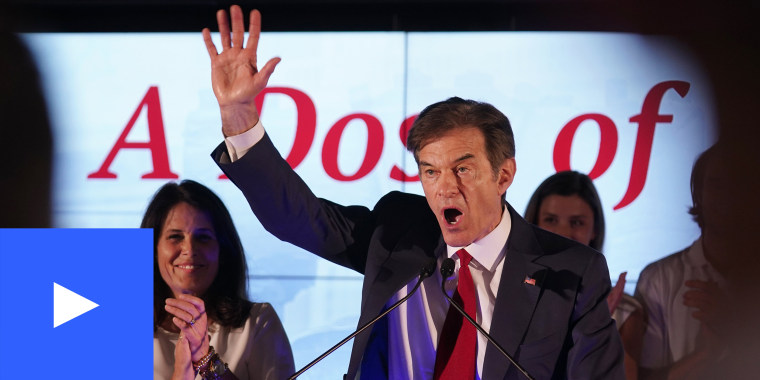
Here are some other key results from Tuesday’s wild primaries, with NBC News’ projection in parentheses, as they stand now:
Here are some other key results from Tuesday’s wild primaries, with NBC News’ projection in parentheses, as they stand now:
Kentucky-03 (Democratic): Morgan McGarvey 63.3 percent (winner), Attica Scott 36.7 percent.
Idaho-02 (GOP): Mike Simpson 54.6 percent (winner), Bryan Smith 32.7.
North Carolina-01 (GOP): Sandy Smith 30.7 percent, Sandy Roberson 26.1 percent (race has not been called).
North Carolina-13 (GOP): Bo Hines 32.1 percent (winner), DeVan Barbour 22.7 percent.
North Carolina-13 (Democratic): Wiley Nickel 51.7 percent (winner), Sam Searcy 23 percent.
North Carolina-14 (Democratic): Jeff Jackson 86.4 percent (winner), Ram Mammadov 13.8 percent.
Oregon governor (Democratic): Tina Kotek 57.4 percent (winner), Tobias Read 33 percent.
Oregon governor (GOP): Christine Drazan 23.5 percent, Bob Tiernan 20 percent.
Oregon-04 (Democratic): Val Hoyle 65.3 percent (winner), Doyle Canning 15.5 percent.
Oregon-04 (GOP): Alek Skarlatos ran unopposed.
Oregon-05 (GOP): Lori Chavez-DeRemer 42.2 percent, Jimmy Crumpacker 30.5 percent (race has not been called).
Oregon-06 (Democratic): Andrea Salinas 37.8 percent (winner), Carrick Flynn 19 percent.
Pennsylvania-01 (GOP): Brian Fitzpatrick 65.5 percent (winner), Alex Entin 34.5 percent.
Pennsylvania-08 (GOP): Jim Bognet 68.8 percent (winner), Mike Marsicano 31.2 percent.
Elsewhere on the campaign trail:
Oklahoma Senate: The Daily Beast is reporting that Rep. Markwayne Mullin, who is running in the crowded GOP Senate primary, plans to introduce a bill to expunge Trump’s impeachment
Pennsylvania Senate: NBC’s Mike Memoli reports that Rep. Conor Lamb faced long odds with President Biden, a key supporter of his marquee 2018 House race, sitting on the sidelines.
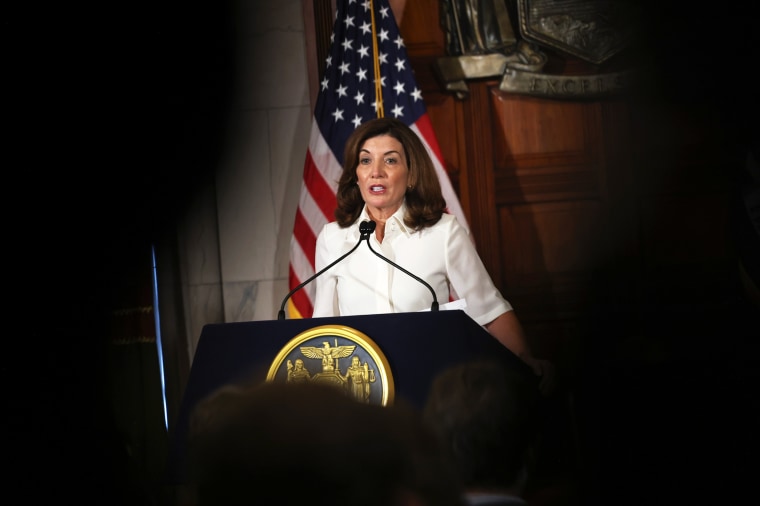
New York governor: Gov. Kathy Hochul is up with a new spot centered on protecting abortion access.
Los Angeles Mayor: There were a few big developments in the race for mayor — actor Danny Trejo cut an ad for Councilman Kevin de León, rapper Snoop Dog endorsed businessman Rick Caruso, and City Attorney Mike Feur dropped his bid to endorse Rep. Karen Bass.
Two neighboring Pa. districts tell the tale of changing terrain for Democrats
MONACA, Pa. — If you want a sense of the challenges Democrats face in 2022’s House races, look no further than two districts that share a common border in western Pennsylvania.
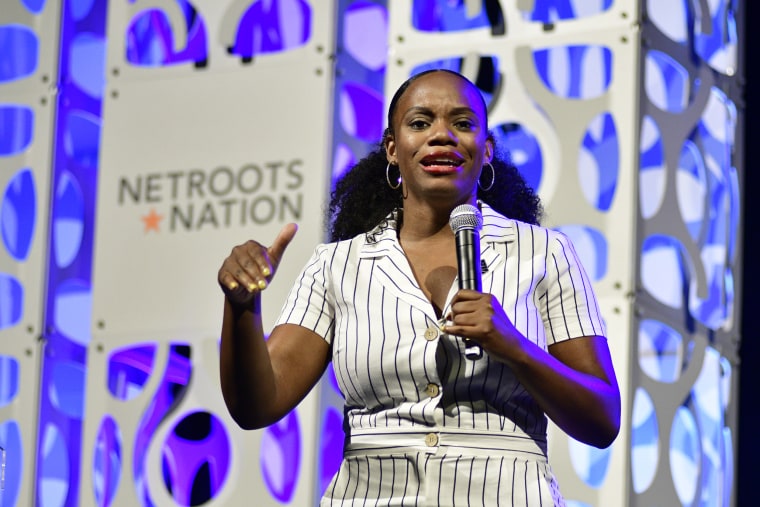
Pennsylvania's 12th District, which includes Pittsburgh as well as suburbs to the east and south looks to be solidly Democratic. A deep blue stronghold, the district is home to Democratic candidate Summer Lee, who has built her campaign around environmental justice and income inequality.
The state's 17th District, which holds some of Pittsburgh’s suburbs and all of rural/exurban Beaver County, looks much more like a toss-up. The district is home to Democratic candidate Chris Deluzio, who focuses on his veteran status and his work to help unionize the University of Pittsburgh’s faculty.
Both districts include parts of Allegheny County, the home of Pittsburgh, but the two offer very different terrains for Democrats.
Not long ago, this entire area was Democratic. In the 2000 presidential race, Democrat Al Gore carried Allegheny County by 16 points, while carrying Beaver by 9 points. But 2020 showed how the map had changed. Joe Biden carried Allegheny by 20 points, but Donald Trump carried Beaver by 18 points.
What happened? Pittsburgh, still considered the “steel city” by many Americans, has morphed into a medical and tech center. About 43 percent of the 25-and-over population has a bachelor’s degree. But many of the suburbs around the city, like those in Beaver, are still rooted in the area’s industrial past; about 26 percent of adults in Beaver have a bachelor’s degree.
The emerging differences are clear to see on the ground.
Last week in Pittsburgh, we met with Jasiri X, the co-founder and CEO of 1Hood, a community organizing group in the city. His concern is whether Democrats are doing enough on the issues that Black voters face on a day-to-day basis.
“2018 was this very pivotal year for Pittsburgh,” he said. “We had a very high profile police killing of a young man named Antwon Rose. ... We also had the Tree of Life massacre later on that year."
"It began to be like, ‘OK, well, protesting by itself isn't enough," he continued. "Can we move to come together to actually create and change laws?’” He says that these voters haven’t seen the return on their investment and want Democrats to push harder on progressive policies instead of being “passive.”
An hour drive away from the city, in the far northern reaches of the northwestern Pittsburgh suburbs — the United Steelworkers Local 1016 held a meeting in Wheatland, Pennsylvania. There, we heard a very different message of what the country needs: Trump’s new brand of union workers were more worried about issues like the emerging Supreme Court decision on abortion.
United Steelworkers District 10 Director Bernie Hall studied his crowd of union leaders closely, taking stock of what political questions arose. A Biden voter himself, he was worried about candidates increasingly going to “extremes.” If the Supreme Court can overturn a law like Roe v. Wade from 1973, what about the 1935 Wagner Act that said employees have a right to establish a union?
“We’ll have dozens of these [meetings] across the state,” he said. “I'm concerned that people aren't getting facts in general, not only about President Biden but just about the political process and issues that face our country.”
In Aliquippa, after the local steel mill shut down, nature is slowly reclaiming empty homes and many of residents of this hard-hit African-American community are well beneath the poverty line.
Aliquippa Mayor Dwan Walker (D) urged Democrats to unite the rural voters and urban progressives. The way forward in Western Pennsylvania, he says, is to remind people the area is the birthplace of the unions.
“There’s 72,000 Democrats [here that are] ‘light blue’ [Reagan Democrat]” he said. “But they’ll vote Republican just based off the message. The message just has to be claimed.”
Oz and McCormick backers have dominated ad spending but pro-Barnette group made late push
Groups backing businessman David McCormick and television doctor Mehmet Oz alone make up 88 percent of all ad spending in Pennsylvania's GOP Senate primary, data from the ad-tracking firm Advertising Analytics shows.
But a late push by a powerful ally of Republican activist Kathy Barnette meant that she and her allies actually outspent the pro-Oz effort in the race's final week.
Overall, the pro-McCormick effort has spent $32.8 million on ads through Tuesday, with $16.9 million coming from the Honor Pennsylvania super PAC and $12 million from McCormick's campaign alone (two other super PACs added another $3.9 million).
While Oz's campaign spent $13.2 million, more than McCormick's campaign, he had a far smaller, $4.3 million push from super PACs, bringing the pro-Oz ad spending total to $17.5 million.
And Barnette's campaign, which has spent just $210,00 on ads, was boosted by a $2.1 million, last-minute ad buy from Club for Growth Action.
While Pennsylvanians have been inundated with ads for McCormick and Oz for months, that late push by the Club, coming amid Barnette's late surge, made her competitive with her rivals on the airwaves for the final week. The pro-McCormick effort still led the pack with $4 million spent over the last seven days, but the Club's spending pushed the pro-Barnette effort into second place for the final week with $2.2 million in ad spending, followed by the pro-Oz $1.4 million.
Where is Trump’s endorsement power on the line in Tuesday’s primaries?
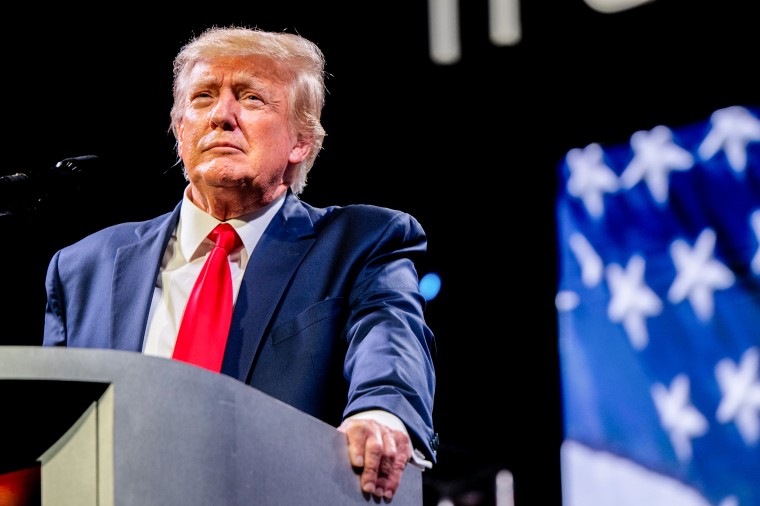
Trump has endorsed 25 candidates in Tuesday’s primaries in Pennsylvania, Kentucky and Idaho, with a handful of races testing the former president's power over the GOP.
All but six of those endorsements are incumbent lawmakers who are typically favored to win their primaries. Trump has backed eight candidates in North Carolina, eight in Pennsylvania, six in Kentucky and three in Idaho.
The most closely-watched tests of Trump’s endorsements will come in statewide contests, particularly in Pennsylvania. There Trump has backed celebrity doctor Mehmet Oz in the open Senate race, but conservative commentator Kathy Barnette has surged late in the race as she tries to capture grassroots enthusiasm. Trump made a last-minute endorsement in the governor’s race, backing controversial state Sen. Doug Mastriano over the weekend after Mastriano emerged as a frontrunner.
Trump has also weighed in on North Carolina’s open Senate race, backing GOP Rep. Ted Budd over former Gov. Pat McCrory and former Rep. Mark Walker. Budd has also benefited from $11.8 million in outside spending from Club for Growth Action, which has launched ads attacking Budd’s opponents, according to the ad tracking firm AdImpact.
In Idaho, Trump has backed Lt. Gov. Janice McGeachin in a primary against GOP Gov. Brad Little. Trump didn’t mention LIttle in his statement backing McGeachin in November, when he described the lieutenant governor as someone who has been “a true supporter of MAGA since the very beginning.” Little has outspent McGeachin on the airwaves, spending $945,000 to McGeachin’s $215,000, per AdImpact.
Trump has also weighed in on a handful of notable House races. He backed controversial GOP Rep Madison Cawthorn in North Carolina’s 11th District. Cawthorn’s opponents, including state Sen. Chuck Edwards, have painted Cawthorn as an attention-seeker who hasn’t prioritized his district.
The GOP primary in North Carolina’s 13th District will also test Trump’s endorsement after he decided to back law student Bo Hines in the competitive, open seat race. Club for Growth has spent nearly $1.3 million boosting Hines, who faces self-funding attorney Kelly Daughtry, veteran Kent Keirsey, and former Rep. Renee Ellmers in the primary.
In Pennsylvania’s 8th District, Trump has backed political consultant Jim Bognet to take on Democratic Rep. Matt Cartwright. Bognet lost to Cartwright by nearly 4 points in a district Trump would have won by 3 points had the new congressional map been in place in 2020. Bognet faces former Hazleton Mayor Mike Marsicano, who is also a former Democrat, in the GOP primary.
Outside group launches $6 million ad campaign supporting Ron Johnson
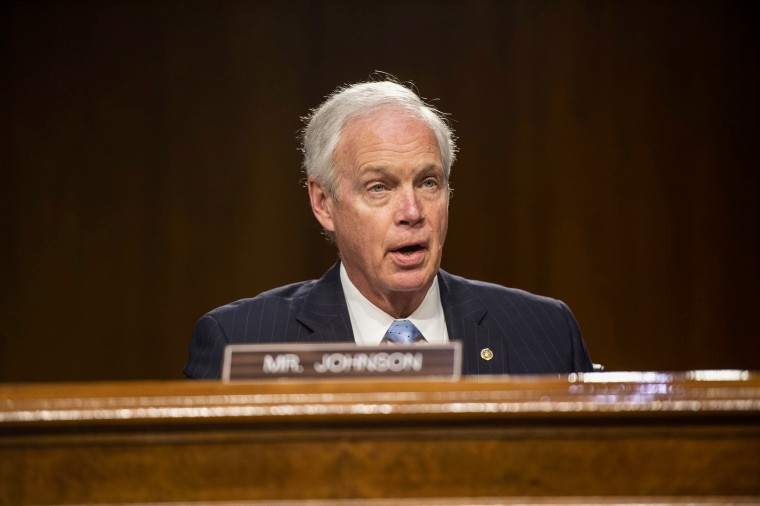
One Nation, a super PAC with ties to the conservative Senate Leadership Fund, is launching a $6 million ad campaign to back Sen. Ron Johnson, R-Wis., today.
The group’s first ad will run for eight weeks in Wisconsin and highlights Johnson’s efforts to curb inflation.
“Gas, groceries, rent. Everything costs more. Senator Ron Johnson is fighting back,” a narrator in the ad says.
The narrator adds, “The D.C. liberals' spending spree is out of control. Jacking up inflation on Wisconsin families. Wiping out wage gains and making it harder for families to make ends meet.”
Johnson is running for a third term this year and while he faces no significant primary challenge, Democrats are eyeing his seat as one they can flip in November. So far, there are three main candidates vying for the Democratic nomination for Senate — state treasurer Sarah Godlewski, businessman Alex Lasry and Lt. Gov. Mandela Barnes.
Wisconsin’s primary election is August 9.
So far, Lasry has spent the most on ads of any candidate, spending $5.6 million on the airwaves, according to AdImpact, an ad tracking firm. Johnson himself has spent over $5.1 million on ads.
Godlewski and Barnes trail, with Godlewski having spent $1.9 million on ads so far and Barnes having spent under $100,000 on ads.
Barnes, however, has racked up significant progressive endorsements, with Sen. Elizabeth Warren, D-Mass., planning to campaign for him soon, according to NBC News’ Shaq Brewster.
One Nation, however, will be competing against an anti-Johnson outside group, Opportunity Wisconsin. The group hasn’t explicitly backed any of the Democratic candidates, but they have been running ads against Johnson since early this year.
The commercials allege Johnson used loopholes in legislation he supported to make money for himself. So far, the group has spent the most of any candidate or group on the airwaves, spending $6.4 million.
Like One Nation, Opportunity Wisconsin is an advocacy organization that does not have to disclose its donors, though the group’s website claims they’re, “made up of a diverse group of leaders who span the urban/rural divide and live and work in communities and industries through Wisconsin.”
Barnette says she won't support "globalist" candidates if she loses Pa. GOP primary
Republican Kathy Barnette, who has been surging in the final days before the Pennsylvania GOP Senate primary race, threw cold water on the idea of her backing rivals Mehmet Oz or David McCormick if she loses the primary election.
"I am not a globalist, both of them are. They have very strong ties to the World Economic Forum. I've heard McCormick several times espouse the glowing benefits of ESG scores --environmental social governance scores. If you just look at who they are, Mehmet Oz is not only an American but also Turkish as well. That's a very important distinction," Barnette said during an interview with SiriusXM's Breitbart News Daily.
When asked subsequently if she'd back the eventual GOP nominee if she loses Tuesday, Barnette replied: "I have no intention of supporting globalists."
"I don't think we have room to just vote for any old warm body with an 'R' next to their name. I think we can do better than that."
During the interview, Barnette went onto criticize Oz and McCormick as not authentic conservatives, as well as criticizing the idea that they're electable because they have deep pockets to loan to their campaigns.
"I have been an America First individual long before I decided to run for this race. And now, these two particular men, because it's convenient, because we have this seat open, they are now presenting themselves as Trump, card-carrying members of the Patriot Party," Barnette said.
"That's not how they've lived their life prior to stepping into this role."
In recent interviews with NBC News, both Oz and McCormick raised questions about Barnette's candidacy.
"He's not been transparent. And every time she answers a question, she raises a lot more," Oz told NBC's Dasha Burns last weekend before saying he would support her if she wins.
And Monday, McCormick criticized Barnette for losing her 2020 congressional bid.
"I've gotten to know Kathy on the campaign trail, I respect her personal story. She's been tested, she was tested 18 months ago when she ran for Congress and lost by 20 percentage points," McCormick said.
—Dasha Burns contributed
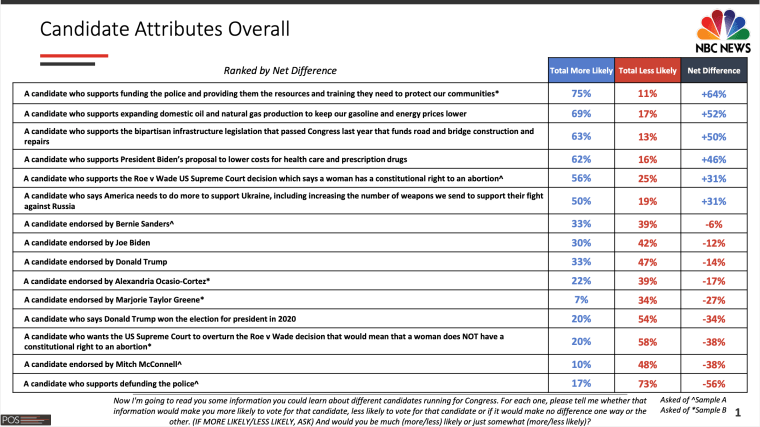
Poll: Democrats are becoming more progressive, while most Republicans want Trump to lead GOP

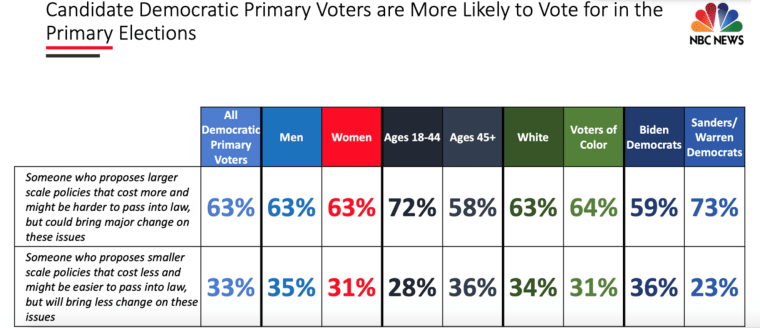
Ahead of a slew of notable primary races taking place over the next two weeks, the latest NBC News poll finds that the Democratic primary electorate has become more progressive since 2020.
It also shows a majority of Republican primary voters wanting Trump to continue leading their party.
Now neither development should be that surprising to anyone who follows politics. But it’s instructive to see them backed up by numbers.
Per the poll, 63 percent of Democratic primary voters say they prefer a candidate who proposes larger-scale policies even if they cost more and might he harder to pass, versus 33 percent who prefer a candidate who proposes smaller-scale policies that cost less and might be easier to pass.
That’s a jump from Feb. 2020 — during the height of the Democratic presidential primary season — when 53 percent wanted candidates proposing larger-scale policies, versus 41 percent who wanted candidate with smaller-scale policies.
As for Republican primary voters, 55 percent believe the party should continue to be led by former President Donald Trump; 33 percent say he was a good president but it’s time for new leaders; and 10 percent say he was a bad president, and it’s time to move on.
On a separate question, however, 34 percent of Republicans in the poll identify themselves as more supporters of Trump, while 58 percent consider themselves more supporters of the party.
The NBC News poll was conducted May 5-7, 9-10 of 1,000 adults — including 750 on their cell phone — and it has an overall margin of error of plus-minus 3.1 percentage points.
The margin of error for the poll’s 259 Democratic primary voters is plus-minus 6.09 percentage points, and the margin of error for the poll’s 247 Republican primary voters is plus-minus 6.24 percentage points.
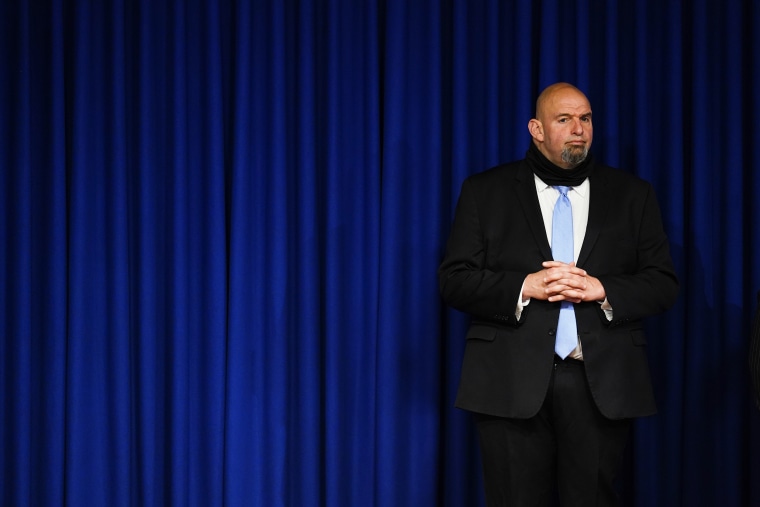
Fetterman won't appear at campaign's primary night event after last week's stroke
Pennsylvania Democratic Lt. Gov. John Fetterman won't attend his Senate campaign's primary-election night event on Tuesday after suffering a stroke late last week.
In a press release Monday, the campaign said Fetterman's wife and "other special guests" will deliver remarks, while Fetterman himself "will not be in attendance on Tuesday as he will remain in the hospital resting and recovering."
Fetterman Sunday that he had suffered a stroke Friday, but he said that he didn't suffer "cognitive damage" and insisted he is "well on my way to full recovery." The Democrat is considered the frontrunner in the Democratic primary bid, where he's running against Rep. Conor Lamb and state Rep. Malcolm Kenyatta.
In Pennsylvania, Mastriano rises to top of GOP field despite little ad spending
State Sen. Doug Mastriano has established himself as a frontrunner in the GOP primary for Pennsylvania governor despite being vastly outspent on the airwaves.
Mastriano’s campaign has spent just $332,000 on ads ahead of Tuesday’s primary, accounting for just over 1 percent of the $22.7 million spent on the governor's race by the total GOP primary field, according to the ad tracking firm AdImpact.
Mastriano, who has championed former President Donald Trump’s false claims that the 2020 election was stolen, has been the target of a $1.1 million ad campaign from Pennsylvania Patriots for Election Integrity. The group has knocked Mastriano for supporting a 2019 law expanding mail voting in the state (which Mastriano has said he would reverse if elected).
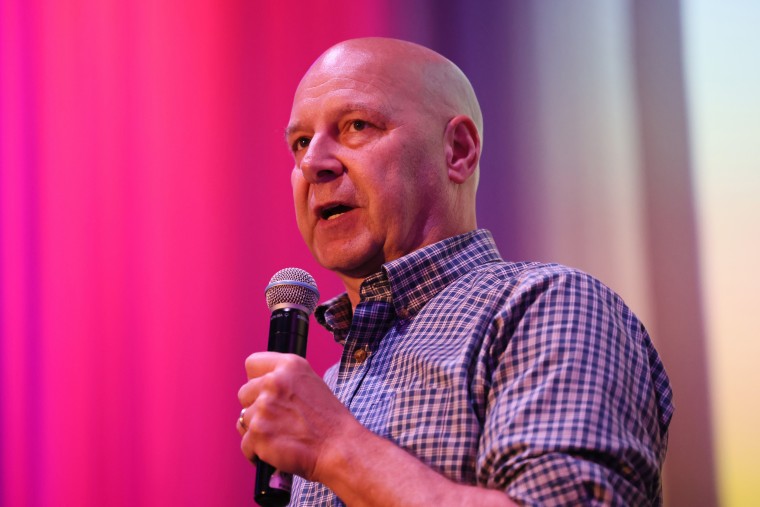
Despite minimal spending on campaign ads, Mastriano has established himself as a frontrunner in the crowded race and he picked up Trump’s endorsement over the weekend.
Trump’s endorsement in the final days of the primary race came after he encouraged his supporters last month to reject former U.S. Attorney Bill McSwain, calling McSwain a “coward” for not investigating election fraud.
Half of all ad spending in the GOP race — $11.1 million — has bolstered McSwain. But Commonwealth Leaders Fund, which has spent millions supporting McSwain, announced over the weekend that it is instead backing former Rep. Lou Barletta in an attempt to consolidate behind one Mastriano opponent.
The group’s decision comes after two other candidates, state Sen. Jake Corman and former Rep. Melissa Hart, dropped out of the race last week and endorsed Barletta, whose campaign has spent $967,000 on ads.
Aside from McSwain, the top spender in the race has been former Delaware County Councilman David White’s campaign, which has dropped nearly $5.7 million on ads so far. The conservative Club for Growth Action has spent $801,000 on an ad campaign opposing White.
Rep. Mike Simpson is seeking to fend off primary challenger in Idaho
Rep. Mike Simpson, R-Idaho, will be defending his seat Tuesday when he faces a challenge from personal injury attorney Bryan Smith in Idaho's 2nd district GOP primary.
The two have been engaged in an intense ad war, running over a dozen unique ads combined this cycle. Most of those ads have been on the offensive, with Smith attacking Simpson over his decision to vote in favor of the House committee investigating the Jan. 6 attack on the Capitol. Simpson has attacked Smith for his debt collection practices, featuring families in his ads who were sought after by Smith’s business to pay back small amounts.
Smith has spent over $450,000 on his ads, while Simpson has spent just over $368,000 on the airwaves, according to AdImpact, an ad tracking firm.
However, Simpson has been defended by outside groups, including the Defending main street Super PAC, which has run ads supporting him. That group has spent over $460,000 on ads in Simpson’s favor.
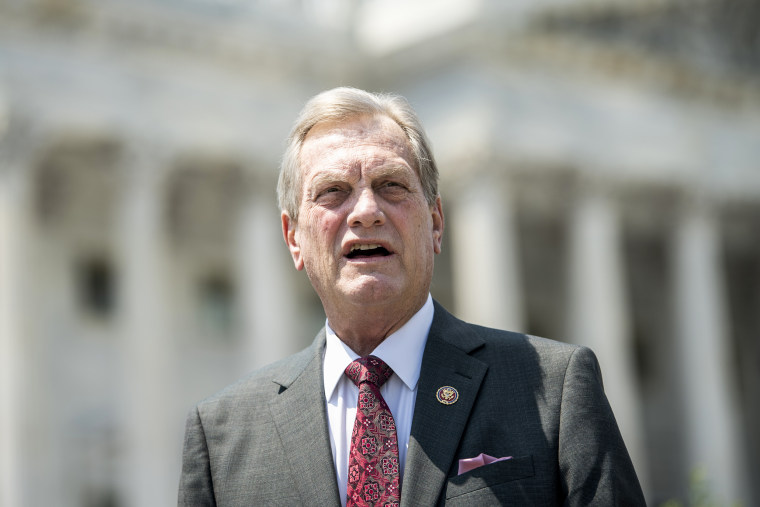
Defending Main Street is the political arm of the Republican Main Street Partnership and is spending in House GOP primaries across the country, including in Ohio and Minnesota.
Smith has had the backing of an outside group, too. America Proud PAC has poured $405,000 into ads supporting him in the district, accusing Simpson of being a “career politician” and a RINO (Republican In Name Only). The group is largely funded by Boise real estate developer Joe C. Russell, according to FEC filings.
Simpson has been serving in this seat since 1999, and it’s the second time he’s faced a primary challenge from Smith. In 2014, Smith ran against Simpson, but Simpson earned 61.6 percent of the vote on election night, compared to Smith’s 38.4 percent.
Though former President Donald Trump has endorsed against some members of Congress who voted in favor of the January 6 commission, he has not publicly supported either candidate in this race.
Data Download: The number of the day is… -19 percentage points.
That’s the net-negative rating for the Democratic Party in the latest national NBC News poll, with 50 percent of adults saying they had negative feelings about the Democratic Party and 31 percent saying they had positive feelings about the party. That’s also the highest net-negative rating the Democratic Party has seen in 30 years of the survey.
Adults surveyed in the poll gave the Republican Party a net negative rating of minus 11 percent, with 46 percent viewing the party positively and 46 percent viewing the party negatively.
The results are yet another warning sign for Democrats heading into a difficult midterm election, with the Democratic Party’s image struggling across the country. Among registered voters in the suburbs, the Democratic Party had a net negative rating of minus 24 percent, which is nearly three times their negative rating among suburban voters in 2018.
The party also had a 2 percent net-positive rating among urban voters, a sizable drop from a plus 15 percent rating in 2021. Rural voters have increasingly reported negative feelings about the Democratic Party, giving the party a rating of minus 32 percent.
Here's the positive/negative ratings – from most popular, to least popular – for all the politicians or institutions the NBC News poll measured:
- Volodymyr Zelenskyy: 62 percent positive, 9 percent negative (+53)
- Disney: 33 percent positive, 30 percent negative (+3)
- Ron DeSantis: 28 percent positive, 26 percent negative (+2)
- The US Supreme Court: 36 percent positive, 35 percent negative (+1)
- The Republican Party: 35 percent positive, 46 percent negative (-11)
- Joe Biden: 37 percent positive, 51 percent negative (-14)
- Donald Trump: 36 percent positive, 51 percent negative (-16)
- Kamala Harris: 31 percent positive, 48 percent negative (-17)
- The Democratic Party: 31 percent positive, 50 percent negative (-19)
PACs funded by crypto executives face first tests in Tuesday’s primaries
The crypto executives behind multiple super PACs this cycle will get their first chances at victory next week in a handful of House primaries as they flood Democratic races with cash.
The super PACs Protect Our Future and Web3Forward have spent a combined $8 million on ads in next week’s primaries so far, according to the ad tracking firm AdImpact.
The bulk of that spending has been focused on Oregon’s 6th District, Protect Our Future has spent over $6.5 million on ads supporting former government contractor Carrick Flynn’s election. The 6th District is brand new, created due to population gain during redistricting in the state.
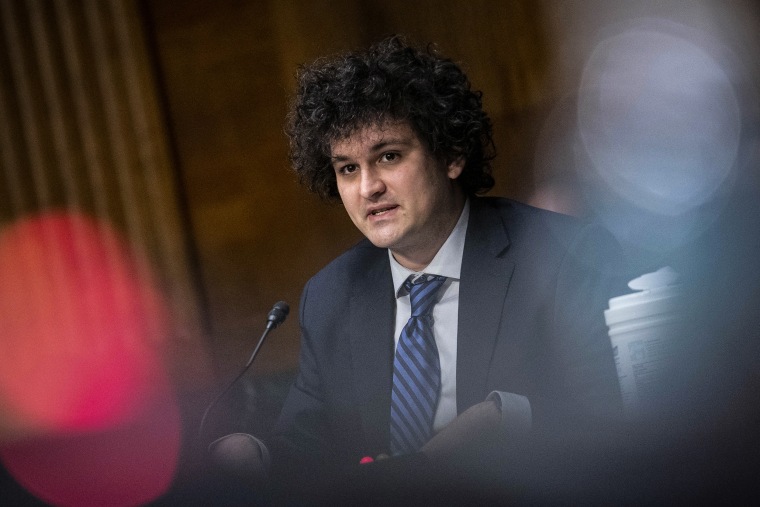
Protect Our Future is a new group funded by crypto executives including Sam Bankman-Fried, the founder of the crypto currency exchange FTX. The PAC has endorsed nearly a dozen candidates and lawmakers and claims to be focused on candidates who take long--term stances on certain legislation, particularly related to pandemic preparedness.
The amount of money spent on Flynn significantly outweighs the money spent on any other candidate in the race, which include veteran and businessman Cody Reynolds, internal medicine Dr. Kathleen Harder, and former state Rep. Andrea Salinas, who has the support of BOLD PAC, the political arm of the Congressional Hispanic Caucus. House Majority PAC, a group tied to top congressional Democrats, has also spent in Flynn’s favor.
Protect Our Future has also spent significantly in two other open Democratic primaries in deep blue districts – Kentucky’s 3rd District and North Carolina’s 4th district.
In North Carolina, the group has spent $625,000 on ads supporting state Sen. Valerie Foushee, who’s running to replace retiring Democratic Rep. David Price. She’s been endorsed by EMILY’s List, the Congressional Black Caucus PAC and other members of Congress.
Her most notable opponent is Durham County Commissioner Nida Allam, who’s been endorsed by progressive lawmakers like Sen. Elizabeth Warren, D-Mass., and Rep. Alexandria Ocasio-Cortez, D-N.Y. American Idol runner-up Clay Aiken is also running.
In Kentucky, Protect Our Future has poured $591,000 into ads supporting state Sen. Morgan McGarvey. McGarvey faces one opponent, state Rep. Attica Scott, in his bid for an open seat to replace retiring Rep. John Yarmuth.
Another crypto-backed super PAC has spent heavily on the open seat race in Oregon’s 4th District.
Rep. Peter DeFazio is retiring, leaving a reliably Democratic seat open. He and Senator Jeff Merkley, D-Ore., have endorsed Val Hoyle, Oregon’s Labor Commissioner.
Web3 Forward, which is tied to another PAC funded by crypto executives from companies like Coinbase and FTX, has spent $286,000 on ads supporting Hoyle. The PAC “supports Democratic candidates committed to making the next generation internet more secure, open and owned by the users,” according to the group’s website.
Web3Forward so far endorsed three Democratic candidates in primaries – Hoyle, Sydney Kamlager in California and Jasmine Crockett in Texas, who’s facing a primary runoff later this month.
Super PACs target Kathy Barnette in Pennsylvania Senate race
A pair of super PACs launched two new TV ads Friday morning attacking conservative commentator Kathy Barnette as she surges in Pennsylvania’s GOP Senate primary.
The ads come as former President Donald Trump, who has backed celebrity doctor Mehmet Oz in the race, and Barnette’s opponents target her as she has turned the race between Oz and former hedge fund manager David McCormick into a three-way contest.
Honor Pennsylvania, a pro-McCormick super PAC that’s spent $16.1 million largely attacking Oz, launched an ad where a narrator asks, “What do we really know about Kathy Barnette?”
The spot goes on to accuse Barnette of supporting the protests that followed the murder of George Floyd and of saying, “I was not a Trumper,” citing her Twitter feed and her book.
Another super PAC, USA Freedom Fund, launched a new ad blasting Barnette for supporting the building of a statue of former President Barack Obama.
The ad starts by mentioning comments Obama made about conservatives in 2008, saying some conservative voters are bitter and “cling to guns or religion or antipathy toward people who aren't like them.”
The ad references a Change.org petition that appears to be written by Barnette, advocating for erecting statues of Obama, his family and abolitionist Frederick Douglas in Washington, D.C. The petition was written two years ago. NBC News hasn’t independently verified whether Barnette was indeed the person who wrote the petition.
USA Freedom Fund previously supported former Ohio state treasurer Josh Mandel’s unsuccessful run for Senate.
New ads target GOP Rep. Madison Cawthorn in primary race
A super PAC supporting one of GOP Rep. Madison Cawthorn's primary challengers launched two new ads targeting the controversial congressman ahead of next week’s primary in North Carolina.
Cawthorn, who has former President Donald Trump’s endorsement, has been at the center of numerous scandals.
The first-term congressman, who faced sexual harassment allegations in his first bid, drew criticism for his repeated lies and aggressive rhetoric about the 2020 election; he called Ukrainian President Volodymyr Zelenskyy a “thug” and he said that he had been invited to drug-fueled sex parties by other lawmakers. And he’s also been the subject of leaked photos and videos of a sexual nature that attempt to paint Cawthorn in a negative light.
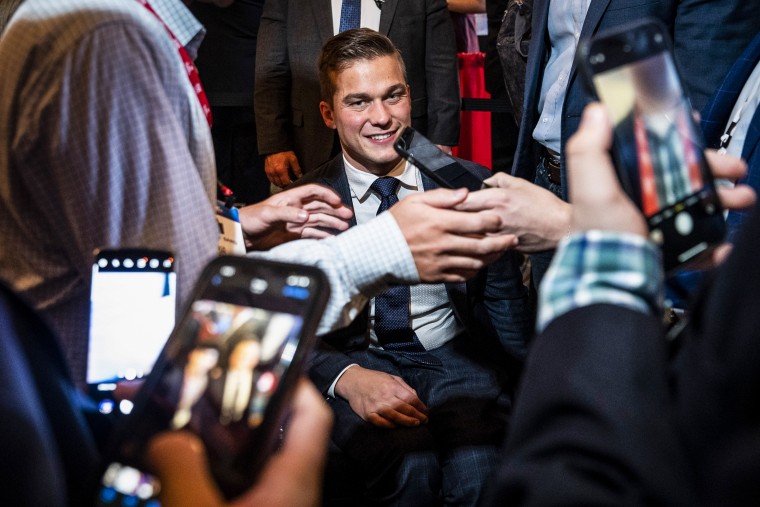
The new spots from the outside group Results for NC slam Cawthorn for falsely claiming an accident prevented him from attending the Naval Academy, even though he had already been rejected prior to the accident.
One of the new ads labels Cawthorn an untrustworthy “playboy politician,” and flashes one of those leaked images. The other spot features a woman veteran who is backing state Sep. Chuck Edwards in the May 17 primary.
Results for NC has spent the most on the airwaves of any campaign or outside group in the 11th District so far, dropping $739,000 on ads, according to the ad tracking firm AdImpact.
Edwards has picked up endorsements as Cawthorn has racked up headlines. North Carolina Republican Sen. Thom Tillis is supporting the state senator.
If no candidate wins more than 30 percent of the primary vote on Tuesday, the top two contenders head to a primary runoff in July.
Beasley internal poll shows dead heat in North Carolina Senate general election
North Carolina Democrat Cheri Beasley's internal campaign polling shows her in a statistical tie with the two Republican frontrunners squaring off in next week's Senate primary.
In a new polling memo shared with NBC News, Beasley, a former state Supreme Court chief justice, is tied with Republican Rep. Ted Budd at 45 percent in a general election matchup with 10 percent undecided. Beasley trails former Gov. Pat McCrory in a separate matchup with McCrory at 45, Beasley at 44 and 11 percent undecided.
The live-caller poll of 800 likely general election voters taken from April 28 through May 4 has a margin of error of +/- 3.5 percent, meaning that the polling shows Beasley in a statistical dead heat with either of the two Republicans. The poll tested head-to-head matchups, which don't capture third-party candidates that may be on the ballot (last cycle, conservative third-party candidates pulled about 4 percent of the vote in the Senate race).
The memo includes favorability ratings for all three candidates, suggesting that the raucous GOP primary may have affected how voters view McCrory and Budd, even while Beasley remains known to a smaller portion of the general electorate.
McCrory, who served four years as the state's governor, has a favorable rating in the poll from 33 percent of the likely general electorate, compared to a 45 percent unfavorable rating. Budd has a 28 percent favorable rating and a 30 percent unfavorable rating.
By comparison, Beasley has a 30 percent favorable rating and a 15 percent unfavorable rating in the poll.
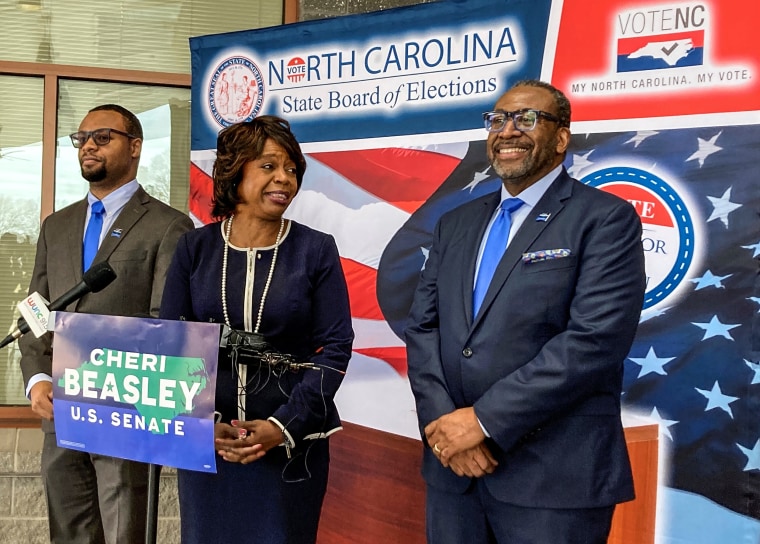
The memo also suggests Beasley leads Budd with suburban voters and white college-educated voters, but the full crosstabs of the poll were not included.
Most public polls show a tight contest in a state that hasn't elected a Democratic senator since 2008 but did elect a Democratic governor in 2016, when Roy Cooper defeated McCrory. Former President Donald Trump won the state in the 2020 presidential election, defeating President Biden by a margin of 50 percent to 49 percent.
The race is expected to draw tens of millions in ad spending — the GOP backed Senate Leadership Fund has $22 million of ad time booked in the race already after primary day, per the ad-tracking firm AdImpact. And Politico reported Thursday that the National Republican Senatorial Committee is buying $6.5 million in advertising time in the state with ads starting Friday.
Biden's influence to be tested in Oregon on Tuesday
Most high profile primary elections this cycle have been viewed at least partially as a test of former President Trump’s power of the Republican Party through the success of candidates he's endorsed. But on Tuesday, we’ll have the first chance to see how far President Joe Biden’s power extends as his first endorsed candidate faces a challenge in Oregon’s Democratic primary for the 5th congressional district.
Biden is backing Rep. Kurt Schrader as he faces a challenge from public official Jamie McLeod-Skinner who has attacked Schrader for taking “millions in corporate PAC money” as he “sold out to big pharma.”
Schrader has defended himself on the airwaves, citing his record fighting for lower prescription drug prices and affordable healthcare.
He’s spent over $1.8 million on ads already, with five days to go until the primary. Two groups — Center Forward and Mainstream Democrats — have also spent money on the airwaves to support Schrader and attack McLeod-Skinner. They’ve spent a combined $1.3 million, according to AdImpact.
Center Forward in particular has run ads highlighting the fact that McLeod-Skinner was fired from a position as city manager in Phoenix, Oregon, in 2018 for being too antagonistic.
McLeod-Skinner has spent just over $250,000 on ads. She also trails Schrader in fundraising, raising almost $700,000 so far this cycle compared to the over $2 million Schrader has raised, according to the FEC.
She’s also run for Congress before. In 2018, she ran for and won the Democratic nomination for Oregon’s 2nd district, but was defeated in the general election by then-Rep. Greg Walden.
The non-partisan Cook Political Report rates this district as Lean Democratic, but there's a chance Republicans could flip the seat in November. On that side of the aisle, Jimmy Crumpacker and Lori Chavez-DeRemer are engaged in a tight primary.
Crumpacker ran for the state’s 2nd district in 2020, but came fourth in the GOP primary. Chavez-DeRemer served as mayor of Happy Valley from 2010 to 2018.
Chavez-DeRemer has raised $669,000 so far this cycle, while Crumpacker trails slightly, having raised $541,000, according to the FEC. He also slightly trails her in ad spending. According to AdImpact, Chavez-DeRemer has spent $286,000 on ads so far, while Crumpacker has spent $254,000.
Club for Growth goes in for Barnette in late Pennsylvania Senate primary push
The Club for Growth is coming to the aid of conservative commentator Kathy Barnette, whose Pennsylvania GOP primary candidacy has gained steam in recent days, with a new $2 million ad buy hoping to magnify her surge.
It's the Club's first expenditure of the primary, a biographical spot that features Barnette talking about her roots growing up on a rural pig farm and serving in the military before pivoting to her attacking Democrats.
"Kathy Barnette is a principled conservative and a fighter who will take on the socialists in Washington to preserve the American Dream for generations to come,” David McIntosh, the president of Club for Growth Action, said in a statement. “We look forward to supporting Barnette in her race to become the next Senator from Pennsylvania.”
The spending push is good enough to make the Club the top spender in the race's final week, a shake-up on airwaves that have long been dominated by the efforts supporting celebrity doctor Mehmet Oz and businessman David McCormick.
Up until this point, the pro-Barnette effort has been virtually non-existent on the airwaves. The pro-McCormick and Oz outfits alone have outspent Barnette's campaign (she's had no outside help until this week) by a margin of more than 328-to-1.
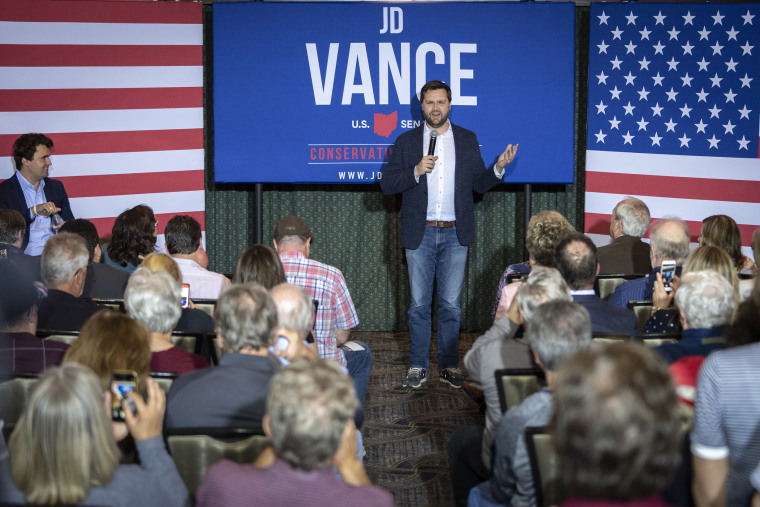
It's also another marquee race where the Club is breaking from former President Donald Trump, who has endorsed Oz. The Club's preferred candidate in Ohio's recent Senate race, former Treasurer Josh Mandel, lost to author J.D. Vance, Trump's pick. But the two were aligned in Tuesday's West Virginia primary, backing Rep. Alex Mooney over Rep. David McKinley.
McCormick dodges Trump question ahead of Pennsylvania primary
Former hedge fund manager David McCormick would rather not get into how he plans to win Pennsylvania's GOP Senate primary next week without former President Donald Trump's support.
McCormick is trying to win over Republican voters ahead of the May 17 contest, while Trump has endorsed celebrity doctor Mehmet Oz in the race.
Asked after a campaign event in Tunkhannoc, Pa., how he plans to win without Trump, McCormick responded, "Listen, I'm not doing any more interviews."
The dodge underscores the challenge McCormick faces in trying to win over the Trump faithful without the former president's backing. On Monday McCormick launched a new TV ad featuring footage of Trump praising McCormick and images of Trump and McCormick together.
On Tuesday Ozreleased his own ad rebutting McCormick's spot, featuring footage of Trump calling McCormick "a liberal Wall Street Republican."
For more coverage of Pennsylvania's Senate race, tune into Meet the Press Daily's special report from the Keystone State at 1 pm E.T on MSNBC.
Infrastructure vote threatens one House Republican. What about the others?
Former President Donald Trump has promised to exact revenge on Republicans who supported the bipartisan infrastructure package. And one of his best chances to do so comes Tuesday in West Virginia’s 2nd District.
“If this deal happens, lots of primaries will be coming your way,” Trump warned in a July statement as senators were negotiating the package.
On the same day President Joe Biden signed the infrastructure package into law in November, Trump announced he was backing West Virginia GOP Rep. Alex Mooney in his primary against GOP Rep. David McKinley, who voted for the package. Mooney and McKinley were forced to run for the same seat due to redistricting, since the Mountain State lost a House seat.
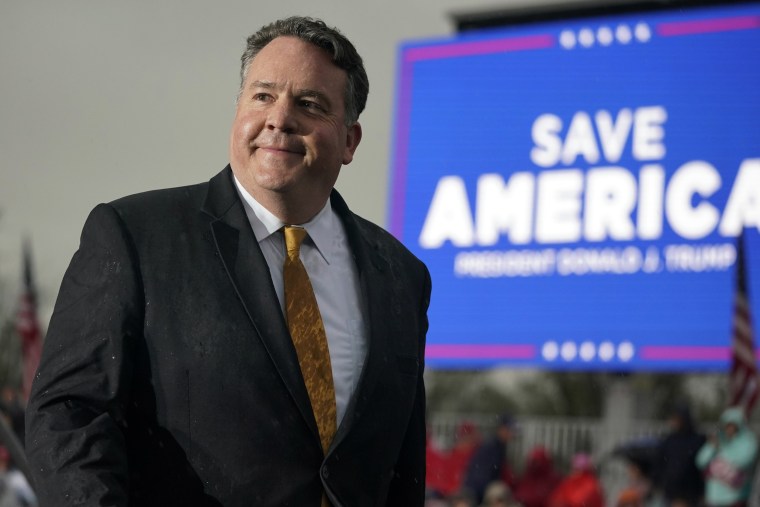
The two congressmen are in a hotly contested race that’s attracted a few million dollars in ad spending from their campaigns and outside groups. But the other six House Republicans who bucked their party to vote for the infrastructure package, and are still running for re-election, aren’t facing similar contests.
Trump has not yet endorsed primary challengers against those House members, even as he’s made his displeasure known.
At a rally in Nebraska earlier this month, Trump called GOP Rep. Don Bacon a “bad guy,” and wished his primary challenger “good luck.” But Trump stopped short of endorsing the challenger, roofer Steve Keuhl. Bacon’s primary is also set for Tuesday, but Keuhl has only raised $5,000 and didn’t have any money left in his campaign account as of March 31.
Trump has said he still supports New York GOP Rep. Nicole Malliotakis despite her vote for the package. But her race is still uncertain with New York’s congressional lines in flux. Fellow New York GOP Rep. Andrew Gabarino also voted for the infrastructure package.
Two New Jersey Republicans — Chris Smith and Jeff Van Drew — also voted for the bill. So did Pennsylvania Rep. Brain Fitzpatrick, whose primary is set for May 17, but he does not face any well-funded challengers from the right.
Of course Trump could still try to elevate a primary challenger against one of these Republicans, but so far the West Virginia race is his best opportunity to take down a GOP lawmaker who crossed the aisle.
Five of the House Republicans who voted for the package — New York Reps. John Katko and Tom Reed, Ohio Rep. Anthony Gonzalez, Illinois Rep. Adam Kinzinger, and Michigan Rep. Fred Upton — are not running for re-election. Another Republican who voted for the package, Alaska Rep. Don Young, died in March.
Data Download: Big money flooded into Tuesday's West Virginia Republican primary clash
The GOP primary in West Virginia's 2nd District is the crown jewel of the state's primary on Tuesday — the member-on-member clash has drawn $4.1 million in ad spending, according to the ad-tracking firm AdImpact.
Voters head to the polls there today to choose between two GOP congressmen, David McKinley and Alex Mooney, in the first incumbent vs. incumbent primary of the year.
Mooney’s campaign has spent nearly $1.5 million on the airwaves, while McKinley’s campaign has spent $1.2 million. Outside groups have also jumped into the race, with Club for Growth Action and School Freedom Fund dropping a combined $931,000 to bolster Mooney. The U.S. Chamber of Commerce and the Defending Main Street super PAC have spent a combined $423,000 supporting McKinley.
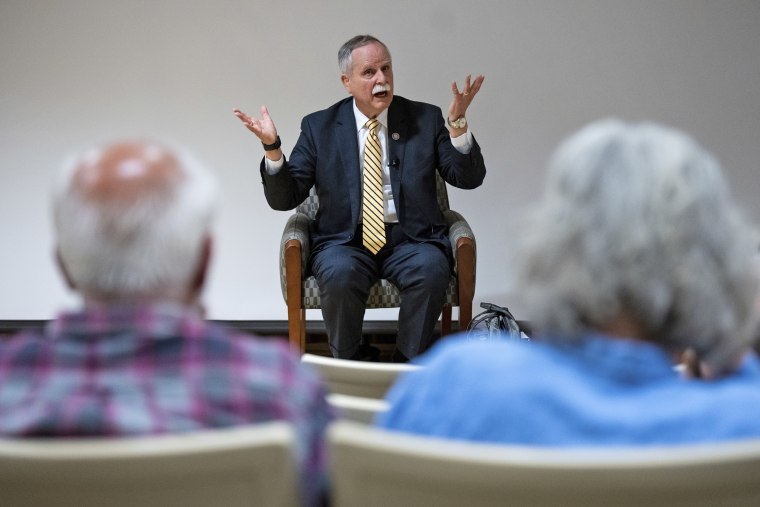
Both candidates reference former President Donald Trump in their closing ads, although Mooney has Trump’s endorsement. In Mooney’s closing spot, a narrator says, “President Trump warned us about RINOs, sellouts and known losers. David McKinley proved him right,” knocking McKinley for supporting the bipartisan infrastructure package and a commission to investigate the Jan. 6 attack on the Capitol.
McKinley’s latest ad on the airwaves goes after the Club for Growth’s spending, with a narrator saying, “Mooney and his Washington special interest group are spending millions lying about David McKinley. Just like they did about President Trump.”
Club for Growth faces tests of its sway in May primaries
The conservative Club for Growth’s sway in GOP primaries will face key tests in May, with half of the candidates being backed by its PAC so far in 2022 facing primaries this month. The contests also come as the group’s past opposition to former President Donald Trump has faced new scrutiny.
So far the Club for Growth’s independent expenditure arm, known as Club for Growth Action, has spent $25.9 million on ads to support its candidates in May primaries, with the most of that spending centered on three Senate races, according to the ad tracking firm AdImpact.
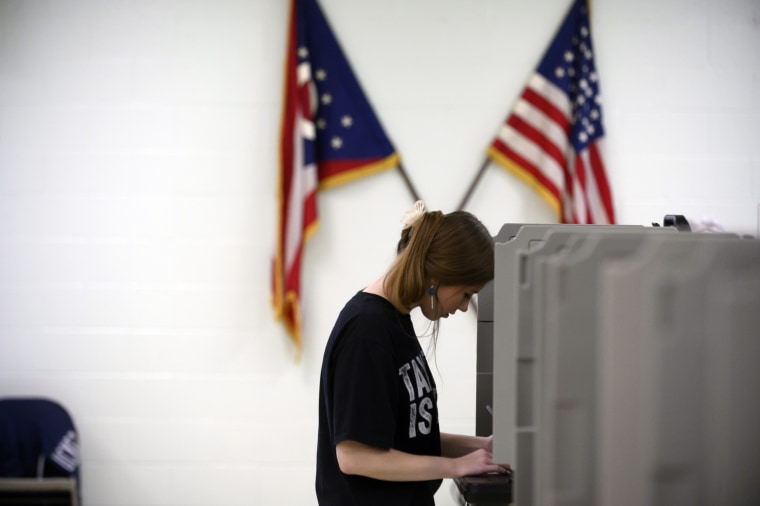
The group did not succeed in helping one of its preferred Senate candidates, former Ohio state Treasurer Josh Mandel, win the GOP nod. Author J.D. Vance, who had Trump’s endorsement, won the primary last week instead.
That race sparked a clash between Trump world and the Club, which has been a staunch Trump ally after initially opposing Trump’s candidacy in 2016.
That past has even popped up in races where both the Club and Trump are backing the same candidate. In West Virginia, GOP Rep. David McKinley highlighted the group’s past opposition to Trump to push back on the Club’s involvement in the 2nd District race in which he is facing fellow GOP Rep. Alex Mooney. Trump and the Club are both backing Mooney in the contest.
McKinley launched a new ad this week saying the Club, which has spent $571,000 on ads boosting Mooney, was “lying about David McKinley, just like they did about Trump.”
Club for Growth spokesman Joe Kildea wrote in an email to NBC News that the group has “no concerns” that its past opposition to Trump will become a more prominent issue in GOP primaries.
“We are confident that we will win most of our races this month,” Kildea wrote.
Ohio isn’t the only place where the Club is at odds with the former president.
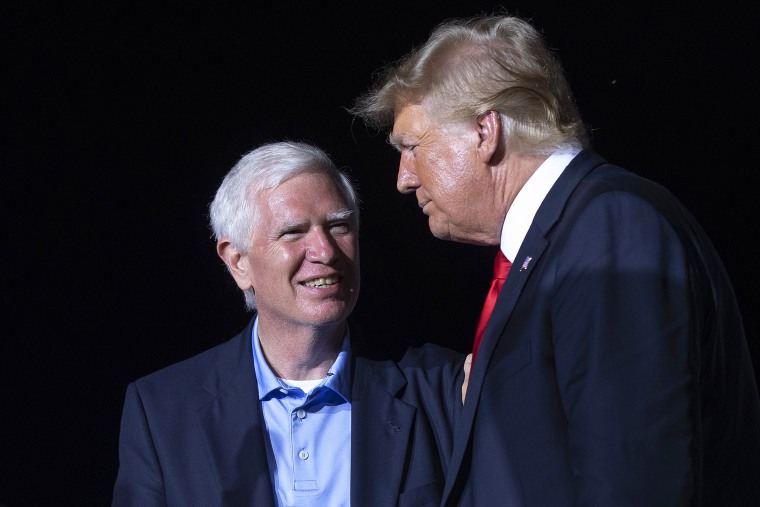
In Alabama’s Senate race, the Club has stuck by GOP Rep. Mo Brooks even after Trump withdrew his support. So far Club for Growth Action, has spent $4.3 million on ads to bolster Brooks.
And in Georgia’s 6th District, the Club is backing Rick McCormick, the 2020 nominee, in the May 24 primary, although the group has not yet spent on the airwaves. Trump endorsed another candidate in that race, attorney Jake Evans, on Thursday.
But the Club is largely aligned with Trump in other key primaries. So far the group has spent $11 million on ads backing GOP Rep. Ted Budd in North Carolina’s Senate primary, set for May 17. The Club has also spent nearly $1.1 million ads to support Trump-backed law student Bo Hines in the open seat race in North Carolina’s 13th District.
Wisconsin Senate politics to make appearance in Game 4 of Bucks-Celtics

When the Milwaukee Bucks face off against the Boston Celtics on Monday night in Game 4 of an intense playoff series, some viewers will be reminded of another contest — Wisconsin's competitive Democratic Senate primary.
A new ad from Outagamie County Executive Tom Nelson, first obtained by NBC News, takes aim at Alex Lasry, the wealthy former Bucks executive who’s rising in the polls and easily outspending his opponents in TV and digital ads.
In it, Nelson, competing against Lasry, Lt. Gov. Mandela Barnes and state Treasurer Sarah Godlewski for the chance to take on Republican Sen. Ron Johnson in the fall, criticizes the $250 million of public money that went into building Fiserv Forum, the home of the Bucks.
Wearing a sweatband and a green jersey with the number 34 on it, the number worn by Bucks star Giannis Antetokounmpo, Nelson says he's rooting for his home team.
“What I’m not rooting for is using your tax dollars to make billionaires richer,” Nelson says in the ad. “We paid a quarter of a billion dollars for the Fiserv Forum, even more than Foxconn, every dollar spent was taken from schools, roads, tax relief, things that benefit all of us.”
Lasry, thanks in part to his deep pockets, is quickly becoming a threat in a race in which Barnes had long been considered the favorite and Nelson has been trying to gain steam when he's been vastly outspent. In recent days he has been ramping up his attacks on Lasry, calling on the Lasry family to refund taxpayers.
Lasry has defended the investment, pointing to evidence that the arena has quickly become an economic driver for Milwaukee.
A Marquette Law School poll in late April had Barnes leading Lasry by just 3 points, with Treasurer Sarah Godlewski following with 7 percent support and Nelson with 5 percent.
In 2015, the state approved a $250 million investment in a funding deal to help build Fiserv Forum. At the time of the deal, then-Bucks head coach Jason Kidd made a prediction.
“Will the new arena be hosting NBA Finals games within a few years? I`m not one to predict, but I think we look forward to our future,” Kidd said, according to a report by Fox News Milwaukee in 2015. “We have a chance to grow, get better each day, and our goal is to hold that gold trophy in that new arena.”
When the prediction came true last year, the Milwaukee Journal-Sentinel’s editorial page applauded the state’s investment, noting the arena now draws tens of thousands of fans to Milwaukee’s downtown, who then pour into nearby restaurants and bars.
“All of Wisconsin has a share in the Bucks’ remarkable rise from small-market doormat to NBA champions,” read an editorial in the Journal-Sentinel just after the Bucks claimed the NBA championship last year. “None of it would have happened without a new arena, built with $250 million of public money.”